Astronomical Darkness Calculator: Dark Hours Tonight UK
Sunset is not darkness. Faint targets only look their best once the Sun is 18 degrees below the horizon, which in Britain can be three hours after sunset, or never. Pick your location and a date to get tonight's real dark window. The catch nobody warns beginners about: from late May to late July, most of the UK gets no astronomical darkness at all.
Where and when are you observing?
All times are UK clock time, so BST in summer and GMT in winter, and they are geometric times for a flat sea-level horizon. Hills, haze and a low Moon all eat into the useful part of the window, so treat the figures as the best case.
The four stages of a British night
Astronomers split the fade from day to night by how far the Sun has sunk below the horizon:
- Sunset: the Sun's upper edge touches the horizon. The sky is still far too bright for anything but the Moon, Venus and Jupiter.
- Civil twilight ends (6 degrees down): the brightest stars appear and you can still read a star chart without a torch.
- Nautical twilight ends (12 degrees down): the horizon is lost, constellations are complete, and most of the Messier list is workable. In practice this is when a beginner's session can start.
- Astronomical twilight ends (18 degrees down): true darkness. The remaining glow from the Sun is below the level of the natural airglow, so faint galaxies, nebulae and the Milky Way reach their maximum contrast.
Why June has no darkness in Britain
The Sun's lowest point of the night sits 90 degrees minus your latitude minus the Sun's declination below the horizon. In late June the declination reaches about 23.4 degrees north, so at London's latitude of 51.5 the Sun only ever drops about 15 degrees down, three degrees short of astronomical darkness. Run the calculator for a string of dates and you get the length of the gap for 2026:
- Plymouth loses astronomical darkness on about 46 nights, from 29 May to 13 July.
- London and Cardiff lose it on about 60 nights, from 22 May to 20 July.
- Manchester loses it on about 78 nights, from 13 May to 29 July.
- Edinburgh loses it on about 96 nights, and on about 40 of those the Sun never even reaches 12 degrees down, so the sky gets no darker than nautical twilight.
- Lerwick in Shetland loses it on about 122 nights, from 21 April to 20 August.
That is not a reason to stop observing in summer. It is a reason to change target: the Moon, the planets, double stars, bright clusters and noctilucent clouds all survive a twilit sky, while faint galaxy hunting waits for autumn.
Planning a session around the window
Two things decide whether the dark hours are usable. The first is the Moon, which can be brighter than any light dome; check it with the moon phase calculator before you commit to a drive. The second is your sky, since a dark window over a city centre still leaves you fighting light pollution, so it is worth knowing your Bortle class and the nearest UK dark sky site. Add 20 to 30 minutes at the start for your eyes to dark adapt, and give a reflector a similar spell outdoors to cool down.
Clear skies forecast? Get a nudge.
Our weekly email flags the next good UK observing window and one easy target to find.
Join the listMore from Starvest
Keep reading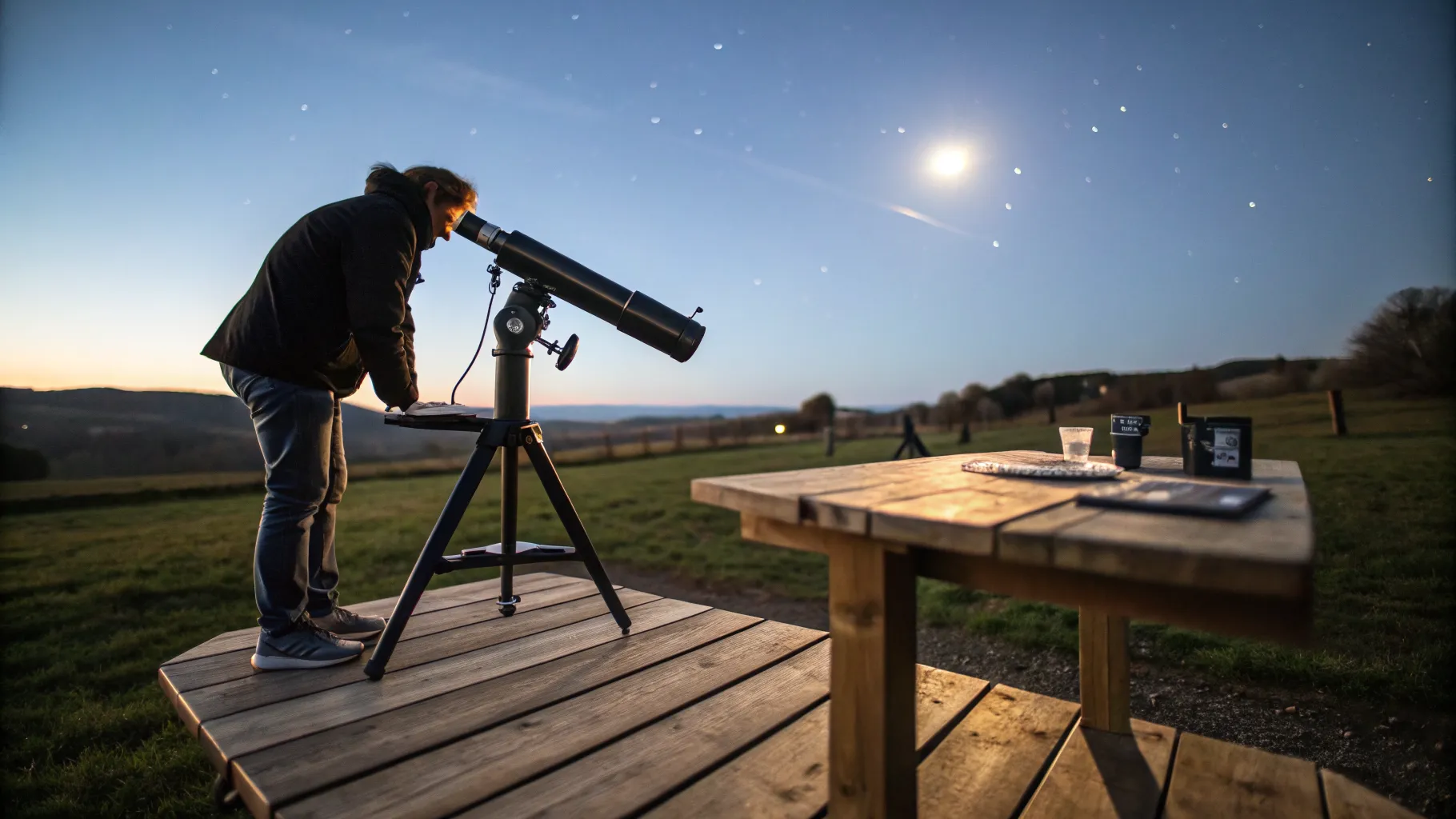
Best Telescopes for Beginners in the UK (Tested by Price Bracket)
The best beginner telescopes in the UK by budget, from sub-£150 tabletop scopes to app-guided and smart telescopes, with real 2026 prices.
What Can You See with Binoculars at Night? A Realistic Astronomy List
A realistic list of what you can see with binoculars in astronomy, from the Moon and Jupiter's moons to Andromeda, with tips for spotting each from the UK.
How to Set Up and Use Your First Telescope (Step by Step)
How to use a telescope as a beginner: assemble the mount, align the finder, focus, and find your first targets. A clear step-by-step UK guide.