What Can You See with Binoculars at Night? A Realistic Astronomy List
If you are wondering what you can see with binoculars in astronomy, the honest answer is: far more than most beginners expect, and far less than the glossy photographs suggest. A basic pair of 10x50 binoculars will show you Moon craters, the four brightest moons of Jupiter, glittering star clusters and the faint smudge of the Andromeda Galaxy. What they will not do is show colourful swirling nebulae or a disc on Saturn. This is a realistic, tested list of the night-sky targets that a beginner in the UK can actually find and enjoy with binoculars alone.
Binoculars are the most underrated tool in astronomy. They are cheap, they need no setup, and their wide field of view makes finding things far easier than squinting through a narrow telescope eyepiece. A 10x50 pair, meaning 10 times magnification and 50mm lenses, is the classic all-rounder. Brace your elbows on a wall or fence, or better still use a tripod, and the difference in what you can hold steady is dramatic.
The Moon
The Moon is the obvious first target and it never disappoints. Even handheld binoculars reveal the large dark plains, the maria, and the brighter cratered highlands. The best views are not at full Moon, when the light is flat, but a few days either side of first or last quarter. Along the terminator, the line dividing day and night on the Moon, craters throw long shadows and the surface looks genuinely three dimensional.
Look too for earthshine on a thin crescent Moon: the dark part of the disc glows faintly, lit by sunlight bouncing off the Earth. For more on lunar observing, see our guide on how to observe the Moon.
Jupiter and its moons
Jupiter itself stays a bright dot in binoculars rather than a disc, but the prize is the four Galilean moons: Io, Europa, Ganymede and Callisto. On a steady night, with your binoculars braced or tripod-mounted, they appear as tiny points of light strung out in a line either side of the planet. Watch across an evening or from night to night and you will see them shift position as they orbit, exactly as Galileo did in 1610.
You will not always see all four. Sometimes a moon is hidden in front of or behind Jupiter. A free stargazing app will tell you which moons are visible on a given night.
Venus, Saturn and Mars
Venus is dazzlingly bright and, when it swings close to Earth, sharp-eyed observers can glimpse its large crescent phase through steadied binoculars. Saturn’s rings are beyond binoculars: the planet just looks slightly oval at best, and you need a telescope to resolve the rings. Mars stays a small orange point. The planets are still worth finding, and our guide on how to see the planets covers when each is visible.
Star clusters
Star clusters are where binoculars truly shine. The Pleiades (M45), the small “seven sisters” dipper shape in winter, explodes from a naked-eye smudge into dozens of blue-white stars. Nearby, the V-shaped Hyades cluster fills the field of view. In summer, the Coathanger asterism looks exactly like its name, and the Double Cluster in Perseus shows two dense knots of stars side by side. The Beehive Cluster (M44) in Cancer is another easy binocular target that dissolves into stars.
The Andromeda Galaxy and other faint objects
From a dark site on a moonless night, binoculars will show the Andromeda Galaxy (M31) as a soft, elongated grey oval. It is the most distant thing most people ever see with their own eyes, around 2.5 million light years away. Do not expect spiral arms; it is a faint glow, and the darker your sky the more of it you see.
The Orion Nebula (M42), hanging below Orion’s belt in winter, appears as a small misty patch of glowing gas. You will not see the pinks and blues of photographs, because your eye cannot gather colour from such faint light, but seeing the cloud itself is a thrill. A dark sky matters enormously here, which is why it is worth checking our list of dark sky sites in the UK.
Double stars, the Milky Way and comets
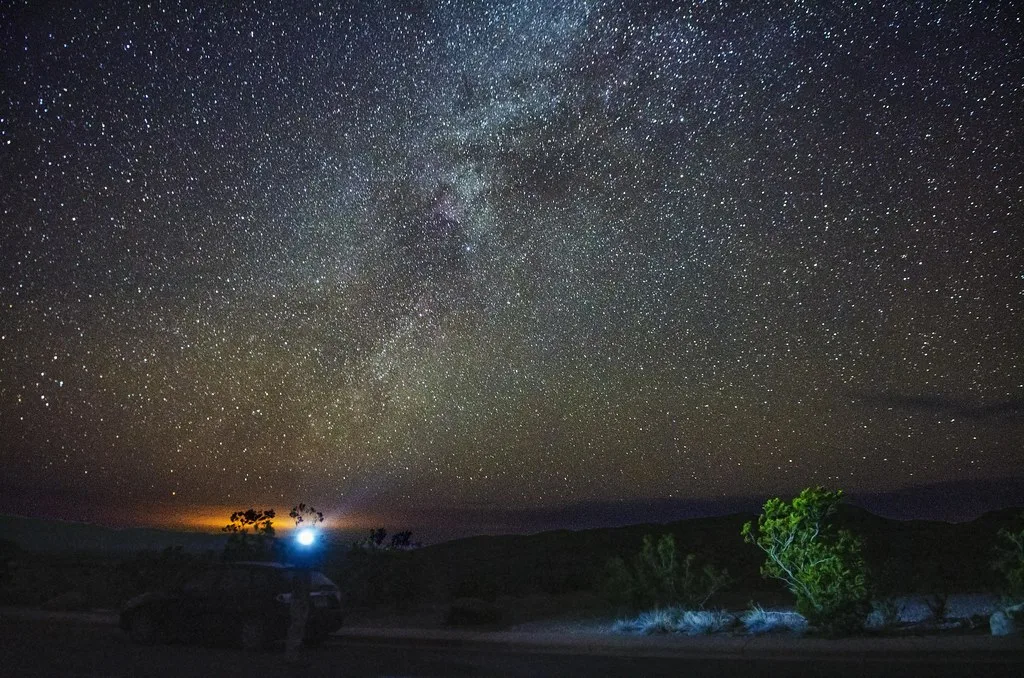
Mizar and Alcor, the famous double in the handle of the Plough, split cleanly in binoculars. Sweep along the Milky Way on a dark summer night, particularly through Cygnus and towards Sagittarius, and the seemingly smooth band breaks up into countless individual stars and glowing star clouds. Binoculars are also the ideal tool for comets, which are usually large and diffuse, and for catching the International Space Station as a bright, fast-moving point on a predicted pass.
What you cannot see
To keep expectations honest: you will not see Saturn’s rings, the polar caps or surface detail on Mars, colour in nebulae, or individual stars in distant galaxies. Those need a telescope with more aperture. If you are weighing the two, read our comparison of a telescope versus binoculars for stargazing. For choosing a first pair, our best binoculars for stargazing in the UK guide and the 10x50 vs 15x70 comparison will help.
For sky charts and what is up tonight, the Royal Observatory Greenwich publishes a helpful monthly guide at Royal Museums Greenwich, and NASA’s night sky team explains binocular observing at science.nasa.gov.
Frequently asked questions
Can you see planets with binoculars? You can find all the naked-eye planets with binoculars, but they mostly stay as bright points. The exception is Jupiter, where you can see its four largest moons as dots beside the planet. Saturn’s rings and surface detail on Mars need a telescope.
Can you see galaxies with binoculars? Yes, a few. The Andromeda Galaxy is the easiest, appearing as a faint grey oval from a dark, moonless site. You will not see spiral structure or colour, just a soft glow, and light pollution makes it much harder to spot.
What magnification of binoculars is best for astronomy? A 10x50 pair is the classic starting point: enough magnification to reveal detail while staying light enough to hold reasonably steady. Larger 15x70 binoculars show more but almost always need a tripod because they are too heavy and too magnified to hold still.
Do you need a tripod for stargazing binoculars? Not for 10x50s if you brace your arms on something solid, but a tripod transforms the view by removing the shake. For anything 15x70 or larger a tripod or mount is essential to see faint objects clearly.
Can you see the Orion Nebula with binoculars? Yes. On a dark winter night the Orion Nebula shows as a small misty patch of light below the three belt stars. Binoculars reveal the glowing gas cloud but not the vivid colours captured by cameras.
Clear skies forecast? Get a nudge.
Our weekly email flags the next good UK observing window and one easy target to find.
Join the listMore from Starvest
Keep reading
Best Telescopes for Beginners in the UK (Tested by Price Bracket)
The best beginner telescopes in the UK by budget, from sub-£150 tabletop scopes to app-guided and smart telescopes, with real 2026 prices.
How to Set Up and Use Your First Telescope (Step by Step)
How to use a telescope as a beginner: assemble the mount, align the finder, focus, and find your first targets. A clear step-by-step UK guide.
How to Collimate a Telescope (Newtonian Reflector)
How to collimate a telescope step by step, aligning a Newtonian reflector's mirrors with a collimation cap, Cheshire or laser for sharp views.