Stargazing in England: Where to Park in Every Region
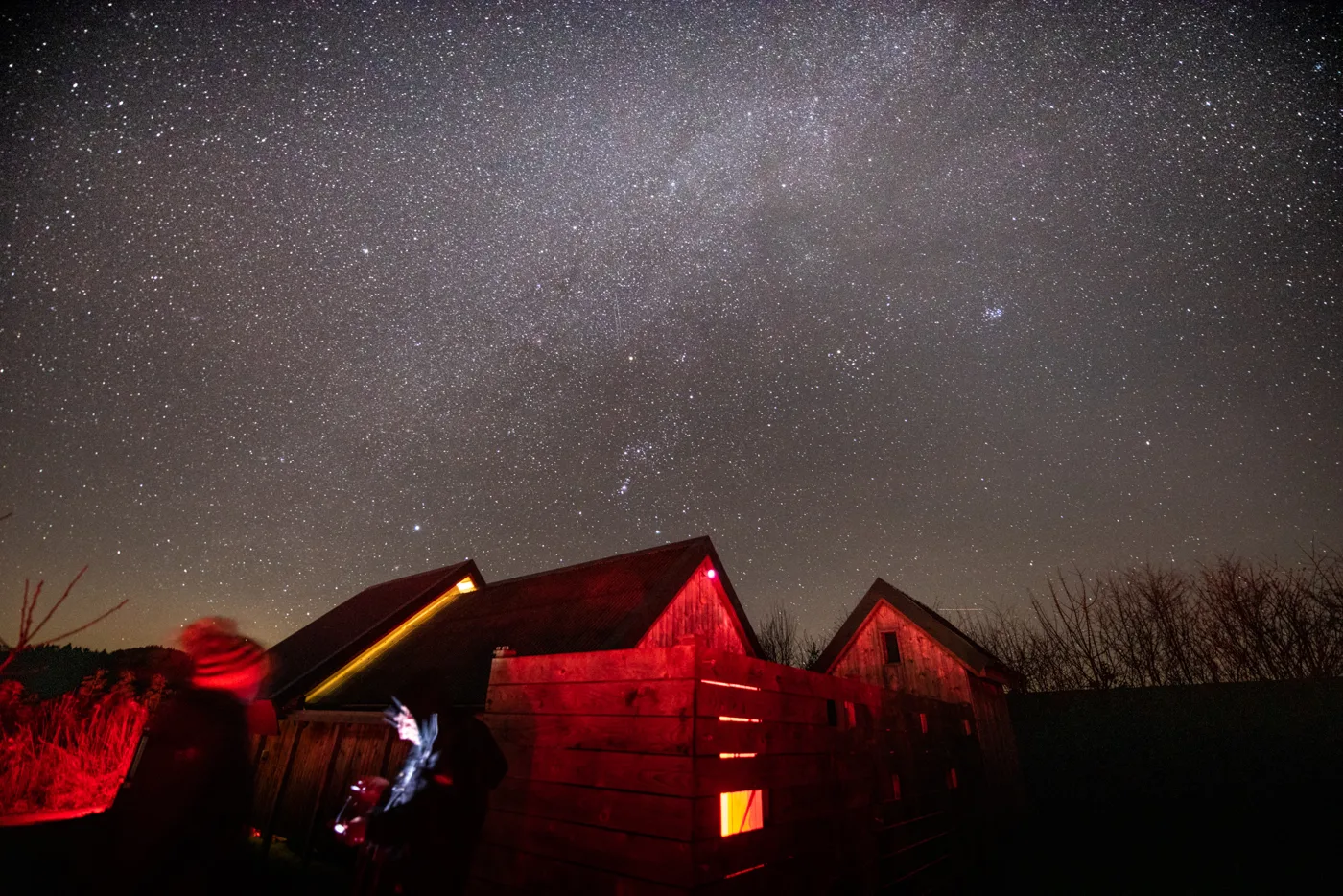
Most guides to stargazing in England hand you a map of protected areas and leave you to work out the rest, which is the hard part. A dark sky reserve covers hundreds of square miles, and standing in the wrong bit of one, behind a hill, in a valley, or in a car park with a security light, gives you a worse night than a well-chosen field an hour from a city. What you need is the named spot, the road it sits on, and whether you can leave a car there in the dark.
So this page is organised by region and built around specific places. Each one is somewhere with a recognised car park or lay-by and an open horizon. The certification story, which reserve is which tier and what that means, is covered separately in our guide to the UK’s dark sky sites. This is the practical companion to it.
North East: the darkest sky in the country
Northumberland International Dark Sky Park covers 1,483 km2 of Northumberland National Park and Kielder Water and Forest Park, designated in December 2013 and holding gold tier status. Within it, the East Kielder Moors are reckoned to be the least light-polluted place in England.
Practically, most first visits should start at the Kielder Water sites rather than driving deep onto the moor. There is proper parking, the forest roads are signed, and Kielder Observatory runs ticketed evening events for anyone who would rather have a telescope pointed for them than fight with their own in the cold.
Bring more layers than you think you need. This is high, exposed, and a long way from anywhere selling coffee.
Yorkshire: two national parks, designated together
The Yorkshire Dales and the North York Moors were awarded International Dark Sky Reserve status jointly in December 2020, which gives the north of England an enormous contiguous run of protected sky.
In the North York Moors, the reliable spots are Danby, Sutton Bank and Dalby Forest. Sutton Bank has a national park centre with a large car park and a west-facing escarpment, which is unusually generous for a horizon. Dalby Forest has a barrier and charges, so check closing arrangements before you plan a late night there.
In the Yorkshire Dales, the national park’s own centres at Hawes and Malham have car parks, as does Buckden. The Tan Hill Inn is the outlier worth knowing about: at 528m it is the highest pub in Britain, sitting in open moorland with nothing around it, which makes for a rare combination of very dark sky and a warm room to retreat into.
North West and the Peaks: the Peak District’s three sites
The Peak District has three recognised dark sky sites, all with parking:
- Surprise View, above Hathersage off the A6187. Park in the gritstone edge car park, then walk up towards Over Owler Tor or Mother Cap for a full 360 degree horizon. The most accessible of the three.
- Parsley Hay, on the Tissington Trail near Hartington.
- Minninglow, on the High Peak Trail at Pikehall.
The Peak District is ringed by Manchester, Sheffield and Derby, so you will see light domes low down on several sides. That does not stop the overhead sky being good, and it is the nearest genuinely dark option for a very large number of people. Manage the expectation and you will not be disappointed.
East Midlands: Rutland Water
The Hambleton Peninsula pushes out into Rutland Water with water on three sides and very little around it. Park near Hambleton Hall or walk out from the main car park. The reservoir gives you the same advantage the coast does: a long, low, unobstructed horizon in one direction, which is what you want for anything rising.
East of England: flatter is better
The east gets overlooked, and it should not be. Flat ground and low population density outside the towns produce very usable skies, and north Norfolk in particular has taken this seriously.
- Kelling Heath is Norfolk’s flagship astronomy site, a Dark Sky Discovery Site, and the venue for the Equinox Sky Camp, the largest annual gathering of amateur astronomers in the country.
- RSPB Titchwell Marsh sits on a raised embankment with 360 degree views over wetland, and holds Orion class Dark Sky Discovery status. So does Barrow Common near Brancaster.
- Wicken Fen in Cambridgeshire gives you boardwalks across open fen and a horizon in every direction, which is a genuinely unusual thing to find this far south.
Coastal sites come with a specific trade-off: you get a superb sea horizon but often more haze and dew than an inland hill. Take something to keep the optics dry.
South East: the South Downs
The South Downs National Park has held International Dark Sky Reserve status since 2016, marking ten years in 2026, and by the park authority’s own account around two-thirds of it is dark enough for the Milky Way and the Andromeda galaxy with the naked eye. That is remarkable for a park within reach of London and Brighton.
The four established viewpoints are Devil’s Dyke, Ditchling Beacon, Birling Gap and Old Winchester Hill. All four have parking. Devil’s Dyke and Ditchling Beacon are the busiest and closest to Brighton’s glow; Old Winchester Hill, further west, is the darker choice if you are willing to drive.
South West: the deepest skies south of the Dales
Exmoor National Park became Europe’s first International Dark Sky Reserve in 2011 and still holds up. The spots the park itself points people towards are Holdstone Hill, County Gate, Brendon Two Gates, Webbers Post, Anstey Gate, Haddon Hill and Wimbleball Lake.
Two are worth singling out. Haddon Hill, at 355m, has a car park with toilets and a flat grassy area, which makes it the easiest choice with children or anyone who does not want to walk over rough ground in the dark. County Gate, at 345m on the Devon and Somerset border, gives you the East Lyn Valley below and a very open sky. Wimbleball Lake adds the reflection off the water and has a Discovery Hub that hosts events.
Cranborne Chase across Wiltshire, Dorset, Hampshire and Somerset was designated an International Dark Sky Reserve in October 2019, the first UK national landscape to be certified in its entirety. More than half of it carries the lowest light pollution levels in England.
In Cornwall, Siblyback Lake on Bodmin Moor has visitor facilities and is managed by South West Lakes Trust, and Lanyon Quoit in West Penwith puts a neolithic monument in the foreground, which is why it gets photographed as much as it gets observed.
The thing that beats a dark sky site
Choose the date before you choose the place. A mediocre site on a moonless night beats an excellent site three days either side of a full moon, every time. A gibbous moon washes out the Milky Way completely, and no amount of driving fixes it.
Work backwards: find the new moon, check the forecast 48 hours out, then pick the nearest of these places you can reach. Our stargazing app comparison covers the tools that do the moon phase and cloud checking for you, and if you are starting without equipment, what you can see with just your eyes is the honest place to begin.
Two practical points that apply everywhere on this list. Give your eyes a full 20 to 30 minutes to dark adapt and do not undo it by checking a phone at full brightness, and visit any unfamiliar site in daylight first so you know where the ground drops away.
Frequently asked questions
Where is the best stargazing in England? The East Kielder Moors, inside Northumberland International Dark Sky Park, are the least light-polluted place in England. The park is gold tier and covers 1,483 km2, so it is also large enough that you need to pick a specific access point rather than just driving into it.
Can you see the Milky Way in southern England? Yes. Around two-thirds of the South Downs National Park is dark enough for the Milky Way and the Andromeda galaxy with the naked eye, and Cranborne Chase is darker still. You need a moonless, clear night, and it is worth waiting for.
Where can I stargaze near London? The South Downs is the realistic option, with Old Winchester Hill the darkest of its four main viewpoints. To the north, Wicken Fen in Cambridgeshire offers a flat 360 degree horizon. Neither is as dark as the north of England, but both are a manageable evening drive.
Do I need a telescope to go stargazing in England? No, and starting without one is usually better. The Milky Way, the Andromeda galaxy, meteor showers and the brighter planets are all naked-eye targets from a decent dark site, and binoculars extend that a long way before a telescope earns its place.
When is the best time of year for stargazing in England? Autumn and winter, because the nights are genuinely dark by early evening rather than after 11pm. The trade-off is cloud cover, so pick your night on the forecast rather than committing to a date weeks out.
Are dark sky site car parks open at night? Many are, but some, including forest sites with barriers such as Dalby, close or charge. Check the specific car park’s arrangements before you go, and have a fallback lay-by in mind.
Clear skies forecast? Get a nudge.
Our weekly email flags the next good UK observing window and one easy target to find.
Join the listMore from Starvest
Keep reading
Best Telescopes for Beginners in the UK (Tested by Price Bracket)
The best beginner telescopes in the UK by budget, from sub-£150 tabletop scopes to app-guided and smart telescopes, with real 2026 prices.
What Can You See with Binoculars at Night? A Realistic Astronomy List
A realistic list of what you can see with binoculars in astronomy, from the Moon and Jupiter's moons to Andromeda, with tips for spotting each from the UK.
How to Set Up and Use Your First Telescope (Step by Step)
How to use a telescope as a beginner: assemble the mount, align the finder, focus, and find your first targets. A clear step-by-step UK guide.