How Much Does a Telescope Cost in the UK? Price Tiers Explained
How much does a telescope cost if you actually want one that works? In the UK, the honest answer is that a genuinely good first telescope sits in the £150 to £300 range, smart telescopes and computerised scopes climb into the £300 to £600 bracket, and anything advertised under £100 is usually a waste of money. This guide breaks the cost down by tier, ties each price band to what you can really see, names the specific UK models worth your money, and adds up the running costs most articles quietly ignore.
The thing to fix in your head first: price tells you very little on its own. A £200 scope with the right design beats a £400 scope sold on inflated magnification claims. So we’ll group scopes by what they do for you, not just by the number on the box.
The price tiers, and what each one buys you
Here is the quick map before the detail. Spend matched to outcome:
- Under £100: avoid. Wobbly mounts, tiny apertures, useless eyepieces. The “hobby killer” zone.
- £150 to £300: the sweet spot for a first proper scope. Real apertures, usable mounts, room to grow.
- £300 to £600: smart telescopes and computerised GoTo scopes that find objects for you or photograph them.
- £600 and up: larger computerised scopes and dedicated astrophotography setups.
Which? tested a batch of beginner telescopes and every one of them, including both of their Best Buy picks, came in under £300; their take is that you do not need to spend more than that to get a usable beginner scope (which.co.uk). That is the single most useful figure for a first-time buyer to anchor on.
Under £100: the tier to walk past
Telescopes under roughly £100 almost never give satisfying optics or a steady enough mount, and they leave you no room to improve. This is where the so-called “hobby killers” live: scopes sold in toy aisles and department stores, plastered with magnification claims like “600x” that are physically impossible to deliver on a small lens.
Magnification is not the spec that matters; aperture is. Aperture is the width of the main lens or mirror, and it decides how much light the scope collects and how much detail you see. A “600x” claim on a 60mm scope is marketing, not capability. The realistic limit is roughly 30 to 40 times the aperture in inches once you account for the UK’s middling atmospheric “seeing”, well short of the headline numbers (skyandtelescope.org). If a box leads with a big magnification figure, that is your cue to put it down.
Spot a hobby killer:
- Magnification quoted as the headline feature (300x, 525x, 600x).
- A flimsy aluminium tripod that shakes when you touch the focuser.
- Sold by a general retailer rather than an astronomy specialist.
- A small aperture (under 70mm) paired with grand claims about galaxies.
£150 to £300: the sweet spot
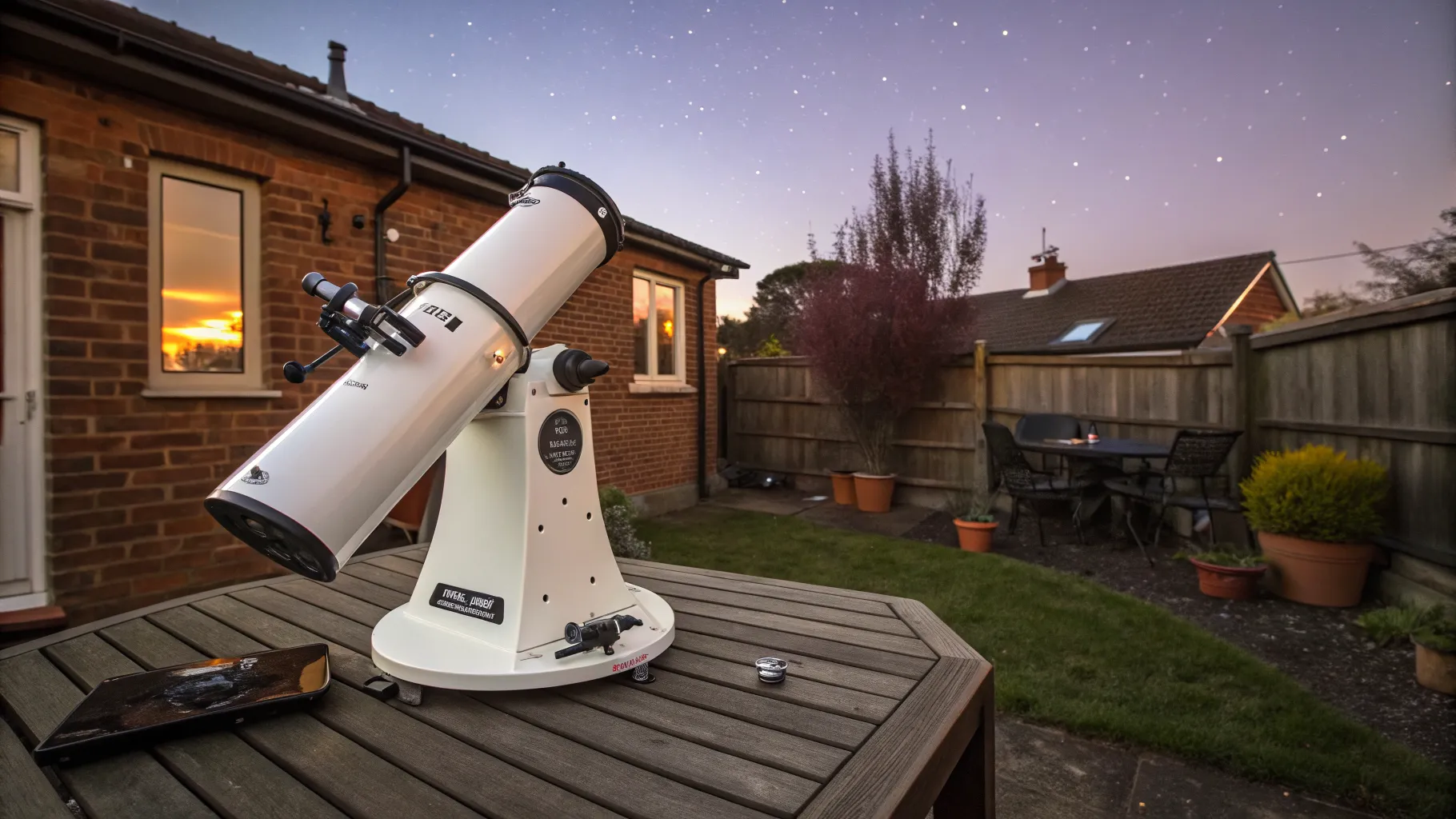
This is where most experienced UK stargazers tell beginners to spend, and it is where the most-recommended first scope lives. The Sky-Watcher Heritage-130P FlexTube is the community default: a 130mm tabletop Dobsonian with a 650mm focal length at f/5, a parabolic primary mirror, two eyepieces (25mm giving about 26x and 10mm giving about 65x), a red-dot finder, and a collapsing tube that packs down small. It weighs around 6.2kg, so a child can carry it out, and its highest practical power is about 260x (firstlightoptics.com). It sells for well under £200 at UK specialists.
With a 130mm aperture in this band you can expect:
- The Moon in sharp, crater-by-crater detail.
- Saturn’s rings as an obvious ring, not a blob.
- Jupiter’s cloud bands and its four bright moons.
- The brighter deep-sky objects: the Orion Nebula, the Andromeda Galaxy as a smudge, star clusters.
You are buying aperture and a stable mount rather than gadgets, which is exactly the right trade for a first scope. Spend toward the top of this tier and you simply get a slightly bigger mirror or a sturdier base, not a different category of experience. For a fuller walk-through of beginner models, see our best telescope for beginners UK guide.
£300 to £600: smart and computerised scopes
Above £300 you start paying for automation, and there are two flavours.
Smart telescopes replace the eyepiece with a camera and your phone. The ZWO Seestar S50 is the headline model: a 50mm f/5 apochromatic triplet with a 250mm focal length, a Sony IMX462 colour sensor, a motorised GoTo mount, and an app that stacks live exposures so faint nebulae build up on screen in minutes. It ships with solar and dual-band nebula filters in the box (seestar.com). It sits in the upper half of this tier at UK retailers, with interest-free instalments commonly offered. Its main rival is the DWARF 3, a dual-lens design pairing a 35mm telephoto with a small wide-angle lens. Smart scopes are aimed at people who want images more than eyepiece views; they are covered in depth in our Seestar and Dwarf smart telescope guide.
Computerised GoTo scopes keep the eyepiece but motorise the mount so it slews to any object you select. The Celestron NexStar 4SE is a compact 102mm Maksutov on a fully computerised mount, sitting near the top of this band in the UK. A cheaper middle path is “push-to”: the Celestron StarSense Explorer DX 130AZ uses your phone’s camera and the StarSense app to guide you, by hand, to targets on a 130mm Newtonian (celestron.com). Push-to gives you the find-it help without the full motorised price.
A fair warning: a GoTo mount does not improve the view, only the finding. A beginner who enjoys learning the sky often gets more aperture for the money by spending the same budget on a manual Dobsonian.
£600 and up: bigger glass and astrophotography
Past £600 you are buying either a larger computerised scope or a dedicated imaging rig: a small refractor on a tracking equatorial mount, a guide camera, and so on. Brand ranges stretch a long way at this end. Celestron and Sky-Watcher both run from around £100 entry models up to several thousand pounds, and Meade reaches into five figures for observatory-grade instruments (which.co.uk). Almost no beginner needs this tier, and stepping into it before you know whether you prefer planets, deep-sky, or imaging is the fastest way to overspend.
What you can see at each price
| Budget | Realistic scope | Moon and planets | Deep-sky |
|---|---|---|---|
| Under £100 | Toy/department store | Blurry Moon at best | Effectively nothing |
| £150 to £300 | 130mm Dobsonian | Saturn’s rings, Jupiter’s bands | Brighter nebulae and clusters |
| £300 to £600 | Smart scope or GoTo Mak | Detailed lunar/planetary | Faint nebulae (imaged, on Seestar) |
| £600+ | Large GoTo / imaging rig | Excellent detail | Photographed galaxies and nebulae |
The cost nobody adds up: accessories and running costs
The price on the box is not the price of the hobby. Budget roughly 10 to 15 percent of the scope’s cost for accessories that genuinely improve sessions, and ignore the freebies in the box.
The plastic Barlow, the 4mm eyepiece, and the coloured “moon filter” bundled with cheap scopes are largely worthless (telescopicwatch.com). A decent 25mm plus 9mm eyepiece pair covers about 90 percent of your observing, so that is where early money should go. Other ongoing or one-off costs to expect:
- Eyepieces: one good wide-field and one higher-power eyepiece.
- A collimation tool for reflectors and Dobsonians, to keep the mirrors aligned.
- A red torch so you can read charts without ruining your night vision.
- Power for GoTo and smart scopes: a rechargeable battery pack, since their motors and apps drain quickly.
- Star charts or a planning app, many of which are free.
Buy from a UK astronomy specialist rather than a general retailer. Specialists like First Light Optics and Rother Valley Optics sell scopes chosen for value, give real advice, and do not pad their range with hobby killers. The difference in what you end up owning is bigger than the difference in price.
Frequently asked questions
How much should I spend on my first telescope? Aim for the £150 to £300 band. That is enough for a real aperture and a stable mount, which is what determines whether you enjoy the hobby, and Which? found usable beginner scopes throughout that range.
Are telescopes under £100 any good? Generally no. Sub-£100 scopes have small apertures, shaky mounts, and poor eyepieces, and they leave no room to improve. The cheap ones sold on huge magnification claims are the classic “hobby killers” that put people off astronomy for good.
Is aperture or magnification more important? Aperture, by a wide margin. It is the width of the main lens or mirror and decides how much you can see. Magnification comes from swapping eyepieces and has a low ceiling in UK skies, so a high magnification number on the box is a red flag, not a selling point.
Should a beginner buy a smart telescope like the Seestar S50? Only if you want photographs more than eyepiece views. A Seestar S50 or DWARF 3 produces shareable images of nebulae through your phone, but it is not the same experience as looking through a manual scope. For pure visual stargazing on a budget, a 130mm Dobsonian gives more for less.
Are GoTo computerised mounts worth it for beginners? They help you find objects, but they do not improve the view, and they cost extra. If you enjoy learning the sky, the same money spent on a larger manual Dobsonian shows you more. A “push-to” scope like the StarSense Explorer DX 130AZ is a cheaper middle ground.
What accessories do I need to budget for? Set aside roughly 10 to 15 percent of the scope price. A 25mm and a 9mm eyepiece cover most sessions, plus a collimation tool for reflectors, a red torch, and a power pack if your scope is computerised. Skip the worthless plastic Barlow and 4mm eyepiece that come in cheap bundles.
Clear skies forecast? Get a nudge.
Our weekly email flags the next good UK observing window and one easy target to find.
Join the listMore from Starvest
Keep reading
Best Telescopes for Beginners in the UK (Tested by Price Bracket)
The best beginner telescopes in the UK by budget, from sub-£150 tabletop scopes to app-guided and smart telescopes, with real 2026 prices.

What Can You See with Binoculars at Night? A Realistic Astronomy List
A realistic list of what you can see with binoculars in astronomy, from the Moon and Jupiter's moons to Andromeda, with tips for spotting each from the UK.
How to Set Up and Use Your First Telescope (Step by Step)
How to use a telescope as a beginner: assemble the mount, align the finder, focus, and find your first targets. A clear step-by-step UK guide.