Leonids 2026 UK: Peak 17 November, Best 1am to 5.30am
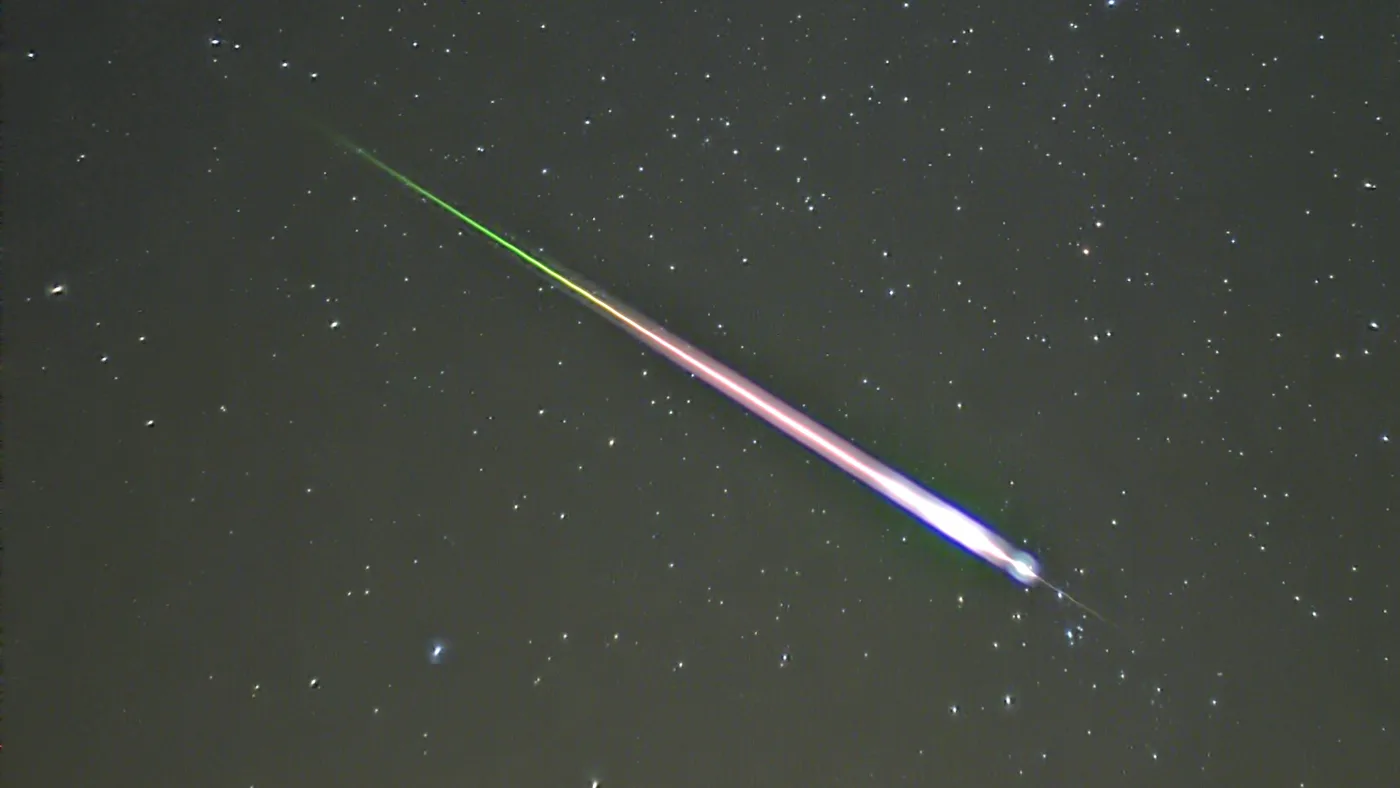
The Leonids 2026 reach their maximum at 11.45pm GMT on Tuesday 17 November, according to the International Meteor Organization. That is a rare piece of luck for Britain: the half-lit Moon sets about a quarter of an hour before the peak, so the whole of the rest of the night is dark. The catch is that Leo has only just cleared the horizon at the moment of maximum. The hours to watch are the small hours of Wednesday 18 November, from about 1am until dawn twilight begins at 5.30am, with the best of it after 3am.
The Leonids are a modest shower in a normal year. No outburst is predicted for 2026, and an honest count from a dark site is a handful of meteors an hour, not dozens. What they lack in numbers they make up in speed: at 71 km/s they are the fastest meteors of the year, and they often leave glowing trains that hang in the sky for a second or two.
The night at a glance
| Tue 17 to Wed 18 Nov (main night) | Wed 18 to Thu 19 Nov (back-up) | |
|---|---|---|
| Moon | about half lit, sets 11.32pm | about two-thirds lit, sets 12.48am |
| Leo rises | about 10.15pm | about 10.10pm |
| Radiant 20 degrees up | about 12.45am | about 12.40am |
| Radiant at 5am | about 55 degrees up | about 55 degrees up |
| Astronomical dawn | about 5.32am | about 5.34am |
| Worth knowing | Peak 11.45pm on the 17th | Two weak dust-trail encounters at about 3.30am and 3.50am |
Times are GMT (the clocks went back on 25 October) for central England at 53 degrees north, from our own calculation using the IMO’s radiant position. London is three or four minutes earlier for most events; Plymouth’s Moon sets at 11.48pm and Leo rises about 25 minutes later; in Edinburgh the Moon sets at much the same time but dawn comes ten minutes later, which buys a little more dark time before the twilight.
Why the peak time is not the time to watch
Every page will tell you the Leonids peak on the night of 17 November, and that is correct. What most do not say is where the radiant is at that moment. At 11.45pm, the point in Leo that the meteors stream from is only about 11 degrees above the eastern horizon. Rates scale with the radiant’s height, and at 11 degrees you see roughly a fifth of what you would with it overhead.
The Leonid maximum is not a sharp spike, and the IMO quotes a zenithal hourly rate of about 15 for the whole night either side of it. So the sensible plan is to give up the first hour or two after the peak in exchange for a radiant that is two, three, then five times higher. You lose a little from being a few hours past the nodal crossing and gain a lot from the geometry.
The Moon matters here too. The IMO calendar notes that the Leonid maximum falls near first quarter, which is right: first quarter is at 11.48am on 17 November. A first-quarter Moon sets around midnight, so by the time Leo is high enough to be worth watching, the sky is moonless.
Hour by hour on Tuesday night
| Time (GMT) | Radiant height, central England | What to expect |
|---|---|---|
| 11.30pm | about 9 degrees | Moon sets. Leo barely up; the occasional long, grazing meteor |
| 1am | about 22 degrees | Worth being outside from here |
| 2am | about 31 degrees | Rates building steadily |
| 3am | about 40 degrees | The start of the best part of the night |
| 4am | about 48 degrees | Good rates, darkest sky |
| 5am | about 55 degrees | Best rates of the night |
| 5.30am | about 57 degrees | Astronomical twilight begins; the fainter meteors go first |
If you can only manage one block, go out from 3am to 5.30am. If you are watching with children, the hour after 1am is the earliest that is worth the effort, though it will be slow.
What you will really count
The figure of 15 an hour is the zenithal hourly rate (ZHR): what one observer would see with the radiant directly overhead in a sky where stars of magnitude 6.5 are visible. Our meteor shower rate calculator converts that to your own sky using the IMO’s formula and the Leonid population index of 2.5.
Run it for 5am, with the radiant about 55 degrees up, and a ZHR of 15 gives:
- A very dark rural sky (faintest stars around magnitude 6): about 8 an hour.
- A good dark site (around magnitude 5.5): about 5 an hour.
- A village or outer-suburban sky (around magnitude 4.5): about 2 an hour.
- A town garden (around magnitude 3.5): fewer than 1 an hour.
At 2am, with the radiant 31 degrees up, a good dark site drops to about 3 an hour. These are honest numbers, and they explain why so many people go out for the Leonids, see nothing, and go back to bed. In a town garden this shower is not worth losing sleep over. From a properly dark site, a couple of hours will usually turn up several, and with luck a bright one with a lingering train. Our dark sky sites list and light pollution map guide will find you somewhere to go.
Is a Leonid outburst possible in 2026?
Not one worth planning around. The Leonids produce storms when Earth passes through a dense, young dust trail left by their parent comet, 55P/Tempel-Tuttle, and that happens mostly in the years either side of the comet’s return. Its next perihelion is due on 20 May 2031.
For 2026, the IMO calendar lists six encounters with older trails modelled by Jérémie Vaubaillon and Mikiya Sato, described as weak, low level or very weak. Vaubaillon notes that the trail ejected in 1800 reaches Earth at 9.55pm GMT on 18 November “but the number of meteoroids will not be sufficient for a significant outburst”, and Leo is below the horizon at that moment anyway. Sato notes that the trails have low dust densities but that low ejection speeds “may imply a modest increase” in activity.
The two Sato encounters that Britain can actually watch fall at about 3.31am and 3.52am GMT on Thursday 19 November, with the radiant around 45 degrees up and the Moon long set. That is a good reason to go out on Wednesday night too if Tuesday is cloudy. Expect the ordinary rate, and treat anything more as a bonus.
The storms everyone remembers
The Leonids are famous because of what they can do, not what they usually do.
- 1966: observers in the western United States watched meteors falling at rates of dozens a second for a short time on the morning of 17 November, the strongest meteor storm of the twentieth century.
- 1999: Europe got its turn. The storm peaked in the early hours of 18 November 1999 with a ZHR of several thousand, and observers in Britain who had clear skies saw part of it before dawn.
- 2001: another storm, best seen from East Asia and Australia.
All three came within a few years of the comet’s return. The next window opens after 2031, and modellers expect the best chance of strong activity in 2033 and 2034. The forecasts for those years have already been revised more than once, so treat any figure you read now as provisional.
Where to look
Not at Leo. Meteors can appear anywhere in the sky; the ones well away from the radiant have the longest trails. Face the darkest, widest part of your sky, recline so you are looking about halfway up, and keep your eyes moving gently across a big patch of sky.
If you want to find the radiant: by 3am the backwards question mark of stars called the Sickle, which forms Leo’s head and mane, is well up in the east-south-east, with the bright star Regulus at its base. Trace any Leonid backwards and it will point there.
Because they are so fast, Leonids are brief: a quick white streak, sometimes with a green tinge, and often a persistent train that you can watch fade if you are looking at the right spot.
How to watch in November without giving up early
- No telescope, no binoculars. Meteors are a naked-eye event. If you want to use binoculars, use them afterwards on a lingering train, which can be spectacular.
- A reclining chair or camping mat, plus a sleeping bag. Ground frost is likely after 3am.
- Give your eyes 20 minutes in the dark and keep any light red and dim. Our page on a red torch for stargazing explains why.
- Watch in at least one-hour blocks. With a handful an hour, ten minutes of nothing is normal.
- Photographers: a wide lens on a tripod with continuous 15 to 25 second exposures, aimed about 45 degrees away from Leo, gives the best odds of catching a bright one and its train.
For the rest of the season, including the Geminids on 13 to 14 December, which are about ten times as busy, see our Geminids 2026 night plan and the full UK meteor shower calendar. The IMO’s 2026 meteor shower calendar has the source data, and the Royal Observatory Greenwich keeps a 2026 meteor shower guide.
Frequently asked questions
When is the best time to see the Leonids in 2026 in the UK? Between about 1am and 5.30am GMT on Wednesday 18 November, with the best rates from 3am onwards. The peak itself is at 11.45pm on the 17th, but the radiant is too low then for good numbers.
Will the Moon spoil the Leonids this year? No. The Moon is about half lit and sets around 11.30pm on 17 November, before the peak, so the useful part of the night is moonless.
How many Leonids will I see per hour? From a good dark site, about 5 an hour before dawn, and up to about 8 under a very dark sky. From a town garden, fewer than one an hour. The often-quoted 15 an hour assumes a perfect sky with the radiant overhead.
Is there a Leonid meteor storm in 2026? No. Modellers expect only weak encounters with old dust trails. The next real chance of strong activity is in the early 2030s, after comet Tempel-Tuttle returns in 2031.
Which direction should I face for the Leonids? Whichever direction gives you the darkest, widest view. The radiant is in the east to south-east before dawn, but meteors can appear anywhere, and the longest trails are often well away from it.
What if it is cloudy on 17 November? Try the next night, Wednesday 18 into Thursday 19 November, after the Moon sets at about 12.50am. Rates are similar and two weak trail encounters are due at about 3.30am and 3.50am.
Clear skies forecast? Get a nudge.
Our weekly email flags the next good UK observing window and one easy target to find.
Join the listMore from Starvest
Keep reading
Best Telescopes for Beginners in the UK (Tested by Price Bracket)
The best beginner telescopes in the UK by budget, from sub-£150 tabletop scopes to app-guided and smart telescopes, with real 2026 prices.
What Can You See with Binoculars at Night? A Realistic Astronomy List
A realistic list of what you can see with binoculars in astronomy, from the Moon and Jupiter's moons to Andromeda, with tips for spotting each from the UK.
How to Set Up and Use Your First Telescope (Step by Step)
How to use a telescope as a beginner: assemble the mount, align the finder, focus, and find your first targets. A clear step-by-step UK guide.