Harvest Moon 26 Sept, and a Radio Signal From a Planet
A full Moon you can see with nothing at all, a detection that needed 64 radio dishes, and a smart telescope launch being drip-fed a chapter at a time. Here is what is worth your attention this week.
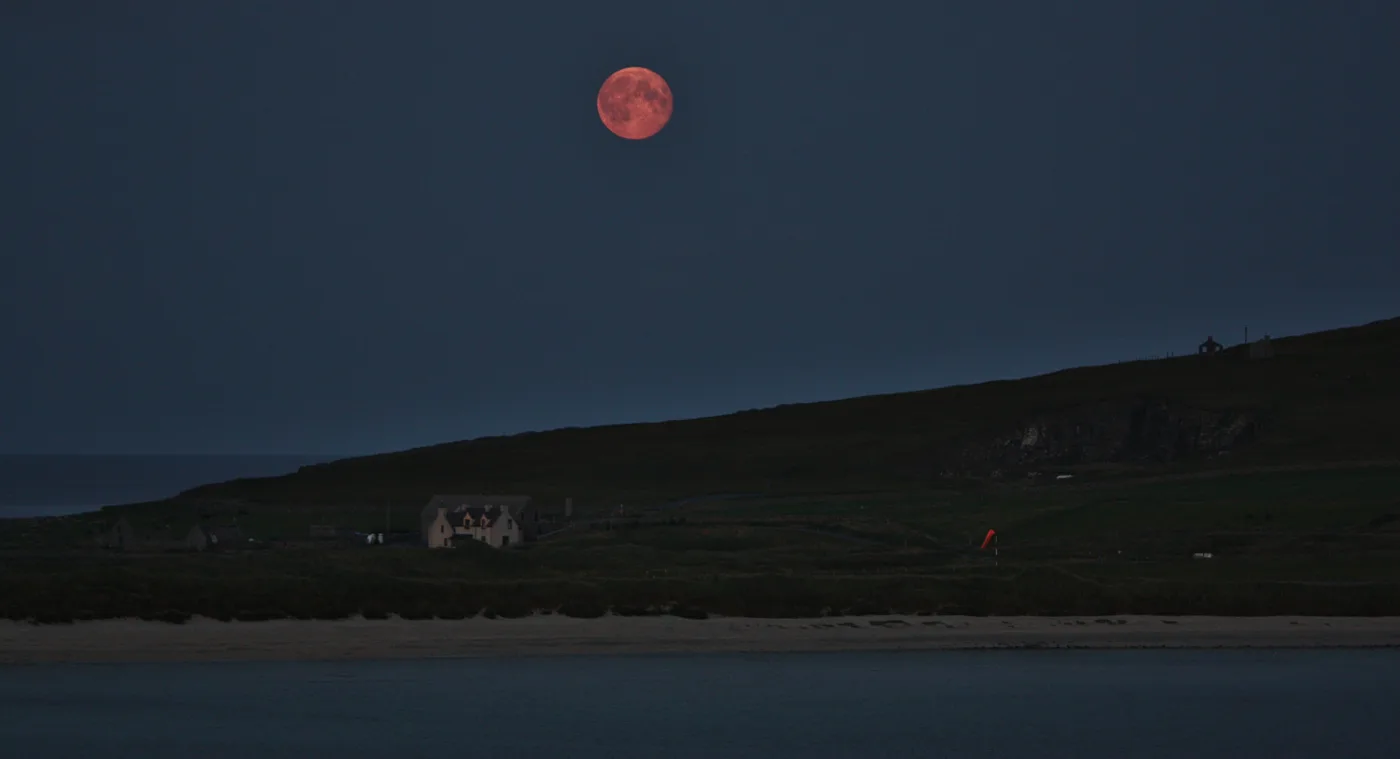
The Harvest Moon rises on Saturday 26 September
September’s full Moon falls on 26 September, and in 2026 the Corn Moon is also the Harvest Moon, the full Moon nearest the autumn equinox. The equinox has already passed, so this is the year’s harvest Moon by definition rather than by folklore.
What makes it worth going outside for is the rising, not the Moon itself. Around the equinox the Moon’s orbit sits at a shallow angle to the horizon, so it rises only a little later each night instead of the usual 50 minutes or so, and comes up close to sunset for several evenings running. That is the whole origin of the name: extra evening light to finish bringing the harvest in. Look east just after sunset on the 25th, 26th and 27th.
You do not need a telescope, and a full Moon is genuinely the worst night of the month for lunar detail, because the Sun is overhead at the lunar surface and there are no shadows to pick out craters. If you want texture, wait a week and work the terminator. If you want a picture, a phone against the eyepiece works better than people expect, and photographing the Moon with a phone covers how. Sky at Night Magazine has its Harvest Moon facts and a piece on the 2026 Corn Moon.
MeerKAT picked up radio bursts from a single exoplanet, a first
Reported on 22 September: an international team using the MeerKAT array in South Africa, 64 dishes working together, has detected variable radio bursts from Beta Pictoris b, a gas giant of roughly 10 to 12 Jupiter masses. The team calculates a magnetic field thousands of times stronger than Earth’s. The paper is on the arXiv preprint server.
The reason this counts as a first is precise: radio emission has been picked up from planetary systems before, but this is the first time a signal has been confirmed as coming from one planet rather than from the star system as a whole. Magnetic fields are what shield an atmosphere from a star’s wind, and until now there has been no direct way to measure one on a planet outside the solar system. If the technique generalises it gives astronomers a new handle on which worlds can hold onto an atmosphere at all.
Nothing here is visible through a backyard telescope: Beta Pictoris is about 63 light years away and the planet is detected, not resolved. It is worth knowing about because it is the kind of result that quietly rewrites what “potentially habitable” means over the next decade. The write-up is at Sky at Night Magazine.
Vaonis is teasing a new smart telescope called Atlas, revealed 15 October
Vaonis started teasing a product called Atlas on 15 September, ten years to the day since it introduced the Stellina, the first smart telescope. Teaser chapters are being released every Tuesday, with the full reveal set for 15 October 2026. Vaonis is calling it “the all-in-one premium smart telescope” and framing it as the start of a new era of smart astronomy.
Treat that as marketing until there is a spec sheet. What we do not yet know is aperture, sensor, mount type, whether it does equatorial tracking, or price, and on past form Vaonis prices above ZWO and Unistellar rather than below. The sensible move if you are shopping now is to wait the three weeks: the Seestar S50 Pro launched in August and Celestron’s Origin Mark II is already out, so there is no reason to buy into the category the fortnight before a new flagship is announced. Our comparison of the best smart telescopes in the UK and the explainer on smart telescopes versus traditional telescopes cover what actually separates them. Details at Skies & Scopes.
Clear skies forecast? Get a nudge.
Our weekly email flags the next good UK observing window and one easy target to find.
Join the listMore from Starvest
Keep reading
Best Telescopes for Beginners in the UK (Tested by Price Bracket)
The best beginner telescopes in the UK by budget, from sub-£150 tabletop scopes to app-guided and smart telescopes, with real 2026 prices.
What Can You See with Binoculars at Night? A Realistic Astronomy List
A realistic list of what you can see with binoculars in astronomy, from the Moon and Jupiter's moons to Andromeda, with tips for spotting each from the UK.
How to Set Up and Use Your First Telescope (Step by Step)
How to use a telescope as a beginner: assemble the mount, align the finder, focus, and find your first targets. A clear step-by-step UK guide.