Hera's First Dimorphos Close-Ups Stream Live on 25 Nov
Four stories this week, from 12 to 19 November, and three dates worth putting in the diary. ESA will show the first close-up pictures of Dimorphos, the asteroid NASA hit in 2022, on Wednesday 25 November, and Sir Brian May has already turned Hera’s early views into 3D. Euclid has released the biggest batch of its sky survey so far, NASA has set 7 December for the first pictures from its Roman telescope, and ESA has picked a seven-spacecraft mission to study the solar wind that drives the northern lights.
Hera’s first close-ups of Dimorphos go out live on Wednesday 25 November
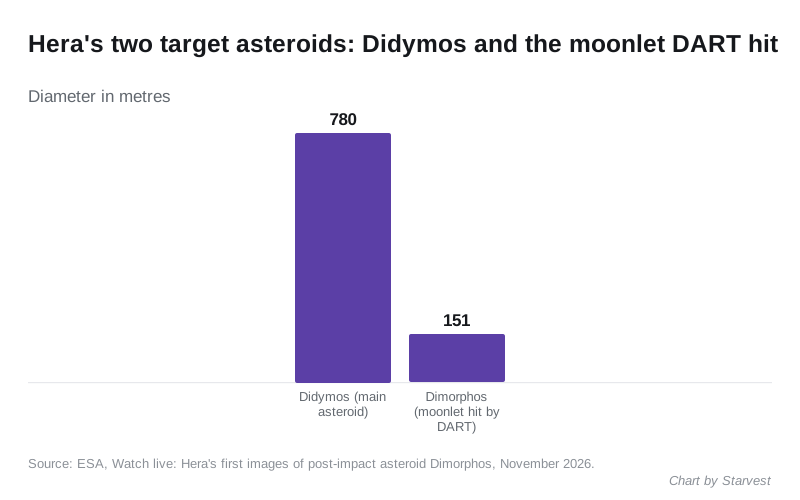
In September 2022 NASA’s DART spacecraft flew into Dimorphos, a moonlet 151 metres across that orbits a larger asteroid, Didymos, which is 780 metres across. The impact shortened Dimorphos’s orbit by about 33 minutes, and the cloud of debris it threw off brightened the pair enough to be seen from telescopes on Earth. ESA’s Hera spacecraft has now arrived to find out what the impact did, and ESA will share the first close-up images of Dimorphos in a livestream from the dinosaur hall of the Museum für Naturkunde in Berlin.
The stream runs from 19:45 to 20:30 Central European Time on Wednesday 25 November, which is 6.45pm to 7.30pm in the UK, on ESA WebTV and ESA’s YouTube channel. ESA says this is only the start: Hera will fly closer over the coming months, and early in the new year it will release two shoebox-sized CubeSats to go nearer still.
The Hera team has been publishing early views this week too. Sir Brian May, astrophysicist, Queen guitarist and a member of the Hera science team, made a stereo pair from two Asteroid Framing Camera images taken on 6 November from 29.7km away, at 2.8 metres per pixel. Seen in 3D, he says, the sharp, smooth ridge around Didymos’s equator stands out against the boulder-strewn rest of the surface. ESA has posted versions for red and blue 3D glasses, for crossing your eyes and for looking “through” the screen.
You will not see Didymos in a backyard telescope: it is a faint near-Earth asteroid, nothing like the bright planets in our guide to seeing the planets. The livestream is the way to watch this one. Sources: ESA, Watch live: Hera’s first images of post-impact asteroid Dimorphos and ESA, Sir Brian May adds new dimension to Hera asteroid.
Euclid releases 13 months of its survey, and the camera behind it was built in the UK
On 12 November ESA released DR1-Foundation, the first major batch of data from the Euclid space telescope since it launched in mid-2023. It holds about 13 months of observations covering an area of sky as big as 9,500 full Moons, with more than a billion objects in it. Among them are about 15,000 candidate strong gravitational lenses, where a foreground galaxy bends the light of a more distant one into arcs or rings, which is more than every previous catalogue combined, and over 60 million candidate quasars. Euclid also measured spectra for 160 million sources, which is how it will work out distances and build its 3D map.
There is a British thread through it. Euclid’s visible-light camera, VIS, was designed and built by an international team led by UCL’s Mullard Space Science Laboratory, and some of the lens hunting was done by volunteers on the Space Warps project on Zooniverse. This release covers only about 14% of the sky Euclid will survey; the full Data Release 1 is due in mid-2027. If galaxy pictures are what draw you in, our Andromeda Galaxy guide is the place to start from a UK garden. Sources: ESA, Euclid lays the foundation for its best-ever 3D map of the Universe and UCL, 12 November.
NASA’s Roman telescope shows its first images on Monday 7 December
NASA said on 17 November that the first images from the Nancy Grace Roman Space Telescope will be released at 3.30pm Eastern on Monday 7 December, which is 8.30pm in the UK. They will be unveiled on a live stream from the American Geophysical Union meeting in San Francisco and posted on NASA’s website at the same time. Roman launched on 30 August on a SpaceX Falcon Heavy and has spent the three months since on a million-mile trip out to its orbit, being switched on and calibrated on the way.
Roman is built to cover huge areas of sky in infrared, for work on dark energy, dark matter and planets around other stars. NASA is also inviting people to “claim” a pixel in one of the first images and get a digital trading card for it. Source: NASA, NASA Invites Media, Public to View Roman Telescope’s First Images.
ESA picks Plasma Observatory, seven spacecraft to study what powers the aurora
ESA’s Science Programme Committee has chosen Plasma Observatory as the agency’s next medium-class science mission. Its seven spacecraft will fly in formation through Earth’s magnetic field to track how energy from the solar wind moves through it, at scales from a few kilometres to tens of thousands of kilometres at the same time. That interaction is what produces the northern lights and, at its most extreme, the storms that knock out satellites and power grids. ESA’s earlier Cluster mission, with four spacecraft, could only look at one scale at once. Launch is provisionally set for the late 2030s.
ESA also shortlisted the next round of candidates, including SPARK, a mission to study how solar flares accelerate particles. None of this changes your chances of an aurora this winter, which our northern lights guide covers, but it is the mission meant to explain how the solar wind’s energy gets through to make one. Source: ESA, Seven-spacecraft observatory to study plasma universe.
Clear skies forecast? Get a nudge.
Our weekly email flags the next good UK observing window and one easy target to find.
Join the listMore from Starvest
Keep readingBest Telescopes for Beginners in the UK (Tested by Price Bracket)
The best beginner telescopes in the UK by budget, from sub-£150 tabletop scopes to app-guided and smart telescopes, with real 2026 prices.
What Can You See with Binoculars at Night? A Realistic Astronomy List
A realistic list of what you can see with binoculars in astronomy, from the Moon and Jupiter's moons to Andromeda, with tips for spotting each from the UK.
How to Set Up and Use Your First Telescope (Step by Step)
How to use a telescope as a beginner: assemble the mount, align the finder, focus, and find your first targets. A clear step-by-step UK guide.