Taurids 2026 UK: Fireball Nights 5 and 12 November
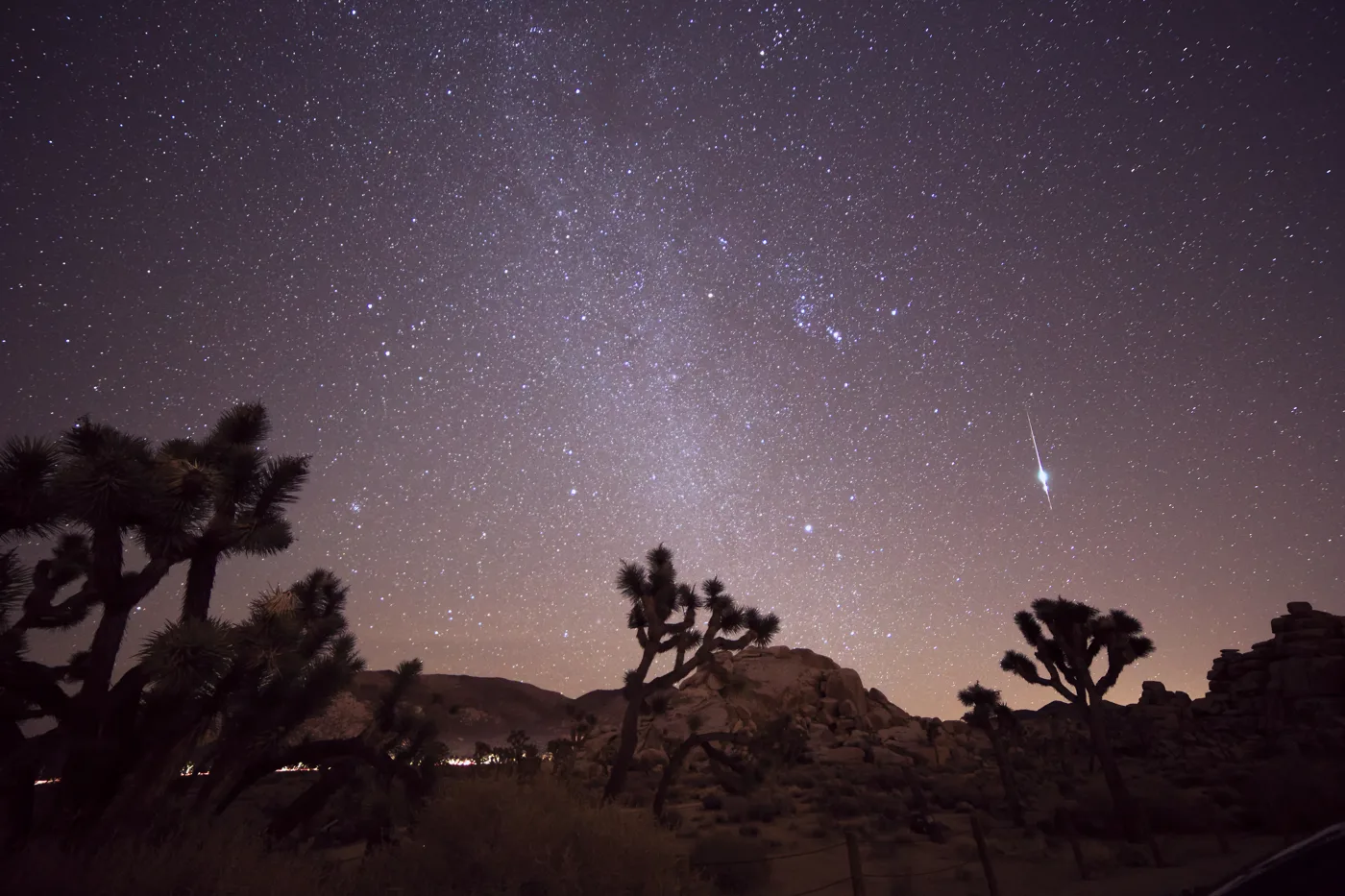
The Taurids 2026 give UK observers something rare: a whole week of meteor watching with no Moon in the way. The Southern Taurids peak around Thursday 5 November, the Northern Taurids around Thursday 12 November, and the new Moon falls on Monday 9 November, right between them. Any clear night in that stretch is worth an hour outside, and the best hour on every one of them is around half past midnight.
Do not expect a storm. The Taurids are a slow, sparse shower. What they offer is the occasional fireball: a slow, bright meteor that lingers long enough for you to point at it and say “look”. Here is when to look, how many you will really see, and what the fireball talk is actually based on.
The two peaks at a glance
| Southern Taurids | Northern Taurids | |
|---|---|---|
| Peak night | Thu 5 into Fri 6 Nov | Thu 12 into Fri 13 Nov |
| Peak rate (ZHR) | 5 to 10 | 5 |
| Active | 20 Sep to 20 Nov | 20 Oct to 10 Dec |
| Radiant highest | about 12.35am, 52 degrees up | about 12.30am, 59 degrees up |
| Moon | 14% lit, rises about 4am | 10% lit, sets about 5.30pm |
| Fully dark | about 6.25pm to 5.15am | about 6.15pm to 5.25am |
| Entry speed | 27 km/s | 29 km/s |
Peak dates, rates, activity windows and speeds are from the International Meteor Organization’s 2026 Meteor Shower Calendar. Times are GMT, after the clocks go back on 25 October, and the Sun, Moon and radiant positions are our own calculation for central England at 53 degrees north. Scotland’s radiant sits a few degrees lower; the south coast’s a few degrees higher.
Why the dates disagree between websites
You will see the Southern Taurid peak given as 10 October, 13 October or 5 November depending on where you look. The IMO calendar explains it: the main Southern Taurid maximum, with a ZHR of 5 to 10, falls around 5 November, but there is an earlier, weaker maximum with a ZHR near 5 around 13 October, “a date which often was listed as actual STA maximum”. Older tables kept the October date. The calendar adds that the October hump might run a little above average in 2026, but that has now passed. For the better rates, take November.
The Northern Taurids have the opposite problem: a single date, 12 November, that hides a broad plateau. The IMO notes that past observations suggest near-peak rates for roughly ten days in early to mid November. Both branches are active at once for the whole of that stretch, which is why the week either side of the new Moon is good rather than just the two named nights.
Hour by hour on the peak nights
The radiant, the point the meteors appear to come from, sits in Taurus and climbs through the evening. The higher it is, the more meteors reach your sky. These are its heights from central England.
| Time (GMT) | Southern Taurids, 5 to 6 Nov | Northern Taurids, 12 to 13 Nov |
|---|---|---|
| 7pm | 16 degrees | 22 degrees |
| 8pm | 25 degrees | 31 degrees |
| 9pm | 33 degrees | 40 degrees |
| 10pm | 41 degrees | 48 degrees |
| 11pm | 48 degrees | 55 degrees |
| Midnight | 51 degrees | 59 degrees |
| 1am | 52 degrees | 59 degrees |
| 2am | 48 degrees | 55 degrees |
| 3am | 42 degrees | 48 degrees |
| 4am | 35 degrees | 40 degrees |
| 5am | 26 degrees | 31 degrees |
Two things stand out. First, the useful window is long: from about 9pm to 3am the radiant is above 30 degrees on both nights, so you do not need an alarm clock. Second, the solar longitudes the IMO gives for the two maxima convert to early evening, around 7pm on 5 November and 6.20pm on 12 November, when the radiant is still low. Because the peaks are broad, that matters very little. Go out later in the evening, when the radiant is high, not at the “peak time” quoted in a news story.
On 5 November the thin waning crescent Moon rises around 4am, low in the east, so the last hour before dawn is slightly brighter. By 12 November the Moon has gone from the morning sky and sets in the early evening, so that night is dark from end to end.
What you will really count
The ZHR is the count one observer would make with the radiant straight overhead under a perfect sky where stars of magnitude 6.5 are visible. Our meteor shower rate calculator corrects that for a real sky using the IMO formula and the Taurids’ population index of 2.3. Run at the best hour of each peak night, it gives:
| Your sky (faintest stars visible) | Southern Taurids, ZHR 7 | Northern Taurids, ZHR 5 |
|---|---|---|
| Perfect, magnitude 6.5 | about 5.5 an hour | about 4.3 an hour |
| Dark rural, magnitude 5.5 | about 2.4 an hour | about 1.9 an hour |
| Village or outer suburb, magnitude 4.5 | about 1 an hour | about 0.8 an hour |
| Town garden, magnitude 3.5 | under 0.5 an hour | under 0.5 an hour |
So the honest answer is: from a properly dark site, two to three Taurids an hour on a peak night, a little more if the Southern branch reaches the top of its 5 to 10 range. From a town garden, perhaps one in a two-hour session. On any night in the 5 to 12 November window both branches are contributing, and you will also see random sporadic meteors that are not Taurids at all, so the total streaks you notice will be higher than these figures.
That table is why the Taurids reward a drive more than most showers. Our dark sky sites list and light pollution map guide will find you somewhere darker than the garden.
The fireball question
Taurids have a reputation for fireballs, and it is deserved, but it is easy to oversell. Three facts sit behind it.
They are slow. At 27 to 29 km/s, Taurids hit the atmosphere at well under half the speed of the Leonids (71 km/s). A slow meteor burns for longer and crosses more of the sky, so a bright one is easy to catch and follow.
The stream carries larger debris than most. The Taurids come from Comet 2P/Encke and a wider complex of material around it. The IMO calendar describes “the brightness and relative slowness of many Taurid meteors”, and the population index of 2.3 is lower than the Geminids’ 2.6, which means a higher share of bright meteors among the ones you see.
Some years are much better than others, and 2026 is not one of them. In certain years Earth passes through a denser clump of Taurid material held in place by Jupiter’s gravity, called the Taurid swarm. A 2022 observational review of the Taurid complex lists 2022 and 2025 as autumn swarm years and puts the next one in 2032. Ordinary years like 2026 still produce Taurid fireballs, just at the normal background level.
The realistic expectation: on a clear November night in a dark place, a Taurid bright enough to make you gasp is a fair chance over several hours, not a near certainty in one. Watching on several nights of the moon-free week is the way to improve your odds.
If you do see one, the IMO runs an online fireball report form. Note the time to the minute, where it started and ended against the stars or a landmark, and how bright it was compared with Venus or the Moon.
How to watch
- Pick any clear night from about 3 to 14 November. The two peak nights are best on paper, but the difference between them and the nights in between is small. Our moon phase calculator confirms the dark stretch.
- Go out between 9pm and 3am. Give your eyes 20 minutes to adapt and keep your phone screen dim or red.
- Do not stare at Taurus. Look about 40 to 50 degrees away from it, somewhere around halfway up the sky. Meteors near the radiant are short; ones further away are long and bright.
- Lie back. A reclining garden chair and a sleeping bag beat standing. November nights in Britain fall close to freezing.
- Trace the trail back. If a slow meteor’s path runs back towards Taurus, near the Pleiades, it is a Taurid. If it does not, it is a sporadic or from another shower.
Photographing them
Taurids are the easiest shower to photograph, because slow, bright meteors leave long trails on a wide-angle frame. Put a camera on a tripod with the widest lens you have, open to its widest aperture, focus on a bright star, and shoot continuous exposures of 15 to 25 seconds at ISO 1600 to 3200 aimed at a dark part of the sky some way from the radiant. Our astrophotography field of view calculator shows how much sky a given lens covers. Expect most frames to be empty; that is normal.
What comes next
The Leonids follow straight on, with a maximum the IMO puts at 11.45pm GMT on 17 November and a ZHR of about 15, but with a first-quarter Moon in the evening sky. Then the main event of the year, the Geminids in 2026, on 13 to 14 December. The full calendar is in our meteor shower tonight UK hub.
Frequently asked questions
When are the Taurids in 2026 in the UK? The Southern Taurids peak around Thursday 5 November and the Northern Taurids around Thursday 12 November, according to the IMO’s 2026 calendar. Both are active for weeks, and the new Moon on 9 November makes the whole stretch from about 3 to 14 November worth watching.
What time should I look for the Taurids? Between about 9pm and 3am GMT. The radiant is highest at around 12.30am on both peak nights, reaching about 52 degrees for the Southern Taurids and 59 degrees for the Northern Taurids from central England.
How many Taurids will I see per hour? From a properly dark site, about two to three an hour at the best hour of a peak night. From a suburban garden, about one an hour or fewer. The headline ZHR of 5 to 10 assumes the radiant overhead and a perfect sky, which Britain does not have.
Is 2026 a Taurid fireball year? Not a swarm year. Earth passes through the denser Taurid swarm only in certain years; a 2022 review of the Taurid complex lists 2022 and 2025 and puts the next autumn swarm in 2032. Taurids still produce some fireballs every year because they are slow and include larger particles.
Where should I look in the sky? Anywhere about 40 to 50 degrees away from the constellation Taurus, roughly halfway up the sky. Taurus rises in the east in the evening and is high in the south around midnight. Meteors further from the radiant leave longer, brighter trails.
Will the Moon spoil the Taurids this year? No. The Moon is new on 9 November, between the two peaks. On 5 November a thin crescent rises only around 4am, and on 12 November it sets in the early evening, so both peak nights are dark.
Clear skies forecast? Get a nudge.
Our weekly email flags the next good UK observing window and one easy target to find.
Join the listMore from Starvest
Keep reading
Best Telescopes for Beginners in the UK (Tested by Price Bracket)
The best beginner telescopes in the UK by budget, from sub-£150 tabletop scopes to app-guided and smart telescopes, with real 2026 prices.
What Can You See with Binoculars at Night? A Realistic Astronomy List
A realistic list of what you can see with binoculars in astronomy, from the Moon and Jupiter's moons to Andromeda, with tips for spotting each from the UK.
How to Set Up and Use Your First Telescope (Step by Step)
How to use a telescope as a beginner: assemble the mount, align the finder, focus, and find your first targets. A clear step-by-step UK guide.