Full Moon December 2026 UK: Supermoon 1.28am, 24 Dec
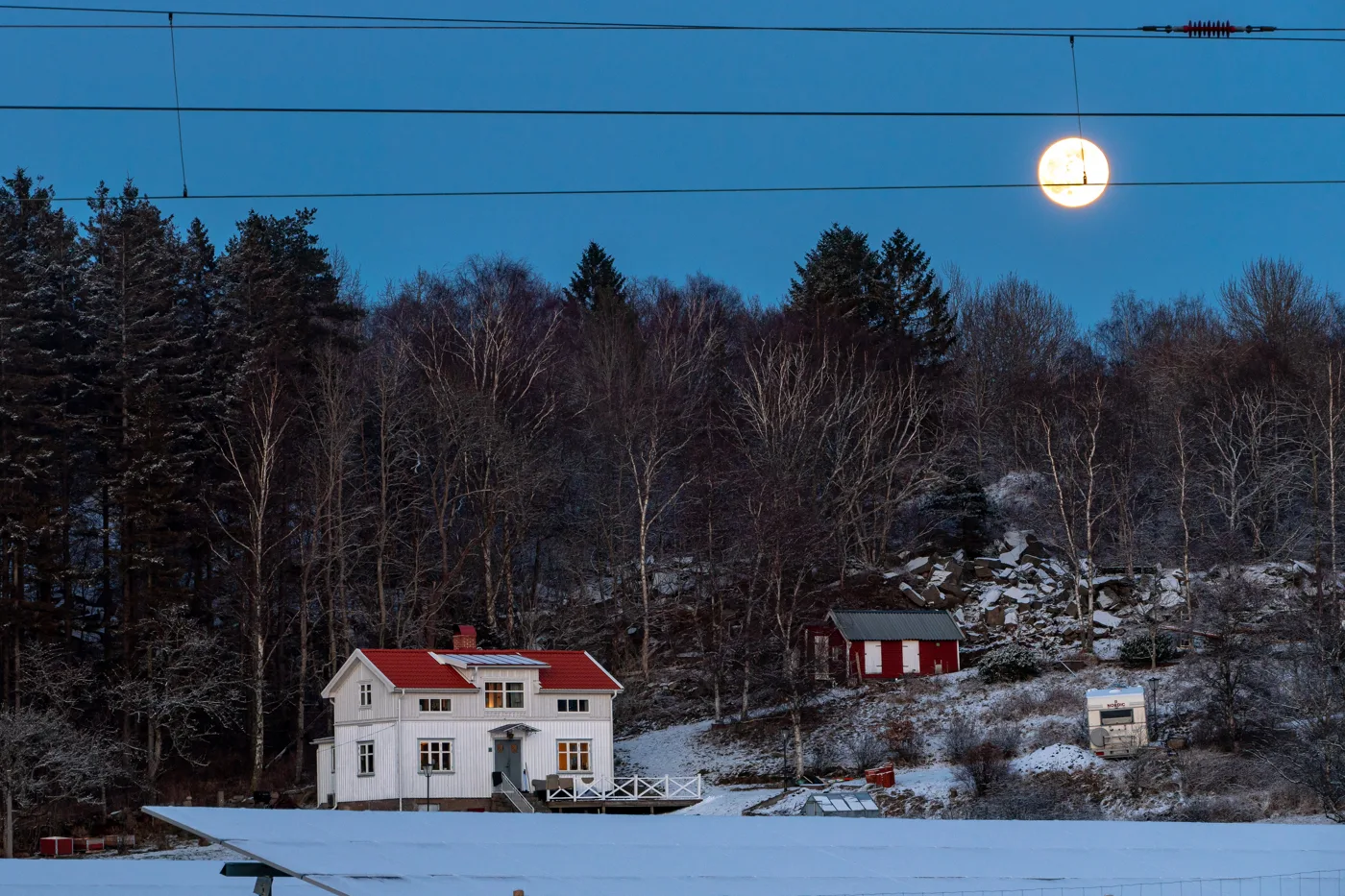
The full Moon in December 2026 peaks for the UK at 1.28am GMT on Thursday 24 December, the early hours of Christmas Eve. It is the Cold Moon, and it is the biggest full Moon of 2026: the closest of the year’s three supermoons, about 356,740 km away. Because the peak falls in the middle of the night, the Moon is high in the sky at that moment, and both the evening of Wednesday 23 December and Christmas Eve itself give a Moon that looks completely full.
It is also the highest full Moon of the year. At midnight it stands about 65 degrees above the southern horizon from London, more than six times higher than June’s full Moon managed. Here are the moonrise times for six cities, which night to pick, and what “closest of the year” actually looks like.
Moonrise and moonset across the UK
Times are GMT, for the Moon’s upper edge on a flat horizon, from the US Naval Observatory’s calculator. Hills and buildings to the north-east will delay what you see by several minutes.
| City | Wed 23 Dec rise | Thu 24 Dec rise | Fri 25 Dec rise | Sunset 24 Dec |
|---|---|---|---|---|
| London | 2.48pm | 4.08pm | 5.40pm | 3.55pm |
| Birmingham | 2.48pm | 4.09pm | 5.42pm | 3.57pm |
| Cardiff | 3.01pm | 4.21pm | 5.53pm | 4.07pm |
| Manchester | 2.42pm | 4.03pm | 5.38pm | 3.53pm |
| Edinburgh | 2.22pm | 3.45pm | 5.25pm | 3.41pm |
| Belfast | 2.47pm | 4.09pm | 5.46pm | 4.01pm |
The Moon sets late the next morning in daylight. After the peak it goes down at 8.57am in London on Christmas Eve, 9.20am in Manchester, 9.46am in Edinburgh and 9.45am in Belfast, and on Christmas morning at 9.39am in London and 10.22am in Belfast. If you are up early on Christmas Day, look west: a 97% lit Moon is still above the horizon after sunrise.
Which night is best?
Wednesday 23 December is the peak night. The Moon is already up by mid-afternoon and becomes 100% full at 1.28am, while it sits high in the south over Gemini. Step outside any time between about 10pm and 3am and you are looking at the full Moon within a couple of hours of its exact moment. This is the night for a look through binoculars or for watching the landscape light up.
Thursday 24 December, Christmas Eve, is the best for a moonrise photograph. In London the Moon comes up at 4.08pm, about 13 minutes after sunset, so it rises into a deepening blue sky rather than daylight, still 100% lit to the eye. In Edinburgh the gap is just four minutes, so be in place before 3.45pm.
Friday 25 December, Christmas Day, gives a 97% lit Moon rising after dark, around 5.40pm. Fine for a walk after lunch, though it has lost the slightest sliver on one edge.
If the 23rd is cloudy, try the 24th. The Moon looks full to the eye for about a day either side of the peak.
The closest full Moon of 2026, and how big that really is
A supermoon is a full Moon close to perigee, the nearest point in the Moon’s slightly oval orbit; the Royal Observatory Greenwich explains the term and where it came from. On 24 December the Moon is about 356,740 km away at the moment of full, measured centre to centre, according to NASA JPL’s Horizons ephemeris. Perigee follows seven hours later, at about 8.30am GMT, at roughly 356,650 km, one of the closest approaches of the year. It is the third and last supermoon of 2026, after 3 January and 24 November.
The difference is real but modest. By our calculation:
- Against November’s supermoon (about 360,765 km away), December’s appears about 1% wider. Nobody can see that by eye.
- Against the smallest full Moon of 2026, on 31 May at about 406,100 km, it appears about 14% wider and about 30% brighter. You would see that in two photographs taken with the same lens, side by side, not in the sky seven months apart.
So the Moon will not look huge overhead. When it does look enormous, low on the horizon at moonrise, that is the Moon illusion, a trick of perception that happens with every full Moon. What you will notice is the brightness: a high, close full Moon over frost or snow is bright enough to read large print by and to cast sharp shadows.
Why the December full Moon rides so high
The full Moon always sits opposite the Sun. In December the Sun is at its lowest of the year, so the full Moon is at its highest, following the path the Sun takes in midsummer. This year the effect is stronger than usual because of where the Moon’s tilted orbit sits: at midnight on the 23rd the Moon is at a declination of about 27 degrees north, in Gemini, near the feet of the Twins.
From London that puts it about 65 degrees up at its highest, around midnight. From Edinburgh it reaches about 61 degrees, and from Cardiff about 65. Compare that with the June full Moon of 29 June 2026, which only reached about 10 degrees above the southern horizon from London. It also means a long night: the Moon is above the horizon for more than 17 hours on the 23rd and 24th.
What else is in the sky
Jupiter is the bright, steady point low in the east by 10pm, in Leo, about 12 degrees up from London and climbing all night. Orion is to the Moon’s lower right, and the bright stars of Gemini, Castor and Pollux, sit just to its left. The Moon’s glare drowns out faint stars, so this is not the week for the Milky Way or meteors: the Geminids peak on 13 and 14 December, a few days after new Moon on 9 December, so the darker skies come earlier in the month.
Why it is called the Cold Moon
The name is North American, from lists popularised by the Farmers’ Almanac, and refers to the start of the coldest part of the year. Another name on the same lists is the Long Night Moon, which fits: it rises in the afternoon and stays up until mid-morning, close to the longest night of the year on the 21st. None of these names are astronomical; they are folklore labels for the month.
Photographing the Christmas Eve moonrise
- Pick your spot by direction. The Moon rises north of east: about 45 degrees on a compass on Christmas Eve from London, and about 42 degrees on the 23rd. Find a church tower, hill, pier or bare tree in that direction and stand well back from it.
- Be in place before moonrise. In the 20 minutes after it clears the horizon the Moon looks largest and most orange, and the sky still has colour.
- Zoom rather than crop. Use the longest lens you have, or the 3x to 5x telephoto camera on a phone. Our guide to photographing the Moon with a phone covers exposure lock and why you should tap on the Moon, not the sky.
- Protect your battery. A December evening drains phone and camera batteries fast. Keep a spare warm in an inside pocket.
For crater detail through a telescope, full Moon is the worst phase, because the Sun shines straight down and there are no shadows. See how to observe the Moon for better nights, and whether a moon filter is worth it for cutting the glare of a full Moon this bright.
Frequently asked questions
What time is the full Moon in December 2026 in the UK? The Moon is exactly full at 1.28am GMT on Thursday 24 December 2026. It is high in the southern sky at that moment, so look on the evening of Wednesday 23 December or after moonrise on Christmas Eve, about 4.08pm in London.
Is the December 2026 full Moon a supermoon? Yes. At about 356,740 km away it is the closest full Moon of 2026 and the last of the year’s three supermoons, after 3 January and 24 November. Perigee follows at about 8.30am on 24 December.
Is there a full Moon on Christmas Day 2026? Not quite. The exact full Moon is on Christmas Eve morning, but on Christmas Day the Moon is still 97% lit, rising around 5.40pm in London and visible all evening.
What is the December full Moon called? The Cold Moon, a North American folk name for the start of the coldest weather. It is also known as the Long Night Moon because it stays up for most of the longest nights of the year.
Why does the December full Moon look so high? The full Moon is opposite the Sun, and in December the Sun is at its lowest. So the full Moon follows the Sun’s high summer path, reaching about 65 degrees above the horizon from London around midnight on 23 to 24 December.
Where should I look for the moonrise on Christmas Eve? North-east, about 45 degrees on a compass from London, a little after sunset. It rises at 4.08pm in London, 4.03pm in Manchester, 3.45pm in Edinburgh and 4.09pm in Belfast.
Clear skies forecast? Get a nudge.
Our weekly email flags the next good UK observing window and one easy target to find.
Join the listMore from Starvest
Keep reading
Best Telescopes for Beginners in the UK (Tested by Price Bracket)
The best beginner telescopes in the UK by budget, from sub-£150 tabletop scopes to app-guided and smart telescopes, with real 2026 prices.
What Can You See with Binoculars at Night? A Realistic Astronomy List
A realistic list of what you can see with binoculars in astronomy, from the Moon and Jupiter's moons to Andromeda, with tips for spotting each from the UK.
How to Set Up and Use Your First Telescope (Step by Step)
How to use a telescope as a beginner: assemble the mount, align the finder, focus, and find your first targets. A clear step-by-step UK guide.