Do You Need a Moon Filter? Usually No, Here Is the Test
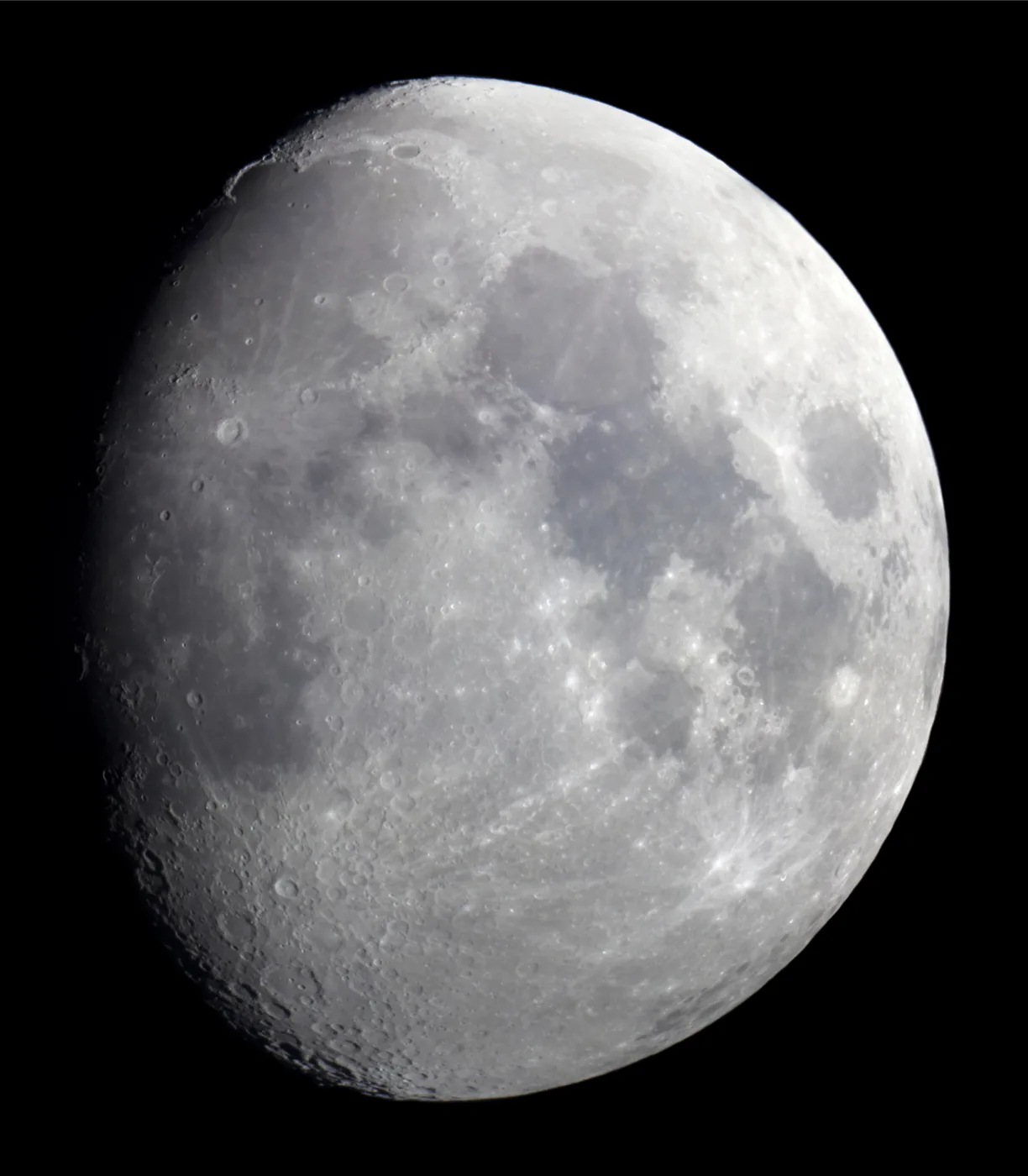
Do you need a moon filter? For most people with a small or mid-sized telescope, no, and certainly not as the first accessory you buy. A moon filter makes the Moon dimmer. It does not add a single crater or ridge that was not already there. You can make the Moon dimmer for nothing by changing eyepiece, and the eyepiece you change to will usually show you more detail at the same time. There are real cases where a filter earns its place, though, and the type you pick matters more than the brand. This page sorts out which camp you are in.
What a moon filter actually does
A moon filter is a piece of tinted glass in a cell that screws into the bottom of an eyepiece barrel. There are three kinds on sale in the UK.
| Type | How it works | Light let through | Colour |
|---|---|---|---|
| Neutral density (ND) | Grey glass at a fixed strength | ND 0.3 = 50%, ND 0.6 = 25%, ND 0.9 = 13% | None |
| Variable polarising | Two polarising layers you rotate against each other | Adjustable, about 40% down to 1% | Very slight tint on some |
| Coloured moon filter | Tinted glass, often green | Celestron’s #58 green version passes 25% | Green cast |
The figures come from Celestron’s own comparison of its three lunar filters. An ND number is a logarithm, so every extra 0.3 halves the light: ND 0.9 lets through about an eighth.
All three do the same basic job. They cut the total amount of light reaching your eye, so a bright gibbous Moon stops dazzling you. None of them sharpens the image or pulls out finer detail than the telescope and the night’s seeing allow.
The free alternative: magnification
Here is the part most filter adverts leave out. The brightness of the Moon in the eyepiece depends on the exit pupil, the width of the beam of light leaving the eyepiece. Exit pupil equals the telescope’s aperture divided by the magnification, and the image brightness falls with the square of it.
Take a common beginner telescope, a 130mm reflector with a 650mm focal length:
- With a 25mm eyepiece you get 26x and an exit pupil of 5mm. A first-quarter Moon is painfully bright.
- With a 10mm eyepiece you get 65x and a 2mm exit pupil. The image is now about one sixth as bright as at 26x.
- With a 6mm eyepiece you get about 108x and a 1.2mm exit pupil. The image is about one seventeenth as bright as at 26x, which is dimmer than an ND 0.9 filter would make the low-power view.
So stepping up from 26x to around 100x dims the Moon more than the strongest common moon filter, and it shows you smaller craters, rilles and mountain peaks while it does it. That is why experienced lunar observers rarely bother with filters at moderate and high power. The glare problem mostly belongs to the low-power, whole-disc view.
If you are not sure what magnifications your eyepieces give, our guides to telescope eyepieces and the best magnification for planets cover the arithmetic. The same limits apply to the Moon: on an average British night, the air rarely supports much above 150x to 200x.
Glare versus detail
The confusion comes from the way a dazzling image feels. When the Moon floods the eye, bright areas bleed into dark ones, your pupil snaps shut and the view looks harsh and washed out. Dimming it makes it comfortable, and comfortable can feel like sharper. Some observers swear they see more with a filter for exactly this reason.
What the filter cannot do is beat the resolution of the telescope or the steadiness of the atmosphere. If the air is turbulent the Moon will boil with or without one. And the best lunar detail is near the terminator, the line between day and night, where the light is already dimmer and the shadows are long. Our page on observing the Moon explains why the nights either side of half Moon beat the full Moon for detail.
The other free option: an aperture mask
If you own a large Dobsonian, a 200mm or bigger, the Moon at low power can be fierce enough that even 100x feels bright. A cardboard disc over the tube with an off-centre hole cut to miss the secondary mirror and its supports cuts the light hard. A 100mm hole on a 200mm telescope passes about a quarter of the light.
The catch is that a smaller opening also lowers the telescope’s resolution, so a mask throws away some of the detail you bought the big telescope to see. It makes sense on poor nights when the air would not let the full aperture perform anyway. On a good night, more magnification is the better fix.
When a filter genuinely helps
There are times when a filter does what nothing else does as neatly.
- Low-power views of a near-full Moon. If you want the whole disc in the field, you are stuck with a large exit pupil, and an ND or polarising filter is the only easy way to calm it.
- Showing the Moon to beginners and children. At an outreach event or with the family, a low-power view through a filter is comfortable for every eye, and nobody steps back blinking.
- Keeping your night vision for fainter targets. After a session on a bright Moon your eyes are partly light-adapted. A filter softens that hit if you plan to move on to double stars or clusters.
- Venus and bright double stars. A polarising or ND filter tames the glare of Venus and helps split pairs where one star swamps the other. Our list of double stars for small telescopes includes several unequal pairs where this helps.
Neutral density or variable polarising?
If you do decide to buy one, a variable polarising filter is the more useful tool. You can turn it from about 40% transmission for a thin crescent down to around 1% for a full Moon at low power, so one filter covers every phase. It is threaded on both sides on the models from Celestron and others, so it can sit under a coloured filter too. The trade-off is that it is two layers of glass instead of one, so it adds a little more length to the eyepiece.
A single ND 0.9 is simpler, cheaper and stays neutral grey, which suits a beginner with a small refractor who mostly looks at the Moon around half phase. ND 0.6 is often enough for telescopes of 90mm and under.
UK astronomy retailers such as First Light Optics stock both types from Baader, Optolong, SVbony and Astro Essentials. Check current price at the retailer, and check the filter thread matches your eyepieces: 1.25 inch filters fit most beginner eyepieces, 2 inch filters fit the larger barrels.
The green #58 filter is the one we would skip. The colour cast is distracting, and modern observers mostly prefer a neutral view. Several cheap telescope kits include one, which is the main reason so many people own one.
A safety warning that is easy to miss
A moon filter is not a solar filter. Every type on this page screws into the eyepiece, behind the focused light of the telescope, and none of them is safe for looking at the Sun, however dark the glass looks. Pointing a telescope at the Sun with one fitted can cause instant and permanent eye damage, and the focused heat can crack the filter. Solar viewing needs a certified filter that covers the front of the telescope. Our solar observing safety guide explains what to buy.
The quick test before you buy
Next clear night with a Moon at half or a little past, try this:
- Look with your lowest-power eyepiece and note how bright it feels.
- Swap to an eyepiece giving roughly 100x and look again.
- If the 100x view is comfortable and shows more, you do not need a filter for detailed lunar work.
- If what you really want is the whole bright disc at low power, or you share the view with other people, a variable polarising filter is worth having.
Most owners find step 3 settles it. Spend the money on a good mid-power eyepiece first, which our telescope accessories for beginners page ranks ahead of filters for exactly this reason.
Frequently asked questions
Do you need a moon filter to look at the Moon safely? No. The Moon is bright but it cannot harm your eyes through a telescope. A filter is about comfort, not safety.
Does a moon filter show more detail? No. It only reduces brightness. Some people find a comfortable image easier to study, but the detail you can see is set by your telescope’s aperture and the steadiness of the air.
What is the best strength of neutral density moon filter? ND 0.9, which passes about 13% of the light, suits most telescopes from 100mm to 150mm at low power. ND 0.6 is often enough for small refractors.
Is a variable polarising filter better than an ND filter? For most people, yes, because you can adjust it from about 40% down to about 1% transmission to suit the phase of the Moon and the eyepiece in use.
Can I use a moon filter to look at the Sun? Never. Moon filters fit the eyepiece and give no protection from focused sunlight. Only a certified solar filter that covers the front of the telescope is safe.
Why does the Moon look so bright through my telescope? Your eyes are partly dark-adapted and a low-power eyepiece sends a wide, bright beam into them. Using more magnification shrinks that beam and dims the image.
Clear skies forecast? Get a nudge.
Our weekly email flags the next good UK observing window and one easy target to find.
Join the listMore from Starvest
Keep reading
Best Telescopes for Beginners in the UK (Tested by Price Bracket)
The best beginner telescopes in the UK by budget, from sub-£150 tabletop scopes to app-guided and smart telescopes, with real 2026 prices.
What Can You See with Binoculars at Night? A Realistic Astronomy List
A realistic list of what you can see with binoculars in astronomy, from the Moon and Jupiter's moons to Andromeda, with tips for spotting each from the UK.
How to Set Up and Use Your First Telescope (Step by Step)
How to use a telescope as a beginner: assemble the mount, align the finder, focus, and find your first targets. A clear step-by-step UK guide.