Best Magnification for Planets: 25x an Inch, Not 675x
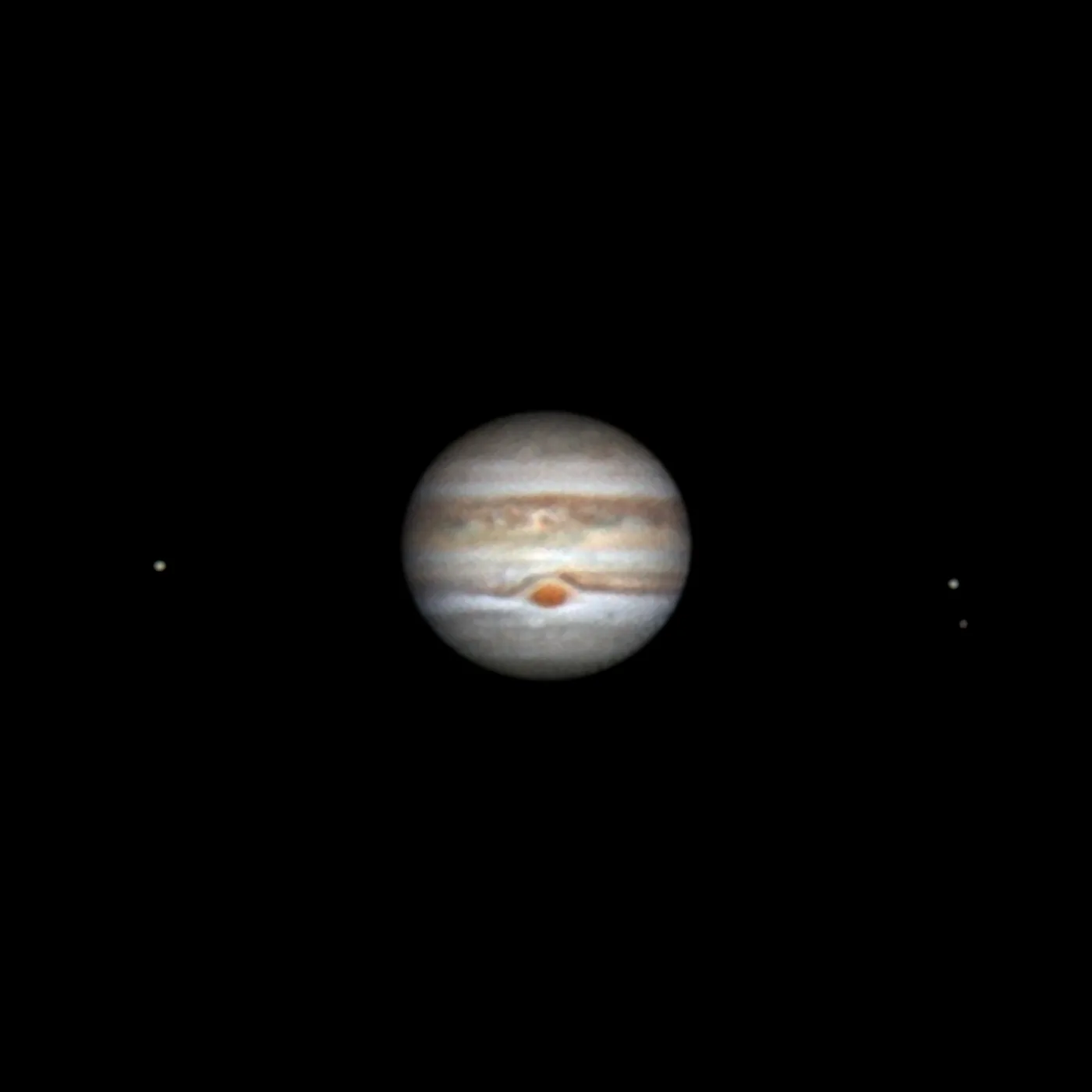
The best magnification for planets is far lower than most people expect, and far lower than the number printed on a telescope box. On a typical night in Britain, the figure that gives you the most detail on Jupiter or Saturn is somewhere around 25x to 30x for every inch of aperture your telescope has. There is a hard optical ceiling above that at 50x per inch, and on nine nights out of ten the atmosphere will stop you well short of even the sensible band. Here is where all three numbers come from and how to find yours.
Start with the three numbers that matter
Your magnification is the telescope’s focal length divided by the eyepiece focal length. A 1,200mm focal length telescope with a 6mm eyepiece gives 200x. Nothing about the eyepiece changes what your telescope can resolve, it only changes how much you spread that resolution across your field of view. Our telescope magnification calculator will do the arithmetic for any combination you own.
Your hard ceiling is 2x per millimetre of aperture, which is the same as 50x per inch. Past that point you are enlarging blur rather than revealing detail, because the aperture has already handed you everything it can resolve.
Your exit pupil is the width of the beam of light leaving the eyepiece, and it equals your aperture divided by your magnification. It is the same rule written a different way, and it is the more useful one, because it explains why the ceiling exists.
The 50x rule and the 0.5mm exit pupil are the same rule
Run the numbers on a 200mm telescope. At 400x, which is 50x per inch, the exit pupil is 200 divided by 400, or 0.5mm. Do it for a 100mm at 200x and you get 0.5mm again. Do it for any aperture at its “maximum useful” magnification and you always land on 0.5mm, because the two rules are one rule.
That matters because 0.5mm is roughly where diffraction takes over the view. Below it the image gets no more detailed, only dimmer and softer. And well before you reach it, your own eye starts intruding. At exit pupils under about 0.7mm the floaters in your vitreous humour come into sharp focus and drift across the planet, and some observers see the shadows of their own retinal blood vessels laid over Jupiter’s belts.
So the useful planetary range runs from about a 1.5mm exit pupil down to about 0.7mm, and 1mm sits comfortably in the middle. A 1mm exit pupil is exactly 1x per millimetre of aperture, or 25x per inch. That is the number in the headline, and it is not a coincidence.
What that means for your telescope
| Aperture | Hard ceiling (2x/mm) | Everyday planetary band (1x to 1.2x/mm) |
|---|---|---|
| 100mm (4 inch) | 200x | 100x to 120x |
| 130mm (5 inch) | 260x | 130x to 155x |
| 150mm (6 inch) | 300x | 150x to 180x |
| 200mm (8 inch) | 400x | 200x to 240x |
| 250mm (10 inch) | 500x | 250x to 300x |
Read the right-hand column as your normal working magnification, not a compromise. Experienced planetary observers spend most of their time there because that is where the image is sharpest, and they only reach for the ceiling on the rare night that earns it.
Notice what happens at the bottom of the table. A 250mm telescope has a ceiling of 500x, but almost nobody in Britain ever gets to use it, because the atmosphere gives out first. That is not an argument against aperture: a bigger mirror still resolves finer detail at the same magnification, and it gathers far more light. It is an argument against assuming the extra aperture buys you extra power.
The real limit on a British night is the air
The optics set a ceiling. The sky sets the actual limit, and it is usually lower.
The seeing over the British Isles is driven largely by the subtropical jet stream. When it sits north of the country the air overhead can be beautifully still. When it slides down over you, lunar and planetary observing is close to hopeless no matter what you paid for the telescope. The British Astronomical Association is blunt about this: in average seeing, use a lower power, because high magnification amplifies the distortion as surely as it amplifies the planet.
Observers rate this on the Antoniadi scale, I to V, where I is a disc that is “absolutely steady” with faint features visible, and V is an image “continually quivering” that you cannot even focus. Eugène Antoniadi himself reckoned genuinely excellent nights came round about one in fifty.
In practice that gives you a rough working rule:
- Steady air, a night where a star barely twinkles: you can push to 200x to 250x and sometimes beyond.
- Average air, which is most nights: 150x is often the point where more power stops helping.
- Turbulent air, stars visibly boiling: stay at 100x or below and enjoy the view you can actually hold.
Two practical points the forecast will not tell you. Seeing is often best just after sunset and in the hour before dawn, when the air has stopped churning. And a still, slightly misty night, the sort that looks unpromising, frequently delivers the best planetary views of the year. Our guide to astronomical seeing goes deeper into reading conditions before you set up.
Why the box says 675x
The “675x60mm” refractor is a real product, sold under names including Tasco and Carson, and the number is the clearest signal in the hobby that a telescope is not serious.
A 60mm aperture is 2.36 inches. Its hard ceiling is about 118x. The advertised 675x is almost six times past that. It is reachable, in the sense that a 3mm eyepiece in a 3x Barlow will produce that number, but the exit pupil at 675x on a 60mm is 0.089mm. You would be looking at a dim, mushy smear roughly nine times narrower than the point where diffraction already dominates.
Manufacturers quote it because magnification is the one telescope number a shopper recognises. Aperture is the number that matters, and it is the one buried in the small print. If you are weighing up a first telescope, aperture explained and are cheap telescopes worth it are the two pages to read before you spend.
How big will the planet actually look?
Magnification numbers feel abstract, so convert them. At opposition Jupiter’s disc spans about 44 to 46 arcseconds. Multiply 44 by 150x and you get 6,600 arcseconds, which is 1.8 degrees, roughly three and a half times the width of the full Moon as you see it with the naked eye.
That is already a substantial object in the eyepiece. Saturn’s globe is smaller, between about 16 and 21 arcseconds, though the ring system extends the visible width considerably. Mars swings from roughly 14 arcseconds at a distant opposition to 25 arcseconds at a close one, which is why some Martian apparitions reward high power and others simply do not.
The lesson buried in those figures is that Jupiter and Saturn do not need heroic magnification to show their main features. Belts, the Great Red Spot, the Cassini Division and the shadows of the Galilean moons are all within reach of a sharp 150x view. What they need is steady air and a properly cooled, properly collimated telescope.
Choosing eyepieces for planets
Work backwards from exit pupil rather than forwards from magnification.
Take a 200mm f/6 Dobsonian, focal length 1,200mm. A 6mm eyepiece gives 200x and a 1mm exit pupil, which is your everyday planetary eyepiece. A 5mm gives 240x and 0.83mm, for good nights. A 4mm gives 300x and 0.67mm, which is into floater territory and only worth owning if your skies genuinely support it. A 9mm gives 133x and 1.5mm, which is the one you will actually use when the air is soft.
Two or three eyepieces spanning that band beat a drawer full of tiny focal lengths. A Barlow lens is a tidy way to get there with fewer eyepieces, since it doubles the magnification of each one, though it will not help you past the ceiling any more than a short eyepiece will. Our exit pupil calculator will check any combination before you buy it, and telescope eyepieces explained covers the designs that suit planetary work.
The method that beats any rule of thumb
On the night itself, ignore the table and do this. Find the planet at low power. Step up one eyepiece at a time. Keep going until the moment the image stops gaining detail and starts going soft, then drop back one step. That is your best magnification for planets tonight, on this telescope, under this sky. It will be a different number next week.
Give the telescope time to reach the outside temperature first, at least half an hour for a small refractor and an hour or more for a large reflector, because tube currents will destroy a high-power view on their own. Check collimation on a reflector before you blame the sky. And observe when the planet is highest, because near the horizon you are looking through several times as much turbulent atmosphere. How to see the planets covers the timing side in more detail.
Frequently asked questions
What magnification do I need to see Saturn’s rings? Around 50x is enough to show the rings as rings rather than a bulge, and 100x to 150x will start to reveal the Cassini Division in good conditions. Beyond that you are chasing ring detail and cloud banding on the globe, which is a steady-air problem rather than a magnification problem. We cover this in seeing Saturn’s rings through a telescope.
Is 200x too much for a beginner telescope? It depends entirely on aperture, not on price. A 200mm reflector reaches 200x at a 1mm exit pupil, which is a comfortable working power. A 70mm refractor at 200x is already past its hard ceiling of about 138x and will show you a dim blur. Work out 2x per millimetre of your own aperture before deciding.
Why does my planet look worse at higher magnification? Three usual causes, in order of likelihood. The air is turbulent, and you are magnifying the turbulence. The telescope has not cooled to ambient temperature, so currents inside the tube are smearing the image. Or you have gone past the useful ceiling and are enlarging a blur. Drop back a step or two and the detail often reappears.
Does a Barlow lens increase what I can see? It increases magnification, not resolution. A 2x Barlow doubles the power of every eyepiece you own, which is useful for filling gaps in your set, but it cannot take you past the aperture’s limit. Used at sensible powers a good Barlow costs you almost nothing in image quality; used to reach 675x it will not rescue a 60mm telescope.
What is the highest magnification I should ever use? Take your aperture in millimetres and double it. That is the absolute ceiling, worth reaching for only on an exceptionally steady night. For routine use halve it, and treat the result as your normal planetary power. Almost no British observer regularly exceeds 250x whatever their telescope.
Does more aperture mean more magnification? It raises the ceiling proportionally, but on most nights the atmosphere caps you well below it, so the practical answer above roughly 200mm is no. What extra aperture reliably buys is resolution and brightness at the same magnification, which is a sharper, more contrasty planet rather than a bigger one.
Sources
Clear skies forecast? Get a nudge.
Our weekly email flags the next good UK observing window and one easy target to find.
Join the listMore from Starvest
Keep reading
Best Telescopes for Beginners in the UK (Tested by Price Bracket)
The best beginner telescopes in the UK by budget, from sub-£150 tabletop scopes to app-guided and smart telescopes, with real 2026 prices.
What Can You See with Binoculars at Night? A Realistic Astronomy List
A realistic list of what you can see with binoculars in astronomy, from the Moon and Jupiter's moons to Andromeda, with tips for spotting each from the UK.
How to Set Up and Use Your First Telescope (Step by Step)
How to use a telescope as a beginner: assemble the mount, align the finder, focus, and find your first targets. A clear step-by-step UK guide.