Telescope Aperture Explained: How Much Do You Really Need?
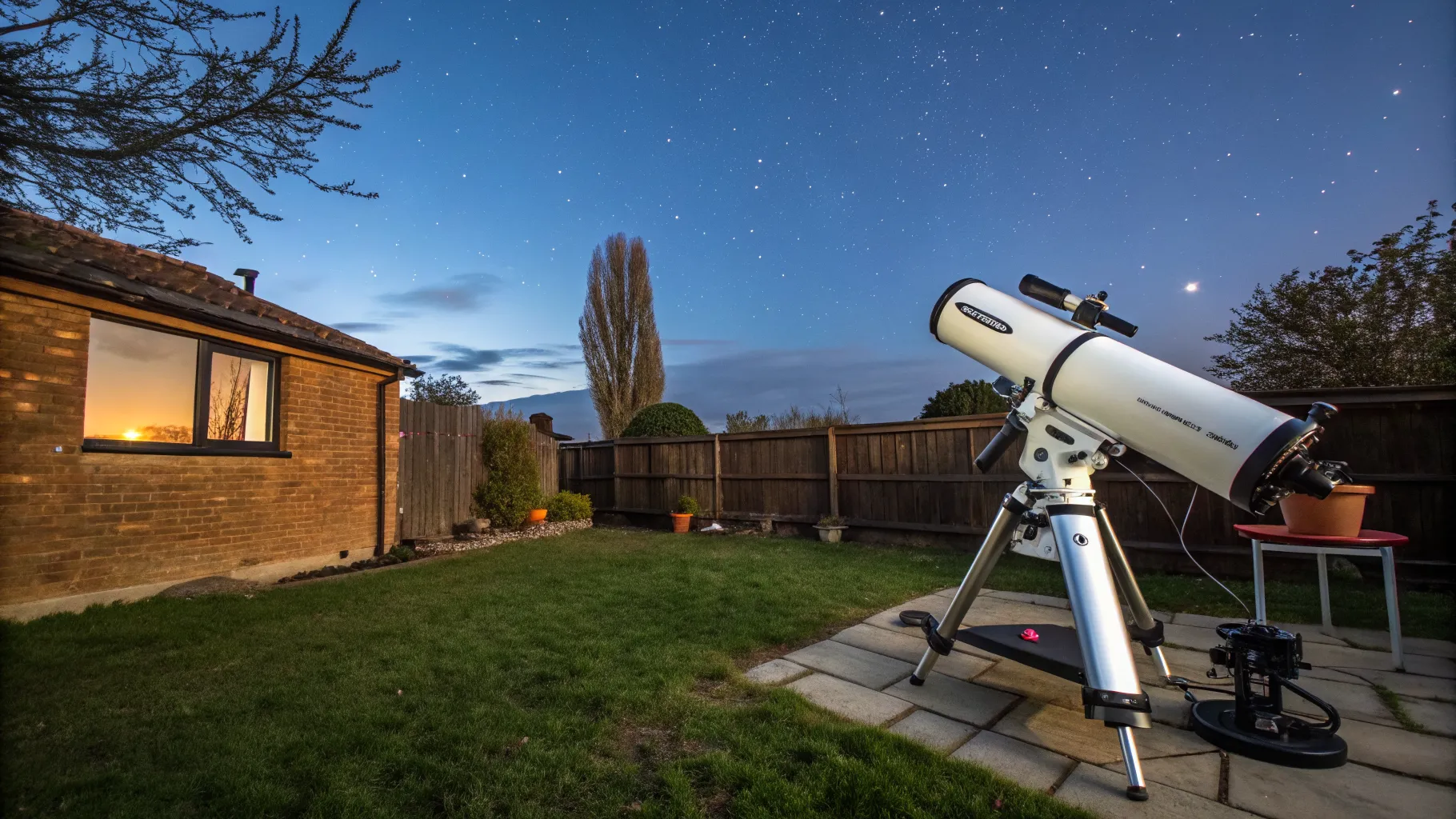
If you want one number to start from: 150mm to 200mm (6 to 8 inches) is the aperture most UK beginners are happiest with, but the honest version of “telescope aperture explained” is that the right amount depends on what you want to look at and how dark your sky is. Aperture is the diameter of the telescope’s main light-collecting part, the lens at the front of a refractor or the mirror at the back of a reflector. It is measured in millimetres, and it decides two things: how much light the scope gathers (how faint an object you can reach) and how much fine detail it can resolve. It is not the same as magnification, which trips up almost every first-time buyer.
This guide gives you the real numbers, target by target, with UK skies and UK retailers in mind rather than the American figures that fill most pages.
What aperture actually does
Aperture has two jobs.
The first is light gathering. A bigger lens or mirror collects more light, so fainter objects become visible. The catch worth understanding: light grasp scales with the square of the aperture, because you are dealing with the area of a circle. Go from a 100mm scope to a 200mm scope and you do not double the light, you roughly quadruple it. For reference, a 200mm telescope gathers roughly 800 times more light than your fully dark-adapted eye, whose pupil opens to about 7mm.
The second job is resolution: the ability to separate fine detail, such as the gap in Saturn’s rings or two close stars that look like one. More aperture means sharper potential detail.
So when people say “more aperture is better,” they are not wrong in principle. They are just leaving out the conditions that decide whether you can use that aperture, which is where most beginners get caught out. If you are still weighing up the whole purchase, our how to buy a telescope guide covers the other specs alongside aperture.
Aperture vs magnification: the mistake to avoid
Here is the single most useful thing in this article. Aperture and magnification are different things. Aperture sets the ceiling; magnification is changed by swapping eyepieces and has nothing to do with the big magnification number printed on the side of a cheap box.
The rule of thumb for maximum useful magnification is about 2x the aperture in millimetres, or 50x per inch. A 100mm scope tops out near 200x, a 200mm scope near 400x. Push past that and you get “empty magnification”: the image grows larger but no fainter and no more detailed, just a bigger, dimmer blur.
The part the cheaper guides skip: that ceiling is theoretical. British skies rarely let you reach it. Atmospheric turbulence, what astronomers call “seeing,” usually caps real-world magnification far lower, often around 20x to 30x per inch on an average night. In practice a 100mm scope frequently tops out near 120x, not 200x, and the very high-power eyepieces sold to beginners spend their lives in the box. Treat the aperture versus magnification gap as a warning: do not buy a telescope because of a magnification number printed on the side.
How much aperture do you need, target by target
Tie the aperture to what you actually want to see. These figures assume reasonable conditions.
- 60mm: the bare practical minimum to enjoy yourself. Moon craters and the brightest objects.
- 70mm: a genuinely good first scope. The Moon in detail, Jupiter’s cloud bands and its four Galilean moons, Saturn’s rings as rings, and Mars as a small reddish disc near opposition.
- 100mm to 130mm: the comfortable beginner range. Now you can pick out Saturn’s Cassini Division, Jupiter’s Great Red Spot, and the brighter deep-sky objects.
- 150mm to 200mm (6 to 8 inches): the sweet spot that balances performance, portability and price. This is where most people settle.
- 200mm and up: the practical threshold for galaxies. A 4-inch scope shows most galaxies as faint smudges; an 8-inch is the size at which they start to give you something to study.
If planets are your main interest, aperture matters less than steady air and good optics; our best telescope for planets page goes deeper. For an all-round first purchase, see the best telescope for beginners in the UK.
Resolution, and why a bigger mirror often cannot use it
There is a proper standard for resolution called Dawes’ limit, named after the British astronomer William Rutter Dawes (1799 to 1868), who set it out in 1867. The formula is simple: resolution in arcseconds equals 116 divided by the aperture in millimetres. So a 100mm scope can theoretically split stars 1.16 arcseconds apart, and a 200mm scope 0.58 arcseconds. You can read the full background on Dawes’ limit on Wikipedia.
Now the reality check. On most UK nights the atmosphere blurs everything to somewhere between 1 and 3 arcseconds no matter how good your telescope is. That means once you get past roughly 150mm to 200mm, you are usually limited by the sky, not by your mirror. You will hit those nights of perfect seeing where a big scope pulls ahead, but they are the exception. This is worth knowing before you spend extra on aperture you cannot use on a typical evening.
Aperture is not the only variable: dark skies and portability
Two factors decide whether your aperture is worth anything, and most pages underweight both.
The first is light pollution. For faint deep-sky objects, dark skies beat aperture, and it is not close. Under a heavily light-polluted suburban sky (Bortle 8 or 9), even an enormous telescope cannot show the faint outer regions of a galaxy; only the bright core punches through the glow. A modest scope under a genuinely dark sky will out-perform a giant scope in a town centre for nebulae and galaxies. The Andromeda Galaxy is a useful gauge: an obvious naked-eye smudge under a dark Bortle 4 sky, hard to find at all under Bortle 8 or 9. If your back garden is bright, prioritise getting somewhere dark over buying more aperture.
The second is portability. Aperture is heavy. A 200mm Dobsonian is excellent value but bulky, and the best telescope is the one you will actually carry outside and use. If it lives behind the sofa because it is a two-person lift up a flight of stairs, a smaller scope you set up in two minutes will show you far more over a year. Be honest about your storage and your steps before chasing the biggest mirror.
The UK beginner ladder
A few specific scopes show how aperture lines up with budget in Britain. These are standard recommendations stocked by UK retailers such as First Light Optics, Rother Valley Optics and 365astronomy.
- Sky-Watcher Heritage-100P: a 100mm tabletop Dobsonian, a common and affordable first scope at roughly 2.8kg. Needs a table or stand to sit on.
- Sky-Watcher Heritage-130P FlexTube: 130mm with a collapsible tube, around 3.3kg, often called the best aperture per pound for beginners. Shows Saturn’s rings and Cassini Division, Jupiter’s belts and Great Red Spot.
- Sky-Watcher Heritage-150P FlexTube: 150mm in the same collapsible tabletop format, a step up in light grasp.
- Sky-Watcher Classic 200P Dobsonian: the classic 8-inch (203mm) Dob, a benchmark for serious beginners who have somewhere to store it.
For budget context across these, see how much a telescope costs, and if you are spending carefully, the best telescope under £200 in the UK.
Frequently asked questions
How much aperture do I need to see Saturn’s rings and Jupiter’s bands? About 70mm is enough to see Saturn’s rings clearly and Jupiter’s main cloud bands plus its four bright moons. Step up to 100mm to 130mm and you start to catch the Cassini Division in the rings and Jupiter’s Great Red Spot on a steady night.
Does more aperture mean more magnification? No. Aperture sets the maximum useful magnification, about 2x the aperture in millimetres, but the actual magnification comes from the eyepiece you fit. You change magnification by swapping eyepieces, not by buying a bigger scope, and UK skies usually limit you well below the theoretical maximum anyway.
What aperture do I need to see galaxies? For galaxies to show real structure rather than faint smudges, around 200mm (8 inches) is the widely cited threshold. The bigger factor is your sky: under heavy light pollution even a large scope only shows the bright galaxy cores, so getting to a dark site matters more than buying extra aperture.
Is a bigger telescope always better? No. Portability and dark skies often matter more than raw aperture. A large telescope you rarely set up will show you less than a smaller one you use every clear night, and a modest scope under dark skies beats a giant one in a bright town for deep-sky objects.
What is the difference between aperture and focal length? Aperture is the diameter of the light-collecting lens or mirror and controls light grasp and resolution. Focal length is how far light travels to form an image. Dividing focal length by aperture gives the focal ratio, which tells you how “fast” and wide-field the scope is, useful to know if you later move into astrophotography.
Can I see deep-sky objects from a light-polluted UK back garden? Partly. The bright cores of galaxies and nebulae will come through, and star clusters do well, but the faint outer detail will be lost to skyglow no matter how much aperture you have. For the best deep-sky views, travel to a darker site rather than buying a bigger scope.
Clear skies forecast? Get a nudge.
Our weekly email flags the next good UK observing window and one easy target to find.
Join the listMore from Starvest
Keep reading
Best Telescopes for Beginners in the UK (Tested by Price Bracket)
The best beginner telescopes in the UK by budget, from sub-£150 tabletop scopes to app-guided and smart telescopes, with real 2026 prices.
What Can You See with Binoculars at Night? A Realistic Astronomy List
A realistic list of what you can see with binoculars in astronomy, from the Moon and Jupiter's moons to Andromeda, with tips for spotting each from the UK.
How to Set Up and Use Your First Telescope (Step by Step)
How to use a telescope as a beginner: assemble the mount, align the finder, focus, and find your first targets. A clear step-by-step UK guide.