How to Buy a Telescope UK: Aperture, Not the 400x Claim
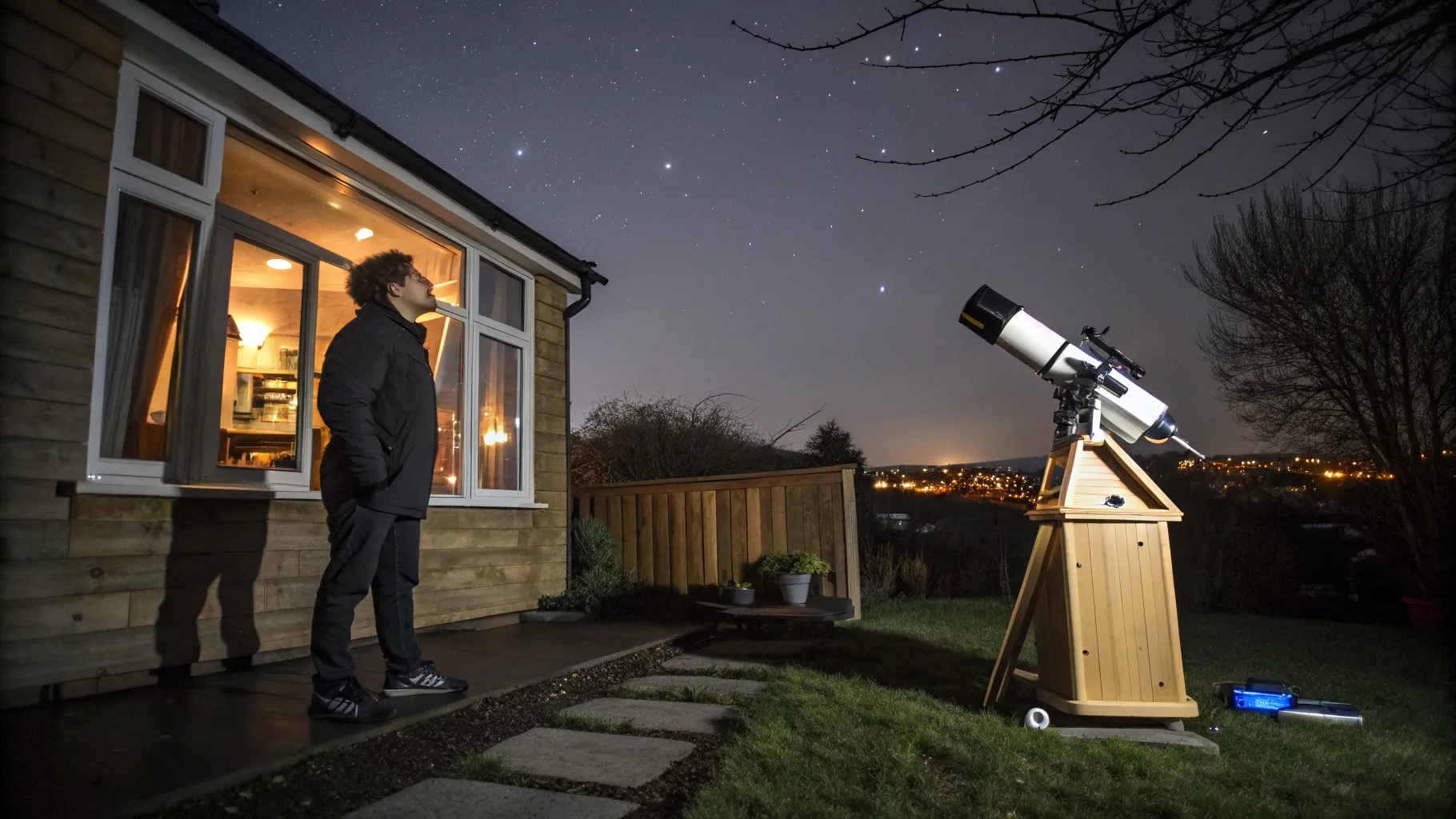
Buying a first telescope is where most new stargazers either fall in love with the hobby or give up in a week. The difference usually isn’t budget. It’s knowing which spec actually matters, what you can realistically expect to see from a UK back garden, and which traps to sidestep. This guide explains the jargon plainly: aperture versus magnification, the four main telescope types, mounts, smart scopes, and four genuinely good first telescopes you can buy in the UK today.
Aperture matters more than magnification
The single biggest beginner mistake is shopping by magnification. A telescope boxed with “525x” on the front is almost always a warning sign, not a feature.
The spec that counts is aperture: the diameter of the main lens or mirror, given in millimetres or inches. A bigger aperture gathers more light, which means more detail on planets and the ability to see fainter objects. A 130mm scope shows you dramatically more than a 60mm one, regardless of what magnification number is printed on either box (High Point Scientific).
A few practical thresholds:
- Don’t go under 60mm aperture if you want worthwhile views.
- A 100mm to 130mm (roughly 4 to 5 inch) scope is the sweet spot for a first telescope: enough to impress, not so big it’s a hassle to carry out.
- More aperture also means more bulk and weight, so the best size is the one you’ll actually set up on a cold Tuesday.
How magnification actually works
Magnification isn’t built into the telescope. It comes from the eyepiece you slot in, using a simple formula:
Magnification = telescope focal length / eyepiece focal length
So a 650mm scope with a 25mm eyepiece gives 650 / 25 = 26x. Swap to a 10mm eyepiece and you get 65x. Change the eyepiece, change the magnification.
There’s a ceiling, though, and it’s lower than the marketing suggests. The theoretical maximum useful magnification is roughly 50x per inch of aperture, which is about 2x the aperture in millimetres (Telescope School). For a 130mm scope that’s a theoretical ceiling near 260x.
In reality, UK skies rarely cooperate. Atmospheric turbulence (astronomers call it “seeing”) usually caps usable magnification closer to 1.2 to 1.3x the aperture in mm, around 30x per inch. Push past that and you get “empty magnification”: the image is bigger but blurrier and dimmer, not better. That is exactly why a “525x” claim on a small scope is meaningless.
| Aperture | Theoretical max (50x/inch) | Realistic UK cap (~30x/inch) |
|---|---|---|
| 70mm | ~140x | ~85x |
| 130mm | ~260x | ~155x |
| 203mm (8”) | ~400x | ~240x |
If you want to play with these numbers for a specific scope and eyepiece, our telescope magnification calculator does the maths for you.
The four telescope types, in plain terms
Beginners usually choose between four designs. Each has a clear trade-off.
| Type | How it works | Strengths | Trade-offs |
|---|---|---|---|
| Refractor | Lens at the front | Low maintenance, sharp on Moon and planets | Smaller apertures get expensive |
| Reflector / Dobsonian | Mirror at the back | Most aperture for your money, great on faint objects | Bulkier; mirror needs occasional alignment |
| Maksutov / SCT | Mirror plus correcting lens | Compact, long focal length, good on planets | Narrower field of view; pricier per inch |
A Dobsonian is simply a reflector telescope sitting on a simple wooden swivel base. It is a design many experienced observers point beginners toward, because it delivers a lot of aperture per pound and is intuitive to point (BBC Sky at Night). Maksutov and SCT (Schmidt-Cassegrain) designs fold a long focal length into a short tube, which makes them compact and strong on planets.
Mounts: do you need GoTo?
The mount is the part the telescope sits on, and beginners often overlook it. A wobbly mount ruins an otherwise good telescope, because everything shakes at the eyepiece.
There are two basic motions and one optional brain:
- Alt-azimuth (alt-az): moves up/down and left/right, like a camera tripod. Simple and intuitive. A Dobsonian base is an alt-az mount.
- Equatorial (EQ): tilted to align with Earth’s axis so you can track a star with one smooth motion. Better for long observing or photography, but it needs polar alignment and has a learning curve (Optical Mechanics).
- GoTo (computerised): motors plus a database that slews the scope to objects you select. Convenient, but it adds cost, needs power, and requires a setup and alignment routine each session.
For a first scope, you don’t need GoTo. A manual alt-az or Dobsonian mount teaches you the sky and never runs out of battery. If you want help finding targets without full GoTo cost, smartphone-guided “push-to” systems (covered below) split the difference nicely.
What you’ll really see (an honest reality check)
This is where a lot of new owners feel let down, usually because their expectations were set by Hubble photos on the telescope box. Here is the truth.
- The Moon is spectacular even in a small scope: craters, mountains, and shadow detail along the terminator.
- Saturn’s rings are visible in a small scope at around 25x; a 3-inch at about 50x cleanly separates the ring from the planet (Space.com).
- Jupiter shows its four large Galilean moons as bright dots and at least two dark cloud belts.
- Galaxies and nebulae appear as faint grey smudges, not glowing colour (BBC Sky at Night). Your eye sees them in monochrome because faint light is detected by the rod cells in your retina, which don’t register colour.
None of this means the views are disappointing. Seeing Saturn’s rings with your own eye, live, is a different experience from any photo. Just don’t expect the colours.
Light pollution and where to observe in the UK
You can absolutely use a telescope from a city. The Moon and planets are bright enough to punch through almost any sky glow, so a Bortle 7 to 9 town centre still gives you great lunar and planetary views (Space.com). What city skies steal is the faint stuff: the Milky Way and dim galaxies wash out.
The Bortle Dark-Sky Scale, created by John Bortle in 2001, rates skies from 1 (pristine) to 9 (inner city) (Sky & Telescope). To find your own number, check a UK light pollution map before you buy, so your expectations match your sky.
When you want darker skies, the UK has dozens of designated dark-sky sites. Standout dark areas include the Elan Valley in Mid Wales (a designated Dark Sky Park), the Yorkshire Dales, and the far north of England near the Scottish border.
Four first telescopes worth buying in the UK
These four are genuine beginner workhorses, each aimed at a slightly different buyer. Specs are confirmed from manufacturer and UK specialist retailer pages. We’ve kept prices out on purpose; check the current price at a UK retailer, as they shift.
Sky-Watcher Heritage-130P FlexTube, the classic first scope
A 130mm tabletop Dobsonian and the default recommendation for good reason: lots of aperture, no fiddly setup, and a collapsible FlexTube that makes it easy to store and carry.
| Spec | Value |
|---|---|
| Type | Tabletop Dobsonian (reflector) |
| Aperture | 130mm |
| Focal length | 650mm (f/5) |
| Mount | Wooden alt-azimuth (collapsible FlexTube) |
| Eyepieces | 25mm (26x) + 10mm (65x) |
| Weight | ~6.2kg |
Specs confirmed at First Light Optics. It sits on a table or sturdy box rather than a tripod, so factor in a surface to put it on.
Celestron StarSense Explorer LT 70AZ, easiest way to find things
A 70mm refractor with a clever trick: it docks your smartphone and uses the StarSense Explorer app to show you exactly where to nudge the scope to land on a target. It’s push-to guidance without full GoTo cost or power.
| Spec | Value |
|---|---|
| Type | Achromatic refractor |
| Aperture | 70mm |
| Focal length | 700mm (f/10) |
| Finding aid | StarSense Explorer app (iOS + Android) with phone dock |
| Eyepieces | 25mm + 10mm, plus Barlow and erect-image diagonal |
App and specs from Celestron UK; the app supports a broad range of iOS and Android devices (Celestron). Best for someone who finds star-hopping intimidating and wants the scope to point the way.
Sky-Watcher Classic 200P Dobsonian, the “buy once” upgrade
An 8-inch Dobsonian for the buyer who knows they’ll get hooked and wants a scope that grows with them rather than one they’ll outgrow in a year. The 203mm mirror pulls in far more light, so galaxies and nebulae go from faint smudges to detailed smudges, and planets sharpen up.
| Spec | Value |
|---|---|
| Type | Dobsonian (reflector) |
| Aperture | 203mm (8”) |
| Focal length | 1200mm (f/5.91) |
| Mount | Wooden alt-azimuth Dobsonian |
| Eyepieces | 25mm + 10mm (1.25”) |
Specs confirmed at First Light Optics. It’s bigger and heavier than the Heritage, so be honest about your storage and carrying.
ZWO Seestar S50, the modern “imaging tonight” option
A different kind of beginner scope. The Seestar S50 is an all-in-one smart telescope: a 50mm apochromatic triplet, a built-in camera, focuser, and motorised alt-az mount, all controlled from an app. You don’t look through it; you watch it stack images on your phone, which is how it beats light pollution and pulls colour out of nebulae that your eye never could.
| Spec | Value |
|---|---|
| Type | All-in-one smart telescope (apo triplet) |
| Aperture | 50mm |
| Focal length | 250mm (f/5) |
| Control | App-controlled, integrated camera and mount |
| Ships with | Tripod, case, solar filter |
Specs from First Light Optics and ZWO. Among smart telescopes it is one of the easiest to live with: open the app, pick an object, and focusing, tracking, and stacking happen automatically. If you want the widest field and longest exposures for deep-sky structure, rivals like the Dwarf 3 are worth weighing up too (World of Telescopes). Choose the S50 if you care more about capturing images simply than looking through an eyepiece. We compare the smart options in more depth on our Seestar S30, S50 and Dwarf 3 guide.
Quick comparison
| Model | Type | Aperture | Best for |
|---|---|---|---|
| Heritage-130P | Tabletop Dob | 130mm | Best all-round first scope |
| StarSense LT 70AZ | Refractor (push-to) | 70mm | Beginners who want help finding things |
| Classic 200P | Dobsonian | 203mm | “Buy once” upgraders |
| Seestar S50 | Smart telescope | 50mm | Imaging and city skies |
For more head-to-head picks across budgets, see our best telescopes for beginners in the UK, or if you’re buying for a child, the best telescopes for kids. To plan how wide a patch of sky each eyepiece shows, try our telescope eyepiece field of view calculator.
What to avoid
The fastest way to kill the hobby is a cheap supermarket or department-store telescope, the kind advertising “400x” magnification on the box. These typically pair tiny plastic optics with a wobbly mount and unusable high-magnification eyepieces. One long-running buyer’s guide warns that spending too little leaves you with optics barely worth the money (Cloudy Nights).
Warning signs to walk away from:
- Magnification (not aperture) headlined on the box, especially numbers like 400x or 525x.
- Plastic lenses or focusers.
- A flimsy mount that shakes when you touch it.
- No aperture stated at all.
Buy from a specialist astronomy retailer rather than a general store, and spend your money on aperture and a steady mount, not magnification claims.
Frequently asked questions
Aperture or magnification: which matters more? Aperture, by a wide margin. It sets how much light the scope gathers and therefore how much detail and how many faint objects you can see. Magnification just depends on which eyepiece you use, and pushing it too high (past roughly 1.2 to 1.3x the aperture in mm under typical UK skies) gives a bigger but blurrier, dimmer image. Ignore big magnification numbers on the box.
Can I see Saturn’s rings and Jupiter’s moons with a beginner telescope? Yes. Saturn’s rings are visible even in a small scope at around 25x, and a 3-inch at about 50x cleanly separates the ring from the planet. Jupiter shows its four large moons as bright dots and at least two dark cloud belts. The planets and the Moon are the easiest, most rewarding first targets.
Will galaxies and nebulae look like the colourful photos? No, and it’s worth knowing this before you buy. To the eye they appear as faint grey smudges rather than glowing colour, because faint light is picked up by the colour-blind rod cells in your retina. The colourful images you’ve seen are long-exposure photographs. Smart telescopes like the Seestar S50 are the exception, since they stack images and show colour on a screen.
Can I use a telescope in a city with light pollution? Yes. The Moon and planets are bright enough to look great from even an inner-city Bortle 7 to 9 sky. What light pollution washes out is the faint stuff: the Milky Way and dim galaxies. Check your sky on a UK light pollution map and, when you can, travel to a darker site for deep-sky objects.
Do I need a GoTo (computerised) mount? Not for a first scope. A manual alt-azimuth or Dobsonian mount is simpler, cheaper, never needs power, and teaches you the night sky. If you find locating objects daunting, a smartphone push-to system like the StarSense Explorer is a good middle ground that costs less than full GoTo.
Is a smart telescope better for a beginner than a traditional one? It depends on what you want. If you want to look through an eyepiece and see Saturn live, a traditional scope like the Heritage-130P is better value and more aperture. If you’d rather capture colourful deep-sky images from a phone, especially in a light-polluted city, a smart telescope like the Seestar S50 is the better fit. They answer different questions.
Clear skies forecast? Get a nudge.
Our weekly email flags the next good UK observing window and one easy target to find.
Join the listMore from Starvest
Keep reading
Best Telescopes for Beginners in the UK (Tested by Price Bracket)
The best beginner telescopes in the UK by budget, from sub-£150 tabletop scopes to app-guided and smart telescopes, with real 2026 prices.

What Can You See with Binoculars at Night? A Realistic Astronomy List
A realistic list of what you can see with binoculars in astronomy, from the Moon and Jupiter's moons to Andromeda, with tips for spotting each from the UK.
How to Set Up and Use Your First Telescope (Step by Step)
How to use a telescope as a beginner: assemble the mount, align the finder, focus, and find your first targets. A clear step-by-step UK guide.