Telescope Eyepieces Explained: the Numbers That Matter
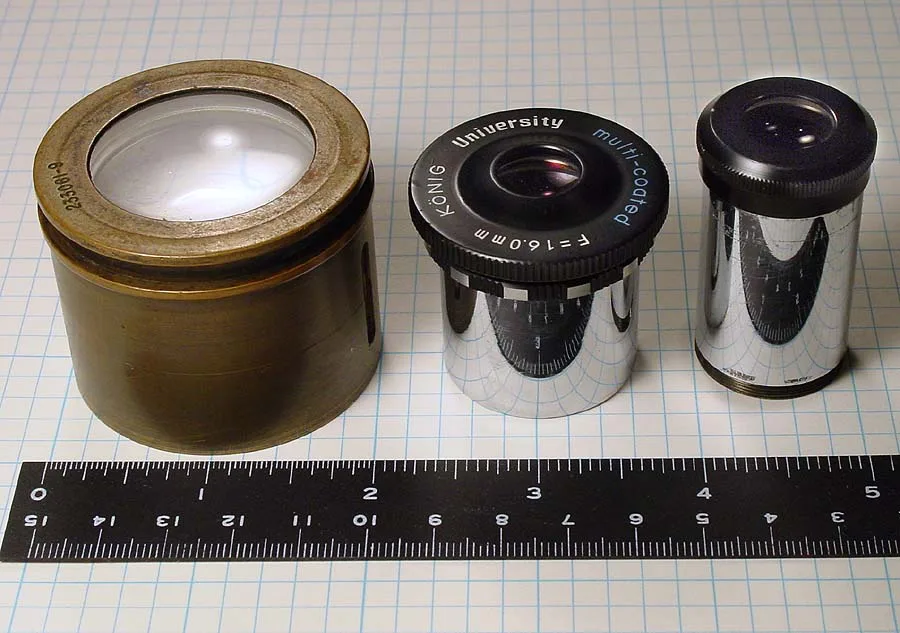
Most beginners buy a telescope, look through the two eyepieces in the box, and assume the disappointing view is the telescope’s fault. Usually it is not. Telescope eyepieces explained in plain terms come down to four numbers, and once you can read them off the barrel you can predict what a view will look like before you ever put the eyepiece in the focuser.
Those four numbers are focal length, apparent field of view, eye relief and barrel size. Everything else follows from them, including the two figures nobody prints on the eyepiece at all: your magnification, and the size of the light beam reaching your eye.
Focal length: the only number that sets magnification
The number in millimetres on the side of the eyepiece is its focal length. Divide your telescope’s focal length by it and you have your magnification.
Take a Sky-Watcher Heritage 130P, a common British first telescope at 130mm of aperture and 650mm of focal length. A 25mm eyepiece gives 650 ÷ 25 = 26x. A 10mm gives 65x. A 6mm gives 108x. Put the same three eyepieces in a 200mm Dobsonian with 1200mm of focal length and you get 48x, 120x and 200x instead.
That is why an eyepiece has no fixed magnification of its own, and why “which eyepiece gives 200x” is a question that cannot be answered without naming the telescope. If you are unsure what your telescope’s focal length is, it is printed on the tube or in the manual, usually alongside the f-number.
The counter-intuitive part: a smaller number means more magnification. A 4mm eyepiece is the high-power one, not the low-power one.
Apparent field of view: how big the window feels
Apparent field of view (AFOV) is how wide the circle of sky looks to your eye, measured in degrees. It is a property of the eyepiece design alone and does not change between telescopes.
A classic Plössl, the four-element design that turns up bundled with almost every beginner scope, sits at 50 to 52 degrees. Celestron’s Omni 12mm is a straightforward example at 50 degrees. Step up to a wide-field design and you get 68 degrees, as in the Baader Hyperion range, or 82 and even 100 degrees at the top of the market.
The practical difference is not sharpness, it is immersion. A 50-degree eyepiece feels like looking down a tube. A 68-degree eyepiece feels like looking out of a window, and on an undriven Dobsonian it also means an object drifts across the view for noticeably longer before you have to nudge the scope.
To turn AFOV into the actual patch of sky you are seeing, divide it by magnification:
- Heritage 130P with a 25mm 50-degree Plössl: 26x, so about 1.9 degrees of true field, nearly four full Moons across.
- Same telescope with a 10mm 60-degree eyepiece: 65x, so about 0.9 degrees.
That is the trade you make every time you reach for more power. Doubling the magnification halves the true field, which is why finding an object at high power is so much harder than finding it at low power.
Eye relief: the number that decides whether observing is comfortable
Eye relief is how far behind the lens your eye has to sit to see the whole field. It is the number beginners ignore and then quietly suffer for.
Simple designs tie eye relief to focal length, so it shrinks as the eyepiece gets shorter. That same Celestron Omni 12mm Plössl gives 8mm of eye relief. A 6mm Plössl gives less again, and you end up pressing your eyeball against the glass, fogging it with your breath, and losing the edge of the field every time you blink.
If you wear glasses at the eyepiece, and you should if you have astigmatism, you want around 15mm at minimum and 18 to 20mm to be genuinely comfortable. Better designs hold eye relief constant across the range. Celestron’s X-Cel LX six-element eyepieces keep 16mm at every focal length including the 2.3mm, and the Baader Hyperion 68-degree line holds 20mm across its 5, 8, 10, 13, 17, 21 and 24mm focal lengths.
This is also the strongest argument for a Barlow lens. A 2x Barlow doubles the magnification of whatever you put in it while keeping that eyepiece’s own eye relief. A 12mm Plössl behind a 2x Barlow behaves like a 6mm for power but still gives you the 12mm’s eye relief, which is a far more pleasant way to reach high magnification than buying a 6mm Plössl.
Barrel size: 1.25 inch, 2 inch, and the ceiling on wide views
Eyepieces come in two barrel diameters: 1.25 inch (31.7mm) and 2 inch (50.8mm). Your focuser dictates which you can use, though most 2-inch focusers accept 1.25-inch eyepieces through an adaptor.
Barrel size matters because it physically limits the widest true field possible. A 1.25-inch barrel caps the internal field stop at roughly 27mm, which means the widest view you can ever get is about 57.3 × 27 ÷ your telescope’s focal length, in degrees. On the 650mm Heritage 130P that is around 2.4 degrees no matter what eyepiece you buy. Going beyond a 32mm Plössl in a 1.25-inch barrel does not widen the view at all; it only enlarges the light beam, which brings us to the last number.
Exit pupil: the invisible number that sets the limits
Exit pupil is the width of the beam of light leaving the eyepiece, and it decides both the lowest and the highest useful magnification. Two ways to work it out, and they give the same answer:
- eyepiece focal length ÷ the telescope’s f-number, or
- telescope aperture ÷ magnification
A dark-adapted adult pupil opens to roughly 5 to 7mm, narrowing with age. If the exit pupil is wider than your pupil, the outer part of the beam simply hits your iris and that aperture is wasted. On an f/5.9 200mm Dobsonian, a 32mm eyepiece gives 37.5x and a 5.4mm exit pupil, which is about as low as it is worth going. On a Newtonian, a very large exit pupil also lets you see the shadow of the secondary mirror as a grey blob in the middle of the field.
At the other end, the widely used rule of thumb is that maximum useful magnification is about twice the aperture in millimetres: 260x for a 130mm scope, roughly 400x for a 200mm. In British skies you will almost never get there. Atmospheric seeing usually caps a night at 150x to 250x, and pushing past it gives you a bigger, dimmer, mushier planet rather than more detail. If your view is soft at high power, our notes on why a telescope image goes blurry and on collimation are the first places to look, not the eyepiece.
A sensible set to actually own
Three eyepieces cover almost everything, and there is no need to buy a case of thirteen:
- A low power one, giving an exit pupil of 4 to 5mm. This is your finder and your eyepiece for large open clusters, the Pleiades and the double cluster in Perseus.
- A medium power one, around 100x to 150x on most beginner scopes. This is where galaxies, globulars and the Moon’s terminator live, and it is the eyepiece you will use most nights.
- A high power one, around 180x to 220x, for planets and double stars on the handful of steady nights a year that reward it. A 2x Barlow behind the medium eyepiece can fill this slot instead.
Upgrading the eyepiece is usually the best value improvement you can make to a cheap telescope, with one exception: it will not fix a wobbly mount. For where eyepieces sit among the rest of the kit, see our guide to telescope accessories for beginners, and for how these numbers interact with the telescope itself, telescope aperture explained.
Frequently asked questions
What do the numbers on a telescope eyepiece mean? The millimetre figure is the eyepiece’s focal length, which sets magnification when you divide your telescope’s focal length by it. The degree figure is the apparent field of view, how wide the circle looks to your eye. The inch figure is the barrel diameter, either 1.25 or 2 inches.
Which eyepiece gives the highest magnification? The one with the smallest millimetre number. A 4mm eyepiece magnifies more than a 25mm in the same telescope. Highest is not best, though: past roughly twice your aperture in millimetres, and usually well before that in British seeing conditions, the image gets dimmer and softer rather than more detailed.
Are the eyepieces supplied with a telescope any good? The 25mm supplied with most scopes is usually a perfectly serviceable Plössl and worth keeping. The very short bundled eyepiece, often a 4mm or 6mm, is the weak link: cramped eye relief, a narrow field, and a magnification the telescope frequently cannot support. That is the one to replace first.
Do I need 2-inch eyepieces? Only if your focuser takes them and you want the widest possible low-power views. A 1.25-inch barrel limits the true field to about 57.3 × 27 divided by your telescope’s focal length. For high magnification a 2-inch barrel gains you nothing, so most people run 1.25-inch eyepieces at medium and high power and add a single 2-inch wide-field eyepiece if their focuser allows it.
How much eye relief do I need if I wear glasses? Aim for 18 to 20mm. Below about 15mm you will not see the whole field with glasses on. Long eye relief designs such as the Baader Hyperion at 20mm or Celestron’s X-Cel LX at 16mm hold that figure at every focal length, unlike Plössls, where eye relief shrinks with the eyepiece.
Is a Barlow lens worth buying instead of more eyepieces? For most people, yes. A good 2x Barlow doubles the magnification of every eyepiece you own while preserving that eyepiece’s eye relief, which effectively turns two eyepieces into four. A cheap one will soften the image, so buy a decent multi-element Barlow rather than the plastic-bodied kind.
Clear skies forecast? Get a nudge.
Our weekly email flags the next good UK observing window and one easy target to find.
Join the listMore from Starvest
Keep reading
Best Telescopes for Beginners in the UK (Tested by Price Bracket)
The best beginner telescopes in the UK by budget, from sub-£150 tabletop scopes to app-guided and smart telescopes, with real 2026 prices.

What Can You See with Binoculars at Night? A Realistic Astronomy List
A realistic list of what you can see with binoculars in astronomy, from the Moon and Jupiter's moons to Andromeda, with tips for spotting each from the UK.
How to Set Up and Use Your First Telescope (Step by Step)
How to use a telescope as a beginner: assemble the mount, align the finder, focus, and find your first targets. A clear step-by-step UK guide.