What Does a Barlow Lens Do? It Doubles Focal Length, Not Detail
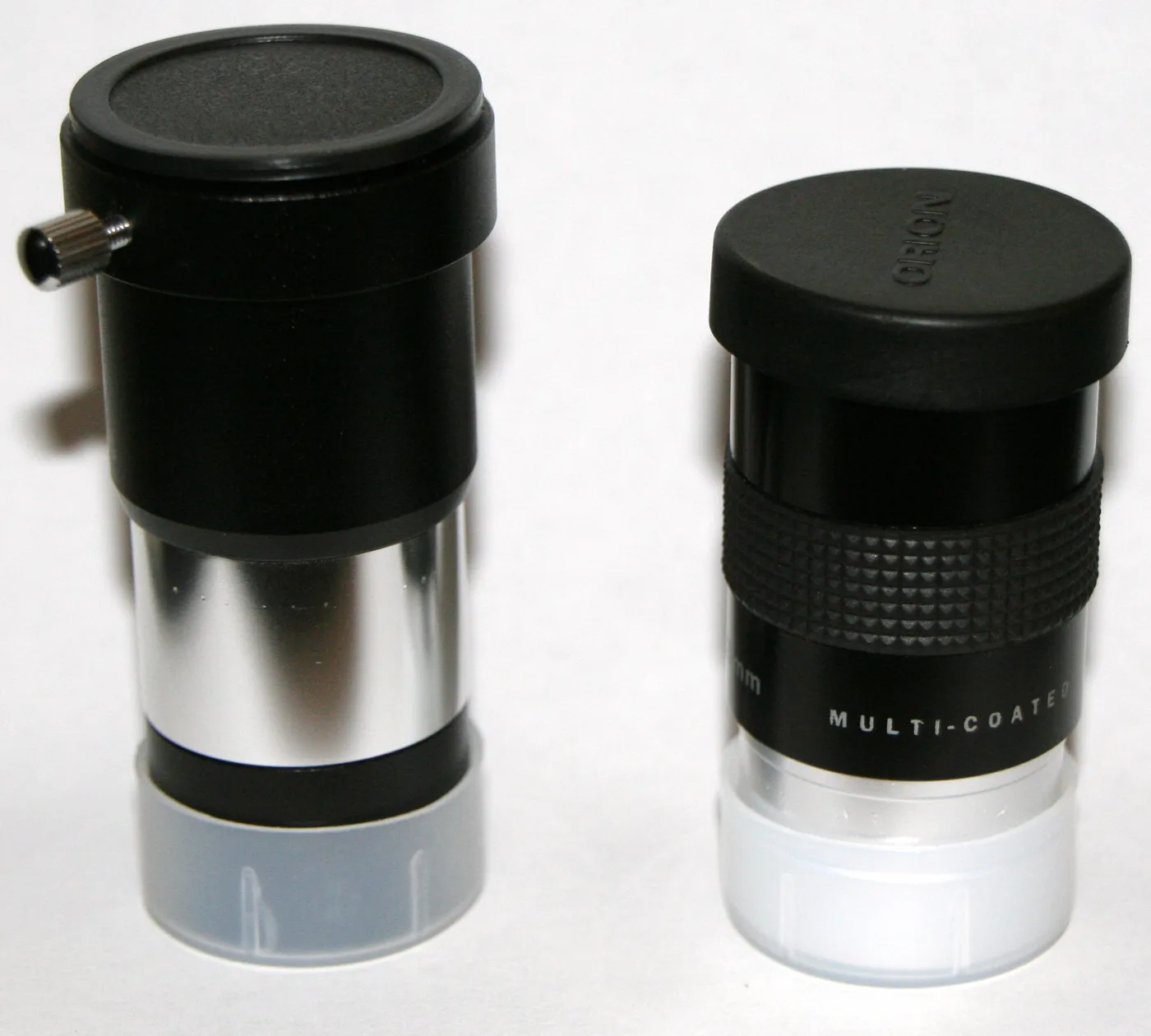
What a Barlow lens does is simple enough to state in one line: it sits between your telescope and your eyepiece, stretches the focal length of the telescope by a fixed factor, and so multiplies the magnification of every eyepiece you own. A 2x Barlow turns a 25mm eyepiece into the equivalent of a 12.5mm one. Two eyepieces plus a Barlow gives you four magnifications instead of two, which is why almost every beginner is told to buy one.
The part nobody puts in the first paragraph is that a Barlow adds magnification, not resolution. Past a certain point your telescope and the British atmosphere have already decided how much detail you are going to see, and a Barlow beyond that point makes a bigger, dimmer, softer version of the same view. Knowing where that ceiling sits is the whole decision.
How it works, in one diagram’s worth of words
The objective lens or mirror in your telescope brings light to a focus in a cone. A Barlow is a diverging lens placed in front of that focus. As Celestron puts it, the Barlow “spreads out the converging light cone from the telescope objective”, which makes the cone shallower and pushes the focal point further back. A shallower cone is the same thing as a longer focal length, and magnification is focal length divided by eyepiece focal length, so the magnification goes up.
Nothing about this collects more light or resolves finer detail. The aperture of your telescope sets both of those, and a Barlow does not change the aperture.
Work out what you actually get by dividing your telescope’s focal length by the eyepiece, then multiplying by the Barlow factor. Our telescope magnification calculator will do it for you if you would rather not.
The maths, with a worked example
Say you have a 150mm f/8 Dobsonian, so a focal length of 1200mm, and two eyepieces: 25mm and 10mm.
| Setup | Effective eyepiece | Magnification |
|---|---|---|
| 25mm alone | 25mm | 48x |
| 25mm + 2x Barlow | 12.5mm | 96x |
| 10mm alone | 10mm | 120x |
| 10mm + 2x Barlow | 5mm | 240x |
Four magnifications from two eyepieces. Notice what happened at the bottom, though. That 240x is above where this telescope can usefully go on a typical night, and that is the trap the tables in most Barlow articles walk you into.
The ceiling that decides whether a Barlow helps
There are two limits, and the lower one always wins.
The telescope’s own limit. The rule of thumb is roughly 2x the aperture in millimetres, or 50x per inch. On a 150mm scope that is about 300x. Celestron is more conservative and says “good performance is usually achieved at 30-40x per inch of telescope aperture”, which puts the same scope at 180x to 240x. Push past it and you get a dim, mushy image with no extra detail in it.
The atmosphere’s limit, which in Britain is the real one. Seeing, the blurring caused by turbulence in the air above you, usually bites long before the optics do. On an average British night you are held to something like 100x to 150x. Nights that support 250x happen, and they are worth staying up for, but they are not the nights you plan around. The British Astronomical Association’s guide to astronomical seeing explains the Antoniadi scale used to grade it, and the practical upshot is that at AIII or worse, more magnification only magnifies the wobble. Our own piece on astronomical seeing covers how to read a night before you set up.
So the useful test before buying is this: take your telescope’s focal length, divide it by your shortest eyepiece, and double it. If the answer is comfortably under 200x, a 2x Barlow will earn its place. If it is already over 250x, the Barlow will spend its life in the case.
When a Barlow is genuinely the right buy
When your shortest eyepiece is not short enough. A 150mm f/8 with only a 25mm eyepiece tops out at 48x, which is not enough for Jupiter’s belts or Saturn’s rings. A Barlow is the cheapest route to 96x.
When you want eye relief you can actually use. This is the argument that gets skipped. A 6mm eyepiece and a 12mm eyepiece behind a 2x Barlow give the same magnification, but the 12mm has far more eye relief, so your eye sits further back and the view is comfortable rather than a squint through a pinhole. Celestron makes the point that the extra eye relief particularly helps observers who wear glasses for astigmatism. For anyone whose eyes need correction at the eyepiece, this alone can justify a Barlow.
When you are building a set rather than buying one eyepiece at a time. Pick eyepieces that do not collide once Barlowed. A 32mm, 20mm and 12mm set with a 2x Barlow gives 32, 20, 16, 12, 10 and 6, a clean ladder. A 25mm and 12.5mm set with the same Barlow gives you 12.5 twice, which is a wasted slot.
When you are imaging planets. Planetary cameras have small sensors and want a long effective focal length, and a Barlow is the standard way to get there.
When a cheap Barlow ruins the view
The bundled Barlow that arrives in the accessory tray of a budget telescope is usually the worst optic in the box, and it is responsible for a great many people deciding their telescope is rubbish.
What goes wrong is not mysterious. A simple two-element achromatic Barlow adds chromatic aberration, so bright targets pick up a colour fringe. Cheap ones also scatter light, which drops contrast on exactly the low-contrast planetary detail you bought the Barlow to see. And a plastic-bodied, loosely machined barrel can sit slightly off-axis, which puts a soft edge on everything.
Better Barlows use three or more elements and are corrected properly. Tele Vue’s Powermates go further again, using a four-element design that pairs a negative group with a positive group specifically to reduce vignetting and aberrations, which is why Tele Vue does not call them Barlows at all.
The blunt rule: a good 2x Barlow costs real money, and a Barlow that costs less than your cheapest eyepiece is unlikely to be worth threading into the light path. If the choice is between a poor Barlow and one decent short eyepiece, buy the eyepiece.
The amplification factor is not fixed
Here is the detail that surprises people who have owned a Barlow for years. The factor printed on the barrel is only true at the spacing the maker designed for.
Move the eyepiece further from the Barlow’s lens elements and the factor rises. Celestron’s own explanation is that the magnification increases by one factor for every additional focal length of separation: a 2x Barlow becomes 3x at twice the distance and 4x at three times. In practice this is what happens when you put a Barlow in front of a star diagonal rather than between the diagonal and the eyepiece, and people are often puzzled that their 2x behaves like a 3x.
It works in the other direction too. Many Barlows have a lens cell that unscrews from the body, and that cell has a standard 1.25 inch filter thread. Screw it straight onto the bottom of an eyepiece and the spacing shrinks, giving roughly 1.5x instead of 2x. A 30mm eyepiece then behaves like a 20mm with the cell attached, or a 15mm with the whole Barlow in the train. That is one Barlow giving you two extra rungs on the ladder for nothing, and it is the single most underused feature on the accessory.
Check whether yours comes apart before you buy a third eyepiece.
Barlow, or just buy the eyepiece?
Buy the Barlow if you own two or three eyepieces already, if the doubled magnifications land inside your seeing-limited ceiling, and if eye relief at high power is a problem for you.
Buy the eyepiece instead if you have exactly one eyepiece, because a Barlow multiplies a set and you do not have a set yet. Buy the eyepiece too if your telescope is short focal length and fast, where the numbers are already in a sensible place and the extra glass buys you little. Our guide to telescope eyepieces covers how to pick the first two or three, and the accessories worth buying first puts a Barlow in order against everything else competing for the money.
Frequently asked questions
What does a Barlow lens do to magnification? It multiplies it by the factor printed on the barrel. A 2x Barlow doubles the magnification of every eyepiece you own, so a 25mm eyepiece behaves like a 12.5mm one. It does this by lengthening the telescope’s effective focal length, not by changing anything about the eyepiece.
Does a Barlow lens reduce image quality? A good one costs you very little. A cheap two-element one costs you contrast and adds colour fringing on bright objects, which is most noticeable on the Moon, Jupiter and Venus. The bigger quality loss usually comes from the magnification itself, because pushing past your telescope’s useful limit dims and softens the image whatever glass you use.
Is a 2x or a 3x Barlow better for a beginner? A 2x, almost always. A 3x on a typical beginner telescope lands you above the atmosphere’s limit on most British nights, so it produces a view you cannot use. Start at 2x, see how often you actually reach the top of your range, and only then consider more.
Can you use a Barlow with any eyepiece? Yes, provided the barrel sizes match, normally 1.25 inch to 1.25 inch or 2 inch to 2 inch. Some telescopes will not reach focus with a Barlow in a diagonal, and heavy 2 inch eyepieces stacked on a Barlow can strain a light focuser, so check both before committing.
Does a Barlow lens make the image dimmer? Yes. Spreading the same light over a larger image means fewer photons per unit area, so the view darkens as magnification rises. On the Moon and the bright planets this rarely matters. On faint galaxies and nebulae it does, which is why a Barlow is a planetary accessory rather than a deep-sky one.
Why does my 2x Barlow seem to give more than 2x? Because the amplification depends on how far the eyepiece sits from the Barlow elements. Placing the Barlow before a star diagonal adds a lot of spacing and pushes a nominal 2x towards 3x. Put the Barlow directly under the eyepiece, after the diagonal, to get the rated figure.
Clear skies forecast? Get a nudge.
Our weekly email flags the next good UK observing window and one easy target to find.
Join the listMore from Starvest
Keep reading
Best Telescopes for Beginners in the UK (Tested by Price Bracket)
The best beginner telescopes in the UK by budget, from sub-£150 tabletop scopes to app-guided and smart telescopes, with real 2026 prices.

What Can You See with Binoculars at Night? A Realistic Astronomy List
A realistic list of what you can see with binoculars in astronomy, from the Moon and Jupiter's moons to Andromeda, with tips for spotting each from the UK.

How to Set Up and Use Your First Telescope (Step by Step)
How to use a telescope as a beginner: assemble the mount, align the finder, focus, and find your first targets. A clear step-by-step UK guide.