Full Moon November 2026 UK: Supermoon 24 Nov, 2.53pm
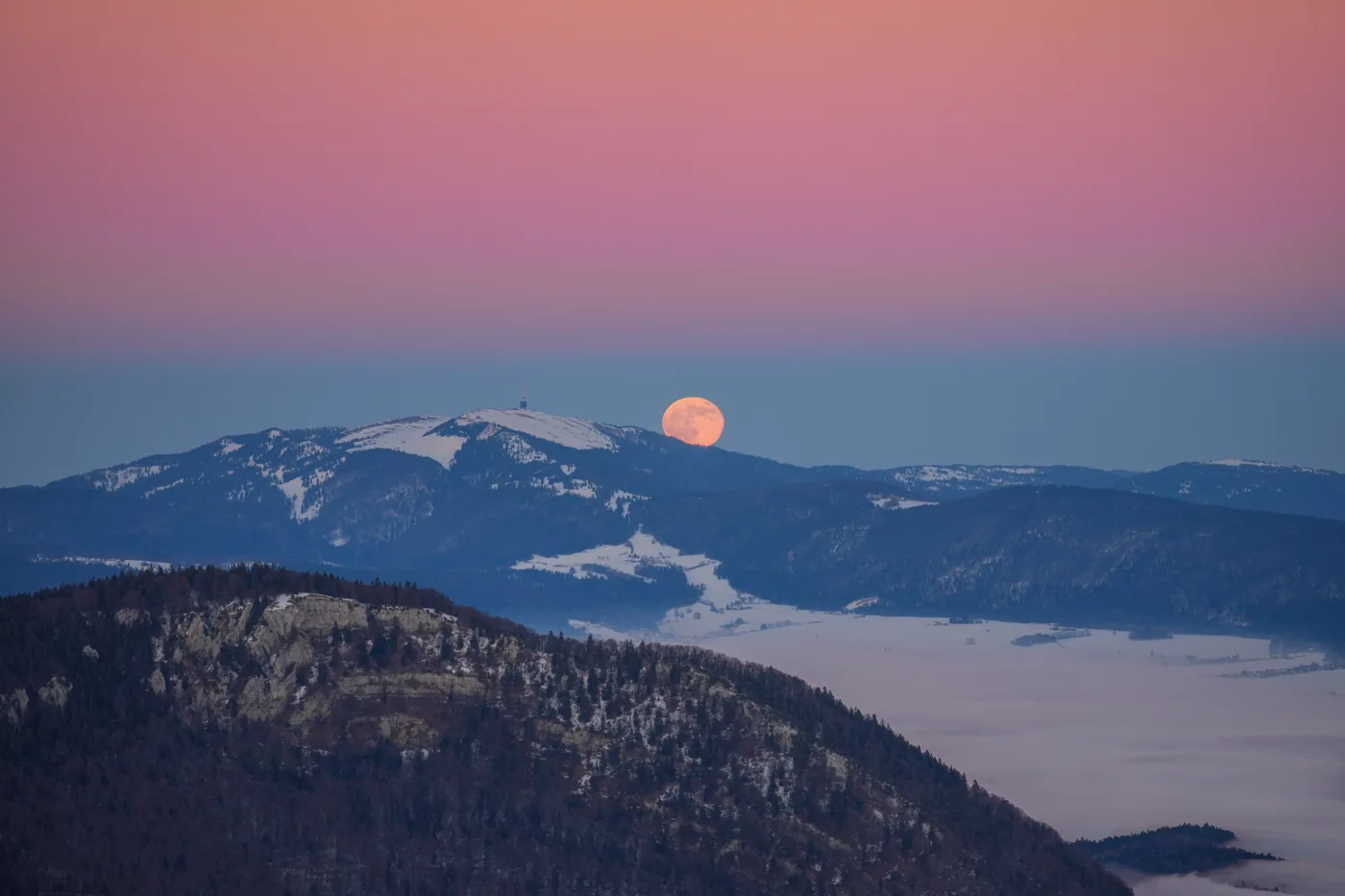
The full Moon in November 2026 peaks for the UK at 2.53pm GMT on Tuesday 24 November. It is the Beaver Moon, and this year it is also a supermoon, the first of two in a row before Christmas. The Moon is below the horizon at the exact moment of full, so the nights to go out are Monday 23 and Tuesday 24 November, with Wednesday 25 nearly as good. On all three, the Moon rises in the north-east around sunset and is visible all night.
Here are the moonrise times for six UK cities, why it counts as a supermoon, how much bigger it really looks, and how to catch it low on the horizon where it looks best.
Moonrise and moonset across the UK
Times are GMT (the clocks went back on 25 October), for the Moon’s upper edge on a flat horizon. Hills and buildings to the east will delay what you see by several minutes.
| City | Mon 23 Nov rise | Tue 24 Nov rise | Wed 25 Nov rise | Sunset 24 Nov |
|---|---|---|---|---|
| London | 2.44pm | 3.18pm | 4.07pm | 4.01pm |
| Birmingham | 2.47pm | 3.19pm | 4.07pm | 4.03pm |
| Cardiff | 2.57pm | 3.30pm | 4.20pm | 4.13pm |
| Manchester | 2.43pm | 3.13pm | 4.01pm | 4.00pm |
| Edinburgh | 2.32pm | 2.58pm | 3.41pm | 3.52pm |
| Belfast | 2.52pm | 3.20pm | 4.06pm | 4.10pm |
The Moon sets the following morning. After the peak night it goes down at 9.09am in London on Wednesday 25 November, 9.34am in Manchester, 10.01am in Edinburgh and 9.59am in Belfast, so early risers get a full Moon sinking in the west in daylight.
These are our own calculations, cross-checked against timeanddate’s London table, which agrees to within a minute. The time of full Moon, 14:53 GMT on 24 November, matches the published phase tables.
Which night is best?
Tuesday 24 November is the closest to the peak: the Moon rises about 40 minutes before sunset in London, and is 100% lit to the eye all night. It climbs to its highest, about 64 degrees above the southern horizon from London, just after midnight. That is very high: winter full Moons ride far higher than summer ones because the full Moon sits opposite the Sun in the sky.
Wednesday 25 November is the best for a photograph of the Moon rising. In London it clears the horizon at 4.07pm, a few minutes after sunset, so it comes up into a darkening blue sky rather than daylight. The disc is still more than 99% lit.
Monday 23 November gives a rise well before sunset, so the Moon is already up and pale in daylight by mid-afternoon. Fine for a look, less dramatic.
If one night is cloudy, try the next. The Moon looks full to the eye for about a day either side of the peak.
Why it is a supermoon, and how big it really looks
A supermoon is a full Moon that falls close to perigee, the nearest point in the Moon’s slightly oval orbit; the Royal Observatory Greenwich explains the term and where it came from. On 24 November 2026 the Moon is about 360,765 km away at the moment of full, and it reaches perigee a day later, at about 359,350 km on 25 November. Sky at Night Magazine lists it as one of three supermoons in 2026, with 3 January and 24 December.
The difference is real but small. By our calculation:
- Against the October full Moon (26 October, about 368,900 km away), November’s appears about 2% wider. Nobody can see that by eye.
- Against the smallest full Moon of 2026, on 31 May at about 406,100 km, it appears about 13% wider and about 27% brighter. That is visible in two photographs taken with the same lens and set side by side, not in the sky months apart.
So do not expect the Moon to look huge overhead. When it does look enormous, near the horizon at moonrise, that is the Moon illusion: a trick of perception that happens with every full Moon, supermoon or not. The 24 December full Moon is closer still, at about 356,700 km, which makes it the biggest full Moon of the year.
Where it sits in the sky
The November full Moon sits in Taurus, about 6 or 7 degrees from the Pleiades star cluster and about 10 degrees from Aldebaran, the orange eye of the Bull, at 10pm. Its glare drowns out the fainter stars, so the Pleiades will look thin, but a pair of binoculars shows the cluster clearly. Jupiter, in Leo, is the bright point rising in the east-north-east at about 10.30pm.
Why it is called the Beaver Moon
The name is North American, popularised by the Farmers’ Almanac. It is usually linked to the time of year when beavers were trapped for their winter fur before the swamps froze, or to beavers finishing their lodges and dams for the winter. Some older lists call November’s full Moon the Frost Moon. None of the names are astronomical; they are folklore labels for the month.
Photographing it low on the horizon
The best supermoon pictures are taken at moonrise, with the Moon next to something on the skyline: a church tower, a hill, a pier. The foreground gives the Moon scale, and the sky is still bright enough to show detail in both.
- Pick the night. Wednesday 25 November is the best rise into a blue sky in most of England and Wales; Tuesday 24 works in Scotland and Northern Ireland, where moonrise and sunset are closer together.
- Find the direction. The Moon rises north of east: about 54 degrees on a compass on 23 November, 46 degrees on the 24th and 42 degrees on the 25th, from London. Stand well back from your foreground object so the Moon looks large next to it.
- Zoom, do not crop. Use the longest lens or the 3x to 5x telephoto camera on your phone. Our guide to photographing the Moon with a phone covers exposure lock and why you should tap on the Moon rather than the sky.
- Be quick. The first 20 minutes after moonrise are when the Moon looks biggest and most orange. After that it shrinks back into a small white disc.
For close-up views through a telescope, a full Moon is actually the worst phase: the Sun is shining straight down, so there are no shadows to show craters. See how to observe the Moon for the better nights, and whether a moon filter is worth it for cutting the glare.
Frequently asked questions
What time is the full Moon in November 2026 in the UK? The Moon is exactly full at 2.53pm GMT on Tuesday 24 November 2026. It is below the UK horizon at that moment, so look after moonrise that afternoon, about 3.18pm in London, or on the evenings either side.
Is the November 2026 full Moon a supermoon? Yes. It is about 360,765 km away at full, close to its nearest point of the month, which it reaches on 25 November. Sky at Night Magazine counts it among the three supermoons of 2026, alongside 3 January and 24 December.
Will the supermoon look bigger? Only slightly. It is about 2% wider than the October full Moon and about 13% wider than the smallest full Moon of 2026, in May. The big orange Moon you see at moonrise is the Moon illusion, which happens every month.
Which direction does the full Moon rise in November? North of east, between about 42 and 54 degrees on a compass from London depending on the night, and it sets north of west the next morning. It is due south and at its highest just after midnight.
What is the next full Moon after November 2026? The Cold Moon on Thursday 24 December 2026, which is also a supermoon and the closest full Moon of the year.
Why is it called the Beaver Moon? It is a North American folk name linked to beavers preparing for winter and to the trapping season before the swamps froze. It is a seasonal label, not an astronomical term.
Clear skies forecast? Get a nudge.
Our weekly email flags the next good UK observing window and one easy target to find.
Join the listMore from Starvest
Keep reading
Best Telescopes for Beginners in the UK (Tested by Price Bracket)
The best beginner telescopes in the UK by budget, from sub-£150 tabletop scopes to app-guided and smart telescopes, with real 2026 prices.
What Can You See with Binoculars at Night? A Realistic Astronomy List
A realistic list of what you can see with binoculars in astronomy, from the Moon and Jupiter's moons to Andromeda, with tips for spotting each from the UK.
How to Set Up and Use Your First Telescope (Step by Step)
How to use a telescope as a beginner: assemble the mount, align the finder, focus, and find your first targets. A clear step-by-step UK guide.