How to Read a Star Chart and Find the Night Sky
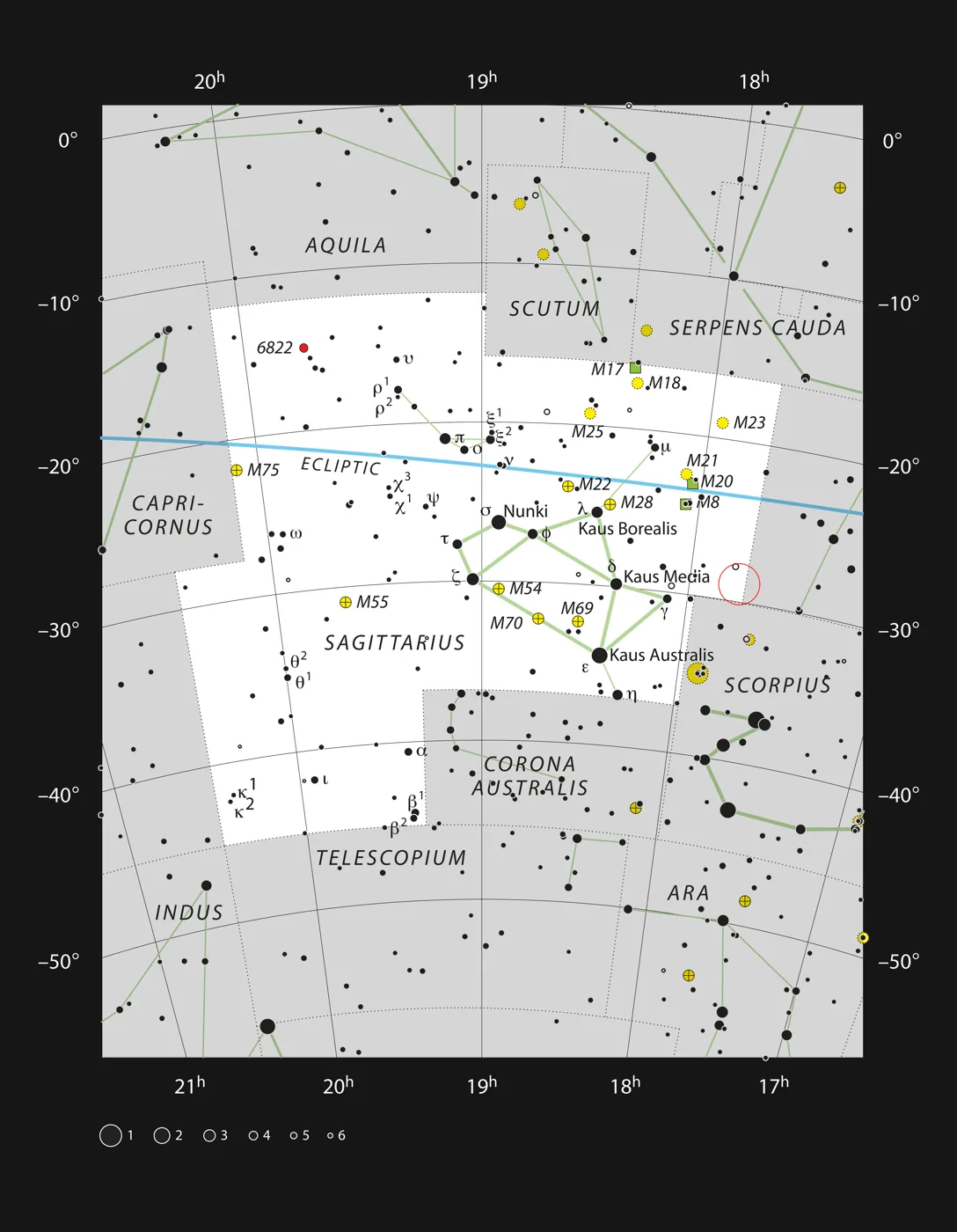
Learning how to read a star chart is the single skill that turns a confusing sky full of dots into a map you can navigate. The chart is a flat picture of a curved sky, so the trick is knowing which way up to hold it, what the symbols mean, and how to jump from a bright star you recognise to the fainter object you are hunting. Once those three things click, a chart becomes as easy to use as a road map.
This guide is written for stargazing in Britain, where the sky sits fairly high in the north and the same handful of anchor patterns are up almost every clear night. You can use a printed chart, a rotating planisphere, or the sky map on your phone, and the reading skills are the same for all three.
Orient the chart before you read anything
A star chart only makes sense once it matches the direction you are facing. Face south, which is where most objects climb highest, and hold the chart up in front of you rather than flat on a table. The key quirk that trips up beginners: east and west are swapped compared with a normal map. On a chart of the southern sky, north is at the top, south at the bottom, east on the left and west on the right. That reversal is correct, because you are looking up at the sky rather than down at the ground.
If you use a planisphere, a rotating star wheel, set the dial so the current date lines up with the current time. The oval window then shows exactly which stars are above the horizon. Planispheres are sold for specific latitude bands, so buy one made for the UK (around 51 degrees north) or the pattern in the window will not match your sky.
Read the symbols: magnitude, lines and coordinates
Every chart uses a small visual code:
- Star brightness (magnitude): stars are printed as dots, and a bigger dot means a brighter star. The number scale runs backwards, so a lower number is brighter. Sirius sits at about magnitude minus 1.4, while the faintest stars a keen eye can see from a truly dark UK site are around magnitude 6. Most charts print a small key showing which dot size equals which magnitude.
- Constellation lines: the solid lines joining dots are the stick figures of each constellation. They are a human invention to aid memory, not anything physical, but they are the fastest way to lock a pattern into your head.
- Coordinates: the faint grid is the sky’s version of latitude and longitude. Right ascension runs like longitude and declination like latitude. You can ignore the grid at first, but it is how a chart tells you precisely where a fainter object sits relative to the bright stars around it.
Deep-sky objects such as galaxies and star clusters get their own symbols, usually a small oval or a dotted circle, often labelled with a Messier number like M31 for the Andromeda Galaxy.
Star hop from a bright anchor to your target
Reading a chart is really about linking what is printed to what is overhead. The reliable method is star hopping. Start from a pattern you already know, then follow the chart from star to star until you reach the target.
The best UK anchor is the Plough, the saucepan shape that is up all year in the north. The two stars at the end of its bowl, the pointers, line up straight to Polaris, the North Star, which marks true north and barely moves. From the Plough you can also follow the curve of the handle to reach the bright orange star Arcturus, a trick summarised as “arc to Arcturus”. Practise a couple of these hops on the chart indoors, then repeat them outside, and the sky quickly stops feeling random.
Go outside with a red light rather than a white torch. Red light lets you read the chart without wrecking the night vision that takes your eyes around 20 minutes to build. A phone screen on full brightness undoes that instantly, so switch any stargazing app to its night or red mode.
When you are ready to point a telescope at what you have found, our guide to finding objects with a telescope covers star hopping at the eyepiece, and the how to start stargazing guide walks through your first evening under the stars. For an authoritative, printable monthly chart, the Royal Observatory Greenwich night sky guide is a good free reference.
Frequently asked questions
How do you read a star chart for beginners? Face south, hold the chart up in front of you, and remember east and west are reversed compared with a ground map. Match a bright pattern you recognise, such as the Plough, to the chart, then trace the printed lines to find fainter stars nearby.
What do the dot sizes on a star chart mean? Dot size shows brightness, or magnitude. A bigger dot is a brighter star. The magnitude scale runs backwards, so lower numbers are brighter, and each chart usually prints a key matching dot sizes to magnitude values.
Which way up do I hold a star chart? Hold it above eye level and turn it so the direction you are facing is at the bottom edge. If you are facing south, keep north at the top; the chart then matches the sky, with east on your left and west on your right.
Is a planisphere better than a star chart app? A planisphere never needs charging, will not ruin your night vision, and teaches you the sky faster because you set it by hand. An app is quicker for identifying one object and can point you in real time. Many stargazers use a planisphere to learn and an app to confirm.
Why are east and west swapped on a star chart? Because you are looking up at the sky, not down at a map of the ground. When you raise the chart overhead to match the stars, the east and west sides fall into their correct places.
How long before I can read the sky without a chart? Most people can name the main anchor constellations after a few clear evenings of practice. Learn the Plough, Polaris and one seasonal pattern first, then add a new constellation each session and the chart becomes a backup rather than a necessity.
Clear skies forecast? Get a nudge.
Our weekly email flags the next good UK observing window and one easy target to find.
Join the listMore from Starvest
Keep reading
Best Telescopes for Beginners in the UK (Tested by Price Bracket)
The best beginner telescopes in the UK by budget, from sub-£150 tabletop scopes to app-guided and smart telescopes, with real 2026 prices.

What Can You See with Binoculars at Night? A Realistic Astronomy List
A realistic list of what you can see with binoculars in astronomy, from the Moon and Jupiter's moons to Andromeda, with tips for spotting each from the UK.

How to Set Up and Use Your First Telescope (Step by Step)
How to use a telescope as a beginner: assemble the mount, align the finder, focus, and find your first targets. A clear step-by-step UK guide.