Roman Space Telescope Launched, First Images in 2027
A busy fortnight at both ends of the hobby. NASA got its next survey telescope off the pad, DwarfLab put the largest aperture yet into the sub-£1,500 smart telescope bracket, and the September sky has a Harvest Moon and a planet at opposition worth a diary entry. Here is what happened and what it changes for anyone observing from the UK.
NASA’s Roman Space Telescope launched on 30 August
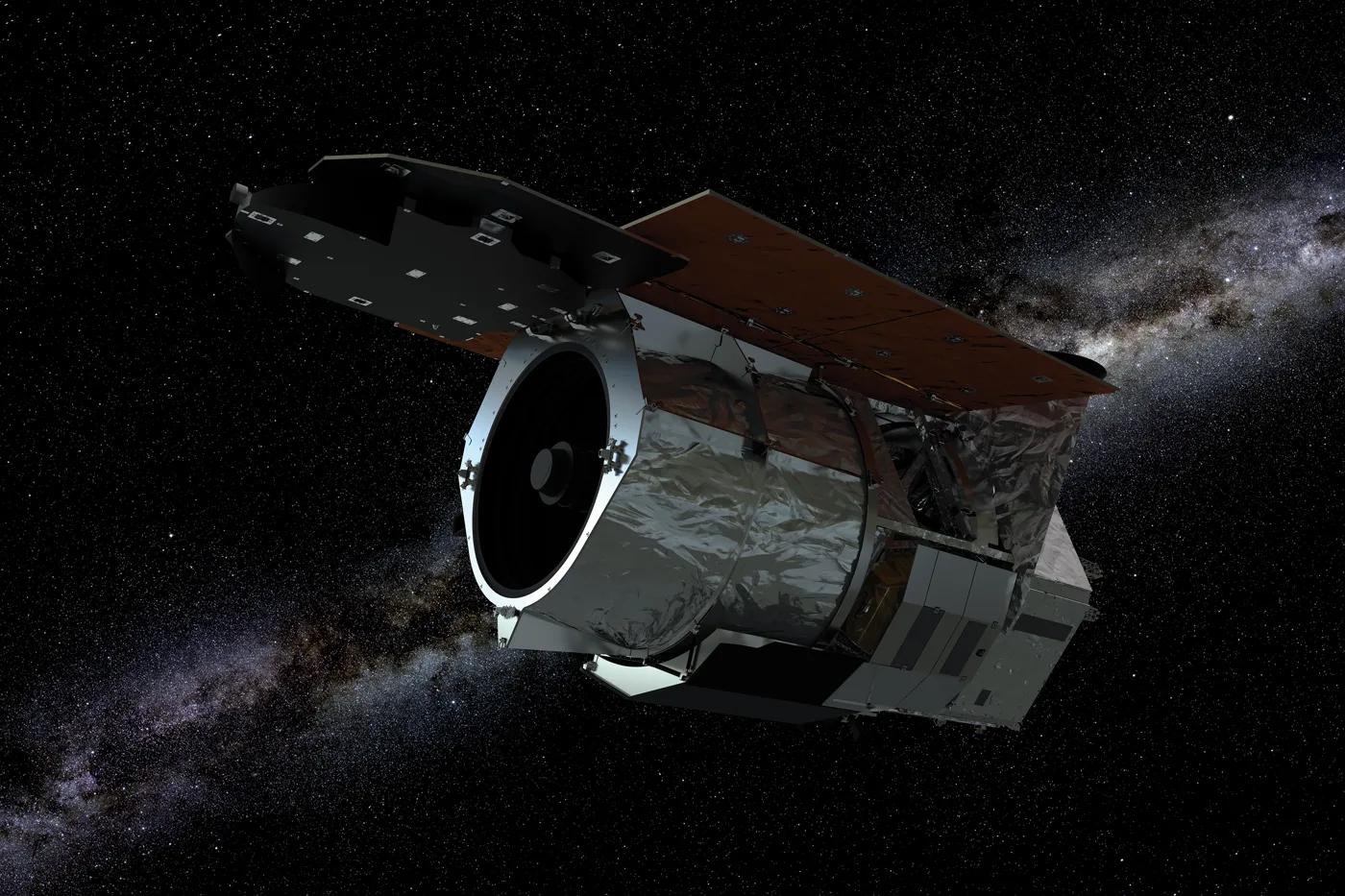
The Nancy Grace Roman Space Telescope lifted off at 7.26am EDT on Sunday 30 August 2026, on a SpaceX Falcon Heavy from Launch Complex 39A at the Kennedy Space Center. It is now on a three-month cruise to the second Sun-Earth Lagrange point, about a million miles out, the same neighbourhood as the James Webb Space Telescope.
The specification is the interesting part. Roman carries a 300-megapixel infrared camera built from 18 4K detectors, and NASA’s claim is that it surveys the sky roughly 1,000 times faster than Hubble. It will return about 1.4 terabytes a day, the highest data rate of any NASA astrophysics mission. The science targets are dark matter, dark energy and exoplanets, and the observing model is wide-field survey rather than the pointed, one-target-at-a-time work Hubble and Webb are known for.
“Roman is exactly the kind of success story we want to see across NASA. Delivered ahead of schedule and on budget, this mission reflects more than a decade of dedication from the NASA workforce and our industry partners,” said NASA Administrator Jared Isaacman.
For amateurs the honest answer is that nothing lands in your eyepiece from this. First images are expected in early 2027, and what follows is a survey archive rather than a stream of pretty pictures. What it will change, slowly, is the target list: wide infrared surveys find things, and the bright end of what they find eventually reaches the sort of objects covered in the best things to see with a telescope. The launch release is at NASA.
DwarfLab’s Draco puts 90mm into the smart telescope bracket
DwarfLab launched the Draco this month, and it moves the goalposts for smart telescopes at this price. The optics are 90mm at 340mm focal length, f/3.8, which is both the largest aperture and the fastest focal ratio in the affordable end of the category. It feeds a 1/1.3-inch 50-megapixel telephoto sensor, with a second 50-megapixel ultra-wide camera alongside it for wide Milky Way frames.
The hardware list is what separates it from the Seestar and Dwarf 3 generation: a built-in guide scope applying live guiding corrections, single exposures up to 300 seconds, a rotating sensor that derotates the field in real time, and sensor cooling. The standard version ships with astro, dark-frame and solar filters plus a dual narrowband filter, and the SHO version adds a second narrowband filter so you can shoot nebulae in the Hubble palette. DwarfLab’s UK store lists it from £1,199, with the SHO edition at £1,349. Deliveries are scheduled from November.
Two cautions before anyone reaches for a card. First, this is a pre-order on a product nobody outside the company has used in the field yet, and smart telescopes live or die on their app rather than their optics. Second, the price puts it against a proper 8-inch Dobsonian plus a decent camera, which is a completely different night out: the Draco is for imaging from a light-polluted garden, not for looking at things. If you are choosing between the current generation, Seestar S30 vs S50 vs Dwarf 3 compares what is actually shipping, and how to buy a telescope covers why aperture beats the number on the box. The launch details are at Skies & Scopes.
September’s sky: Neptune at opposition and the Harvest Moon, both on the 26th
The two dates worth writing down fall together. Neptune reaches opposition on 26 September, meaning it is at its closest and brightest for the year, and the same night brings the Harvest Moon, the full Moon nearest the autumn equinox. The equinox itself is at 01:04 BST on 23 September.
Those two events fighting for the same night is an annoyance rather than a coincidence, and it is worth being clear about what you can realistically do. Neptune at opposition is still a faint blue-green disc under 3 arcseconds across, and a full Moon in the sky is the worst possible background for it. If Neptune is the target, work the nights either side of the 26th, and go after it when the Moon is down. If the Moon is the target, the Harvest Moon rises close to sunset for several evenings running, which is what gives it its reputation, and it needs no equipment at all.
There is more in the month worth a look. On 27 September at around 05:00 BST the full Moon sits 6 degrees northwest of Saturn, and Saturn itself reaches opposition on 4 October, so late September is the run-up to the best planetary viewing of the autumn. On 30 September the 79 per cent waning gibbous Moon sits 1.4 degrees west of the Pleiades after moonrise at 20:30 BST. Our month-by-month guide is at what to see in the night sky tonight, and Saturn specifically is covered in how to see Jupiter and Saturn. The full month is listed at BBC Sky at Night Magazine.
Clear skies forecast? Get a nudge.
Our weekly email flags the next good UK observing window and one easy target to find.
Join the listMore from Starvest
Keep reading
Best Telescopes for Beginners in the UK (Tested by Price Bracket)
The best beginner telescopes in the UK by budget, from sub-£150 tabletop scopes to app-guided and smart telescopes, with real 2026 prices.
What Can You See with Binoculars at Night? A Realistic Astronomy List
A realistic list of what you can see with binoculars in astronomy, from the Moon and Jupiter's moons to Andromeda, with tips for spotting each from the UK.
How to Set Up and Use Your First Telescope (Step by Step)
How to use a telescope as a beginner: assemble the mount, align the finder, focus, and find your first targets. A clear step-by-step UK guide.