Noctilucent Clouds UK: Late May to Early August, Look North
Noctilucent clouds in the UK are a summer-only sight: thin, electric blue-white ripples low in the northern sky, glowing an hour or more after sunset while every ordinary cloud has gone dark. The season runs from late May to early August, with the best chances around the first week of July, and they can be seen from anywhere in Britain on the right night.
They are the highest clouds on Earth, about 82 km up according to the NERC MST Radar Facility at Aberystwyth, roughly 70 km higher than almost every other cloud you will see. That height is the whole trick: long after the Sun has set for you, it is still shining on them.
When is noctilucent cloud season in the UK?
| Dates | |
|---|---|
| Season | Late May to early or mid August |
| First UK sightings | Usually the last week of May |
| Peak | Around the first week of July |
| Best hours | 1 to 2 hours after sunset, and 1 to 2 hours before sunrise |
| Last sightings | Late July or the first days of August |
The clouds are ice crystals that only form where the upper atmosphere drops below about minus 125°C. NERC says that happens almost daily between late May and early August above 65°N, in the Arctic. The further south you go, the less often the cold layer reaches overhead and the shorter the season, which is why Britain sees noctilucent clouds on some nights rather than every night.
The British Astronomical Association (BAA) gives the mid-latitude window as about late May to mid August with a peak in early July, and says a single place in Britain might expect to see them three or four times a year. Most of that limit is our weather, not the clouds.
How far south can you see them?
NERC puts it plainly: noctilucent clouds can potentially be seen from anywhere in the British Isles. It is rare for the clouds themselves to sit further south than 53°N (about the latitude of Manchester or Lincoln) and exceptional below 50°N. But because they are 82 km up, you can see them from up to 7 degrees of latitude further south, roughly 800 km away, low over your northern horizon.
So from Scotland or northern England they can climb high into the sky, while from London or Cornwall a display is usually a band hugging the north, often only 5 to 15 degrees up. A clear, low northern horizon matters more in the south than anywhere else. Our dark sky sites and Scotland stargazing spots pages list places with open northern views.
What time to look, by city
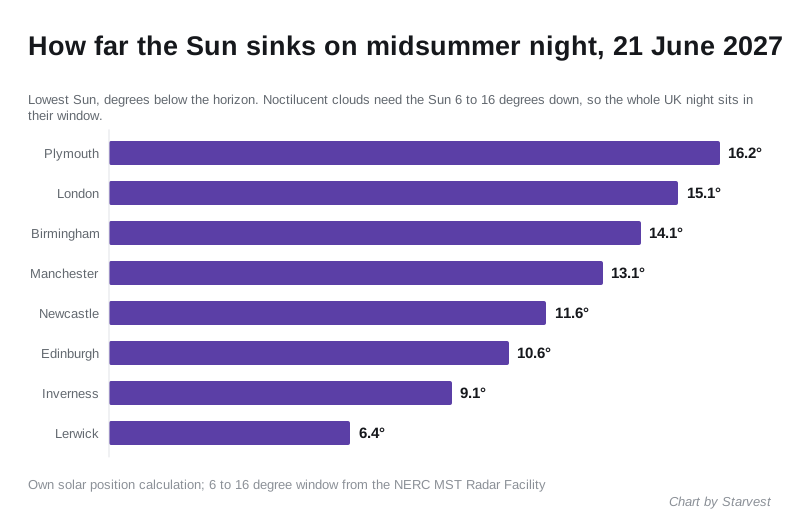
NERC says the clouds only show once the Sun is at least 6 degrees below the horizon, and they stay lit until it is about 16 degrees down. We worked out when the Sun is inside that band for eight UK places. On midsummer night the Sun never gets 16 degrees down anywhere north of Plymouth, so the window runs from dusk right through to dawn.
| Place | 21 June 2027, Sun 6 to 16 degrees down (BST) | 1 August 2027, evening window (BST) | 1 August 2027, morning window (BST) |
|---|---|---|---|
| Plymouth | 22:17 to 04:20, except 00:55 to 01:42 | 21:40 to 23:13 | 03:34 to 05:06 |
| London | 22:10 to 03:55 | 21:30 to 23:09 | 03:05 to 04:44 |
| Birmingham | 22:25 to 03:54 | 21:42 to 23:28 | 03:01 to 04:46 |
| Manchester | 22:35 to 03:47 | 21:49 to 23:44 | 02:47 to 04:42 |
| Newcastle | 22:48 to 03:29 | 21:56 to 00:11 | 02:15 to 04:30 |
| Edinburgh | 23:06 to 03:24 | 22:09 to 00:54 | 01:45 to 04:30 |
| Inverness | 23:32 to 03:06 | 22:25 to 01:24 | 01:25 to 04:22 |
| Lerwick | 00:26 to 01:47 | 22:38 to 01:11 | 01:12 to 03:45 |
Two things follow from the table:
- The best part of the window is early and late. When the Sun is only 6 to 10 degrees down, the whole of the northern sky can hold lit cloud. Nearer 16 degrees, only cloud close to the horizon is still in sunlight. In practice the hour after the sky starts to darken, and the hour before it starts to brighten, give the most chance.
- Shetland is almost too far north. At Lerwick the sky only just becomes dark enough on midsummer night, so the window is about 80 minutes. By August it opens up again. This is the same short-nights effect we describe in our astronomical darkness dates.
These times come from our own solar position calculation and shift by a few minutes for places east or west of each city.
Where in the sky to look
Look north. The clouds are lit by the Sun from below your horizon, so they appear in the part of the sky the Sun is under:
- Evening: north-west to north, low down, from about an hour after sunset.
- Around 1am BST: due north, lowest in the sky.
- Before dawn: north to north-east, often brightening into a bigger display just before the twilight swamps it.
NERC notes that in the north of Britain displays are more often seen at dawn than at dusk, so if you only go out once, a clear morning can be the better bet.
How to tell them from ordinary cloud
The test is simple: ordinary clouds go dark, noctilucent clouds glow. After sunset, low and mid-level cloud turns grey, then black against the twilight. Noctilucent clouds do the opposite and shine, with lower cloud often silhouetted in front of them.
Other signs, from the BAA’s observing notes:
- Colour: bluish or brilliant silvery white, sometimes golden very low near the horizon.
- Structure: fine detail, especially a herringbone ripple like sand on a beach at low tide.
- Position: low in the north, inside the brightest part of the twilight glow.
- Movement: slow. A display changes over tens of minutes, not seconds.
The trap is high cirrus caught by twilight or moonlight. Cirrus is much lower, so it loses the light much sooner after sunset. If it is still glowing more than an hour after sunset in the northern sky, it is far more likely to be noctilucent cloud.
The four forms
The BAA sorts what you see into four types, which is also how you describe a sighting:
| Type | Name | What it looks like |
|---|---|---|
| I | Veil | A thin, featureless sheet, often a background to the others |
| II | Bands | Long streaks, roughly parallel or crossing at small angles |
| III | Billows (waves) | Fine herringbone ripples; the classic noctilucent look |
| IV | Whirls | Large loops and twists |
A display can show several at once. Billows are the giveaway that you are looking at noctilucent cloud rather than cirrus.
How to photograph noctilucent clouds
They are bright enough for any camera, which is part of their appeal:
- Phone: use night mode on a tripod or propped on a wall, and tap to focus on the brightest part. Turn the exposure down a step if the sky looks washed out; the clouds should stay blue-white, not grey.
- Camera: a tripod, a standard or short telephoto lens, and exposures of a few seconds. Bracket, because the twilight changes fast.
- Framing: include a skyline, building or tree line. The silhouette shows the clouds’ height, and a fixed point makes a time-lapse of the slow drift work.
No telescope is needed, and binoculars are optional; the BAA uses “visible only with binoculars” as its faintest brightness grade. The same kit and patience suits catching the northern lights, which occasionally appear on the same night.
How to report a sighting
The BAA Aurora and Noctilucent Cloud Section, first formed in 1899, collects reports from Britain and Europe, and every report helps map how far south the clouds reach each summer. Its guidance for a useful record:
- Place, with latitude and longitude to the nearest half degree.
- The double date for the night, such as “July 3/4”, meaning the evening of the 3rd and morning of the 4th.
- The time, stating whether it is BST or UT. Observations every 15 minutes are ideal.
- Azimuths of the left and right ends of the display, and the elevation of its top and bottom edges if you can measure them.
- Brightness on a 1 to 3 scale, and structure (types I to IV).
- Negative nights: a clear night with no noctilucent cloud is useful data too.
Contact details for the section are on the BAA Aurora and NLC page. Photos with an accurate time are especially valued. If you see aurora at the same time, describe it as well: the BAA calls that combination unusual and of great interest.
Forecasts and satellite images
There is no forecast in the weather sense. NERC points observers to NASA’s AIM satellite, which maps the clouds from orbit (it calls them polar mesospheric clouds); its daily images arrive a few days late, so they show how active the season is rather than tonight’s chances. The practical method is the old one: on every clear night from late May, step outside an hour or so after sunset and look north. NERC’s own noctilucent cloud page has a map of how far the clouds can be seen from southern England.
For what else is up in the summer sky, see the best time of year for stargazing in the UK.
Frequently asked questions
When can you see noctilucent clouds in the UK? From late May to early August, with the best chances in late June and the first week of July. Look 1 to 2 hours after sunset or before sunrise, low in the northern sky.
Can you see noctilucent clouds from southern England? Yes. The clouds are 82 km up, so NERC says they can be seen from up to about 800 km away. From London or the south coast a display is usually lower in the northern sky than from Scotland, so a clear northern horizon helps.
What time of night are noctilucent clouds visible? When the Sun is between 6 and 16 degrees below the horizon. In London on 21 June 2027 that is from about 10.10pm to 3.55am BST; in Edinburgh about 11.06pm to 3.24am.
What causes noctilucent clouds? Ice crystals forming about 82 km up, where the mesosphere in summer gets colder than about minus 125°C. They shine because the Sun still lights them from below the horizon after it has set for people on the ground.
How do I know if it is noctilucent cloud or cirrus? Noctilucent clouds glow blue-white low in the north while lower clouds turn dark in front of them, and they often show a fine herringbone ripple. Cirrus loses the twilight much sooner after sunset.
Do you need a telescope to see noctilucent clouds? No. They are a naked-eye sight, and any phone or camera on a tripod will photograph them. Binoculars help only with faint displays.
Clear skies forecast? Get a nudge.
Our weekly email flags the next good UK observing window and one easy target to find.
Join the listMore from Starvest
Keep readingBest Telescopes for Beginners in the UK (Tested by Price Bracket)
The best beginner telescopes in the UK by budget, from sub-£150 tabletop scopes to app-guided and smart telescopes, with real 2026 prices.
What Can You See with Binoculars at Night? A Realistic Astronomy List
A realistic list of what you can see with binoculars in astronomy, from the Moon and Jupiter's moons to Andromeda, with tips for spotting each from the UK.
How to Set Up and Use Your First Telescope (Step by Step)
How to use a telescope as a beginner: assemble the mount, align the finder, focus, and find your first targets. A clear step-by-step UK guide.