Red Dot Finder vs Finderscope: Which Finds Targets Faster
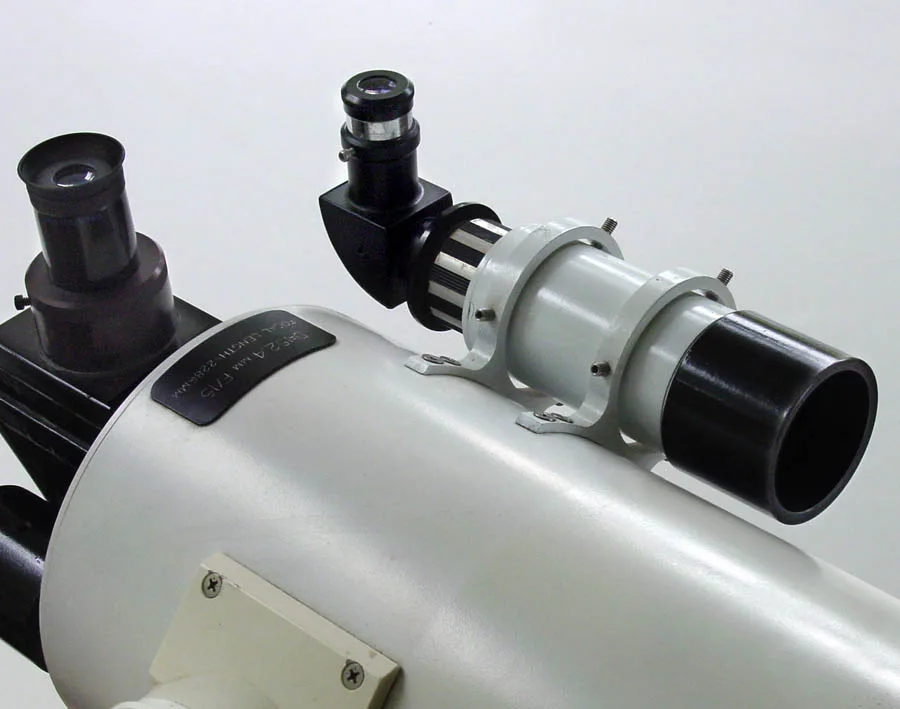
The red dot finder vs finderscope question comes down to one thing: whether you can see your target with your naked eye. A red dot finder has no magnification, so it is the fastest way to point at anything you can already see: the Moon, a planet, a bright star. A finderscope magnifies, typically 6 to 9 times, so it shows faint stars that are invisible from a British back garden, which is what you need to hop your way to a galaxy or cluster. Beginners who give up on their telescope usually do so because their finder did not match what they were trying to find.
Here is how each type works, where each one fails, and the setup most experienced observers settle on.
The short answer
| Red dot / reflex finder | Magnifying finderscope | |
|---|---|---|
| Magnification | None (1x) | Usually 6x to 9x |
| What you see | The real sky with a projected dot or rings | A small magnified patch of sky with crosshairs |
| Best for | Bright targets, fast pointing | Faint targets, star-hopping |
| Faint stars shown | Only what your eye sees | Several magnitudes fainter |
| Learning curve | Minutes | An evening or two |
| Weak spots | Dew, flat batteries, light-polluted skies | Upside-down or mirrored views, neck ache |
How a red dot finder works
A red dot finder (also called a reflex sight) projects an illuminated dot onto a small window of glass. You look through the window with both eyes open, see the real sky, and move the telescope until the dot sits on your target. Because there is no magnification, nothing is flipped or mirrored: left is left, up is up. That is why almost every beginner telescope, from the small Celestron and Sky-Watcher refractors upwards, ships with one, often the Celestron StarPointer or a close copy.
Two popular upgrades replace the dot with rings. The Telrad projects three concentric circles, 4°, 2° and 0.5° across, which lets you measure distances on the sky and follow star charts drawn with Telrad circles printed on them. The smaller Rigel QuikFinder does the same job with two rings, 2° and 0.5°. Either one turns “point roughly at Andromeda” into “put the 4° ring two ring-widths up from this star”, which is the first step towards real star-hopping.
Where red dots fail:
- You can only aim at what you can see. From a town with a washed-out sky, the stars you need to navigate by simply are not there.
- Dew. The glass window mists over on a damp British night, often within the first hour. A small dew shield helps.
- Batteries. Most take a coin cell, and it always dies mid-session. Keep a spare in your eyepiece case, and turn the finder off when you pack away.
- Brightness. Set the dot as dim as you can still see it. A bright dot hides the faint star you are aiming at.
How a finderscope works
A finderscope is a small, low-power telescope strapped to the main one. The number on the label tells you what you get: an 8x50 magnifies 8 times through a 50mm lens. The StellaLyra 8x50 sold by First Light Optics, for example, shows a 5.4° field, roughly ten Moon widths, and the 50mm lens gathers far more light than your eye, so stars you cannot see unaided appear in the view.
That extra depth is the whole point. The Telrad’s largest ring is 4° for exactly this reason: it outlines about what a typical finderscope shows, so you can pick your way from a visible star to a finder field, and from there into the eyepiece.
The catch is orientation. There are three kinds, and the one you have changes how easy it is to use:
- Straight-through. You look along the tube. The view is upside down and back to front (rotated 180°), which is confusing at first, and pointing near the zenith means kneeling on the patio with your neck bent back.
- Right-angle, not corrected. A mirror or prism turns the view 90° so you look down into it, which saves your neck, but the image is mirror-reversed. Matching it to a printed chart is the “mirror-image confusion” that makes people give up.
- Right-angle correct-image (RACI). Uses a roof or Amici prism to give a view that is the right way up and the right way round. The StellaLyra 8x50 above is this type. It is the most comfortable and the easiest to match to a map or app.
Which one finds things faster?
It depends on the target.
- The Moon, planets, bright stars and double stars: the red dot wins, easily. You look along the finder, line up, and it is in the eyepiece in seconds. A finderscope’s small field makes you hunt for something you could see anyway.
- Galaxies, nebulae and faint clusters: the finderscope wins, because the target (or the stars pointing to it) only appear with magnification. With a red dot alone you can get close but then sweep blind.
- Fast-moving sessions under a poor sky: a red dot to get into the area, then a finderscope to arrive, is quicker than either on its own.
Use both: the setup most observers end up with
The common endpoint is a red dot or Telrad for coarse aiming and a RACI finderscope for the last step. Many Dobsonians, including the Sky-Watcher Skyliner range, come with a finderscope mount already on the tube, and a red dot base can be stuck alongside it. Align both on the same distant target in daylight, a chimney or a telegraph pole at least a few hundred metres away, never the Sun, and they will agree with each other and with your low-power eyepiece.
Our step-by-step guide to finding objects with a telescope covers star-hopping itself, and how to set up your first telescope walks through aligning a finder for the first time.
Why beginners give up, and how to avoid it
Most “this telescope is useless” stories start with an unaligned finder. If the finder points somewhere different from the main tube, nothing you do in the eyepiece will work. Align it every session until you trust it, using your lowest-power eyepiece. Start on the Moon, which is big enough to find even with a poorly aligned finder, then refine on a bright star.
The second cause is the wrong tool for the sky. A beginner in a light-polluted town trying to star-hop with only a red dot will fail. A beginner trying to catch Jupiter with only a straight-through finderscope will spend twenty minutes upside down. Match the finder to the target list, and see our list of the best things to see with a telescope to decide what that is.
Frequently asked questions
Is a red dot finder better than a finderscope? For bright targets, yes: it is faster and nothing is flipped. For faint galaxies and clusters, no, because it cannot show stars that are invisible to your eye. Most keen observers use both.
What does 8x50 mean on a finderscope? It magnifies 8 times and has a 50mm front lens. The larger lens gathers more light, so an 8x50 shows fainter stars than a 6x30, which matters most from towns and suburbs.
Why is my finderscope view upside down? Straight-through finderscopes rotate the image 180°. A right-angle correct-image (RACI) finderscope uses a prism to give an upright, correctly oriented view that matches star charts.
Why can I not see the red dot? Usually a flat battery, the brightness turned right down, or dew on the window. Check all three, and remember some newer finders switch themselves off after a set time.
Is a Telrad worth it? For a Dobsonian user who star-hops, yes. Its 4°, 2° and 0.5° rings let you measure distances on the sky and follow charts marked with Telrad circles. It is large, so check it will fit your tube first.
How do I align a finder? In daylight, centre a distant fixed object in the main telescope with your lowest-power eyepiece, then adjust the finder’s screws until it points at the same spot. Never use the Sun.
Sources
- First Light Optics, StellaLyra 8x50 RACI finder specifications: product page.
- Telrad and Rigel Systems reticle specifications, via retailer listings (High Point Scientific, Astronomics).
Clear skies forecast? Get a nudge.
Our weekly email flags the next good UK observing window and one easy target to find.
Join the listMore from Starvest
Keep reading
Best Telescopes for Beginners in the UK (Tested by Price Bracket)
The best beginner telescopes in the UK by budget, from sub-£150 tabletop scopes to app-guided and smart telescopes, with real 2026 prices.

What Can You See with Binoculars at Night? A Realistic Astronomy List
A realistic list of what you can see with binoculars in astronomy, from the Moon and Jupiter's moons to Andromeda, with tips for spotting each from the UK.
How to Set Up and Use Your First Telescope (Step by Step)
How to use a telescope as a beginner: assemble the mount, align the finder, focus, and find your first targets. A clear step-by-step UK guide.