Refractor vs Reflector Telescope: Which Should a Beginner Buy?
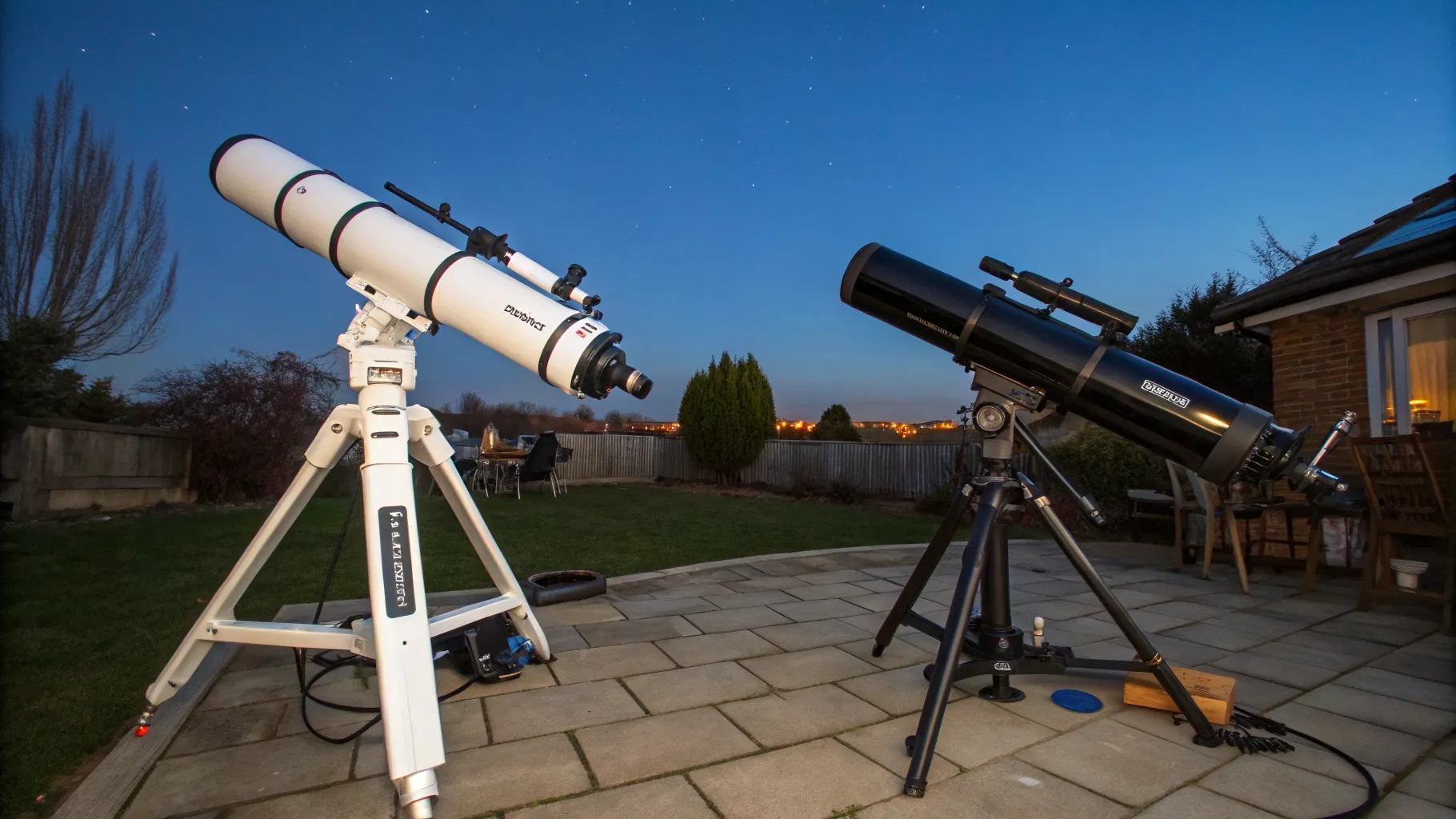
The refractor vs reflector telescope question is the one almost every first-time buyer gets stuck on, and the honest answer is that neither is “better”. They collect light in completely different ways, and that single difference cascades into everything else: what you can see, how much you pay, and how much fiddling you do before each session. Pick the one that matches the kind of stargazing you actually want to do, and you will be happy. Pick on price alone and you can end up with a scope that fights you.
Here is the plain comparison, with the trade-offs that genuinely decide it for a beginner rather than a tidy “this one wins” that ignores how you will use it.
The core difference
A refractor uses a glass lens at the front to bend light to a focus. It is the classic long, slim tube most people picture when they think “telescope”. A reflector uses a curved mirror at the bottom of the tube to bounce light back up to a focus, the design pioneered by Newton, which is why the common beginner version is called a Newtonian. Everything below flows from lens versus mirror.
Aperture for your money
This is the difference that matters most, because aperture, the diameter of the lens or mirror, decides how much light the scope gathers and therefore how faint an object you can see. Mirrors are far cheaper to make at large sizes than precision lenses, so a reflector gives you much more aperture per pound. A 150mm (6 inch) reflector costs a fraction of what a 150mm refractor would, and in astronomy, where you are chasing dim light, that extra light grasp is a serious advantage. If you want the most capable scope your budget allows, a reflector almost always wins on paper.
Planets vs deep sky
What you want to look at tilts the decision. Refractors give sharp, high-contrast views of bright targets, the Moon, Jupiter, Saturn and Venus, because there is no secondary mirror sitting in the light path to soften the image. Reflectors, with their bigger apertures for the money, are the better deep-sky tool: galaxies, nebulae and star clusters need raw light-gathering power more than they need contrast, and that is exactly what a large mirror delivers. Neither is locked to one job, but if your dream is detailed planets, a good refractor punches above its size; if it is faint fuzzies far from the city, aperture-rich reflectors pull ahead.
Maintenance: the part beginners underestimate
A refractor is essentially sealed. The lens lives in a closed tube, stays aligned, and asks almost nothing of you: set it up, look, pack it away. A reflector’s mirrors need occasional collimation, the process of nudging them back into precise alignment so the light converges correctly. It is not difficult once learned, and it takes a couple of minutes, but it is a real, recurring job, and an out-of-alignment reflector gives mushy views. If the idea of adjusting your telescope puts you off entirely, weigh that honestly before buying a reflector.
Image quality quirks
Budget refractors can show chromatic aberration, faint coloured fringing (often purple or green) around bright objects like the Moon or Venus, because the lens bends different colours of light by slightly different amounts. Better refractors reduce it, but cheap ones show it plainly. Reflectors are immune to this, because a mirror reflects every colour equally, so there is no colour fringing at all. Against that, a reflector’s open tube takes longer to cool to outside temperature and is more exposed to dust.
Cost and portability
Small refractors (70mm to 90mm) are compact, light and grab-and-go, which makes them great for quick sessions and for travelling. Reflectors give you more scope for the money but get bulky fast; a 200mm Newtonian on a Dobsonian base is wonderful to use but is a two-handed lift, not something you pop in a bag. Factor in where you will store it and how far you will carry it, because the best telescope is the one you actually take outside.
So which should a beginner buy?
If you want lowest hassle, bright planetary and lunar views, and easy grab-and-go sessions, a small to mid refractor is the comfortable choice. If you want the most light-gathering power for your budget and you are drawn to deep-sky objects, a Newtonian reflector (often on a Dobsonian mount) is the classic beginner recommendation and the better value. For a first scope where you want both ease and aperture, many beginners land on a Dobsonian reflector around 150mm to 200mm.
For more on sizing, read our guide to telescope aperture explained, and for the full buying process see how to buy a telescope in the UK and our best telescope for beginners picks. The BBC’s Sky at Night Magazine also has a useful first-telescope breakdown.
Frequently asked questions
Is a refractor or reflector telescope better for a beginner? Neither is universally better. A small refractor is easier, needs no maintenance and gives crisp planetary views, while a reflector gives far more aperture for the money and suits deep-sky objects. Choose by what you want to see and how much maintenance you will tolerate.
Which is better for viewing planets, a refractor or a reflector? A refractor often gives the sharpest, highest-contrast planetary views at a given size because nothing obstructs the light path. That said, a larger reflector still shows excellent planetary detail thanks to its extra aperture, so a good example of either type works well on the Moon and planets.
Do reflector telescopes really need collimation? Yes. A reflector’s mirrors drift out of alignment over time and need collimating to keep images sharp. It is a quick, learnable job that takes a couple of minutes, but it is a recurring task that refractors do not need.
Why are reflector telescopes cheaper than refractors? Mirrors are far cheaper to manufacture at large sizes than precision lenses, so you get much more aperture per pound with a reflector. A 150mm reflector costs a fraction of a 150mm refractor, which is why reflectors dominate the budget end.
What is chromatic aberration and which type has it? Chromatic aberration is coloured fringing around bright objects, caused when a lens focuses different colours at slightly different points. It affects refractors, especially cheaper ones, and is worse at the Moon and bright planets. Reflectors do not suffer from it because mirrors reflect all colours equally.
Clear skies forecast? Get a nudge.
Our weekly email flags the next good UK observing window and one easy target to find.
Join the listMore from Starvest
Keep reading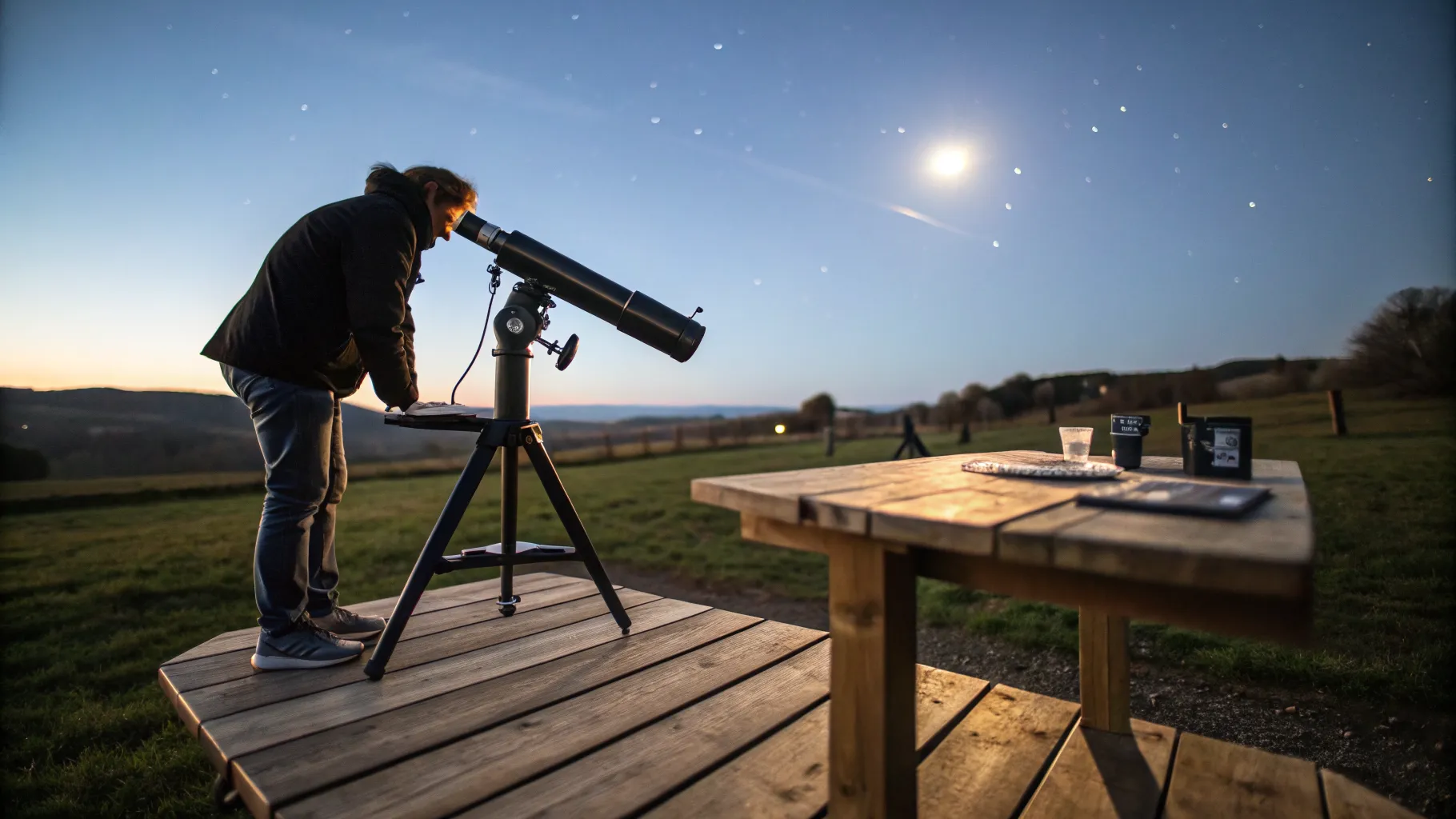
Best Telescopes for Beginners in the UK (Tested by Price Bracket)
The best beginner telescopes in the UK by budget, from sub-£150 tabletop scopes to app-guided and smart telescopes, with real 2026 prices.
What Can You See with Binoculars at Night? A Realistic Astronomy List
A realistic list of what you can see with binoculars in astronomy, from the Moon and Jupiter's moons to Andromeda, with tips for spotting each from the UK.
How to Set Up and Use Your First Telescope (Step by Step)
How to use a telescope as a beginner: assemble the mount, align the finder, focus, and find your first targets. A clear step-by-step UK guide.