Sky-Watcher Heritage 100P Review: A True Starter Telescope
The Sky-Watcher Heritage 100P sits at the point where a telescope stops being a toy and starts being an instrument, and that is a more interesting place than most reviews admit. This Sky-Watcher Heritage 100P review covers what its 100mm mirror genuinely shows on a British night, the one specification that quietly shapes everything about how it performs, and the honest case for spending a little more instead. It is a good telescope. It is not always the right one.
If you are still narrowing the field, our best telescopes for beginners in the UK roundup and the telescope aperture explainer set the context, then come back for the detail.
What the Heritage 100P is
The 100P is a 100mm (4 inch) Newtonian reflector with a 400mm focal length, which makes it an f/4 scope, sitting on a compact wooden tabletop Dobsonian base. The primary mirror is parabolic rather than the cheaper spherical mirror you find in most scopes at this size, which matters: a parabola brings light to a single sharp focus instead of smearing it slightly.
Unlike its bigger siblings, the tube is solid, not collapsible. There is no FlexTube here, so what you see is what you carry, and at roughly 2.8kg the whole telescope weighs less than a full kettle. First Light Optics lists it with two 1.25 inch eyepieces, a 25mm and a 10mm, a red dot finder and a 2x Barlow, giving four magnifications: 16x, 32x, 40x and 80x.
That accessory set is more generous than usual, and the 2.8kg grab-and-go weight is the real selling point. This is a telescope you take on holiday, or carry to the end of the garden without thinking about it.
What you actually see through it
A 4 inch mirror is small, but it is not nothing, and the honest answer is that the 100P shows real astronomy rather than grey blobs.
BBC Sky at Night Magazine’s review of the Heritage 100P rated it 4 out of 5 and logged what it delivered: Jupiter’s equatorial bands with the Galilean moons alongside, Saturn’s rings described as a delight with moons visible, Mars showing a polar cap and dusky markings, and the double star Albireo splitting into its contrasting gold and blue pair. On deep sky it pulled in the galaxy pair M81 and M82 with visible structure, and resolved a sprinkling of stars across the globular cluster M13 as magnification went up.
The Moon is the one place expectations need managing. Craters show, but the same review found them “not in great detail”, and that is the fair verdict for 100mm. You get the terminator, the seas and the big crater walls, not the fine ridges a larger scope pulls out.
For a first telescope, that list is genuinely rewarding. Set against the 70mm supermarket refractors sold at similar money, it is a different hobby.
The f/4 catch nobody mentions
Here is the specification that shapes everything: f/4 is a fast focal ratio, and fast scopes are demanding on eyepieces.
Steeply converging light is harder for simple eyepiece designs to handle at the edge of the field, which is why the Sky at Night review found stars stayed sharp across roughly the central 60% of the view through the 25mm eyepiece, then deteriorated into coma towards the edge. Nothing is broken. That is physics meeting budget eyepieces, and it is the price of a 400mm tube that packs down small.
Two practical consequences follow. First, the 100P responds well to better eyepieces later, more so than a slower scope would, so it has an upgrade path. Second, the short 400mm focal length means high magnification is hard work: the supplied 10mm gives just 40x, and reaching 80x needs the Barlow stacked on top. Planets stay small.
The review also flagged two ergonomic niggles worth knowing: the focuser is a little stiff, and the red dot finder can sit awkwardly in the way when you are at the eyepiece.
The tabletop problem
Tabletop Dobsonians need a table. This is obvious written down and routinely forgotten at the point of purchase.
The 100P’s base puts the eyepiece low, so on the ground it is unusable and on a normal garden table it is often still too low for comfortable seated viewing. A sturdy box, a wall, a bin lid or a purpose-bought stool all work, but you need to have solved this before your first clear night, not during it. Anything wobbly transmits every touch straight into an 80x view.
Heritage 100P or Heritage 130P?
This is the decision that actually matters, and for most UK buyers the answer is the 130P.
The Heritage 130P has a 130mm mirror against 100mm, which is not a 30% improvement but roughly a 70% increase in light-gathering area, and it runs at f/5 with a 650mm focal length, so it is gentler on eyepieces and reaches useful magnification more easily. It costs meaningfully more and weighs about twice as much at 6kg, but it is collapsible, so it stores smaller than the numbers suggest.
The 100P wins on three counts, and they are real ones:
- Weight. At 2.8kg it goes in hand luggage and on holiday. The 130P does not, comfortably.
- Price. It is the cheaper entry point, and it is a proper parabolic-mirror telescope rather than a compromise.
- Simplicity. A solid tube holds its collimation better than a truss that gets extended and collapsed every session.
Buy the 100P if portability or budget genuinely decides it, or if it is a second grab-and-go scope. Buy the 130P if it is going to live in a cupboard at home and come out into the garden, because the extra aperture is what you will still be enjoying in three years.
Verdict
The Heritage 100P is an honest, well-made starter telescope that shows Jupiter’s bands, Saturn’s rings and a resolving globular cluster for a modest outlay, with a parabolic mirror and a decent accessory bundle at a price where corners are usually cut. Its limits are equally honest: modest lunar detail, edge coma from the fast f/4 optics, small planetary images, and a base that needs something solid to stand on.
It earns a recommendation for the traveller, the tight budget and the second scope. For a first and only telescope that will live at home, the 130P remains the better buy. Check price on Amazon, and compare against the field in our best telescope under £200 guide.
Frequently asked questions
Is the Sky-Watcher Heritage 100P good for beginners? Yes. It is simple to point, sets up in seconds and uses a proper parabolic mirror, so it shows real detail on the Moon, planets and brighter deep-sky objects. The main caveats are that it needs a sturdy table to sit on and that lunar detail is modest for a 100mm aperture.
What can you see with a Heritage 100P? Jupiter’s cloud bands and its four Galilean moons, Saturn’s rings and brighter moons, Mars showing a polar cap and dark markings, double stars such as Albireo, star clusters including M13, and brighter galaxies like M81 and M82 from a reasonably dark site.
What magnification does the Heritage 100P give? Four options with the supplied kit: 16x and 40x from the 25mm and 10mm eyepieces, doubling to 32x and 80x with the included 2x Barlow lens.
Is the Heritage 100P collapsible? No. The 100P has a solid tube, unlike the collapsible FlexTube design used on the Heritage 130P. It stays small because the tube is only 400mm long, and the whole scope weighs about 2.8kg.
Should I buy the Heritage 100P or the 130P? The 130P is the better telescope for home use, with around 70% more light-gathering area and a more forgiving f/5 focal ratio. Choose the 100P if portability, hand luggage or budget is the deciding factor.
Does the Heritage 100P need collimation? Occasionally, like any Newtonian reflector, but its solid tube holds alignment better than a collapsible truss that is extended each session. Check it if views look soft after the scope has been knocked or travelled.
Clear skies forecast? Get a nudge.
Our weekly email flags the next good UK observing window and one easy target to find.
Join the listMore from Starvest
Keep reading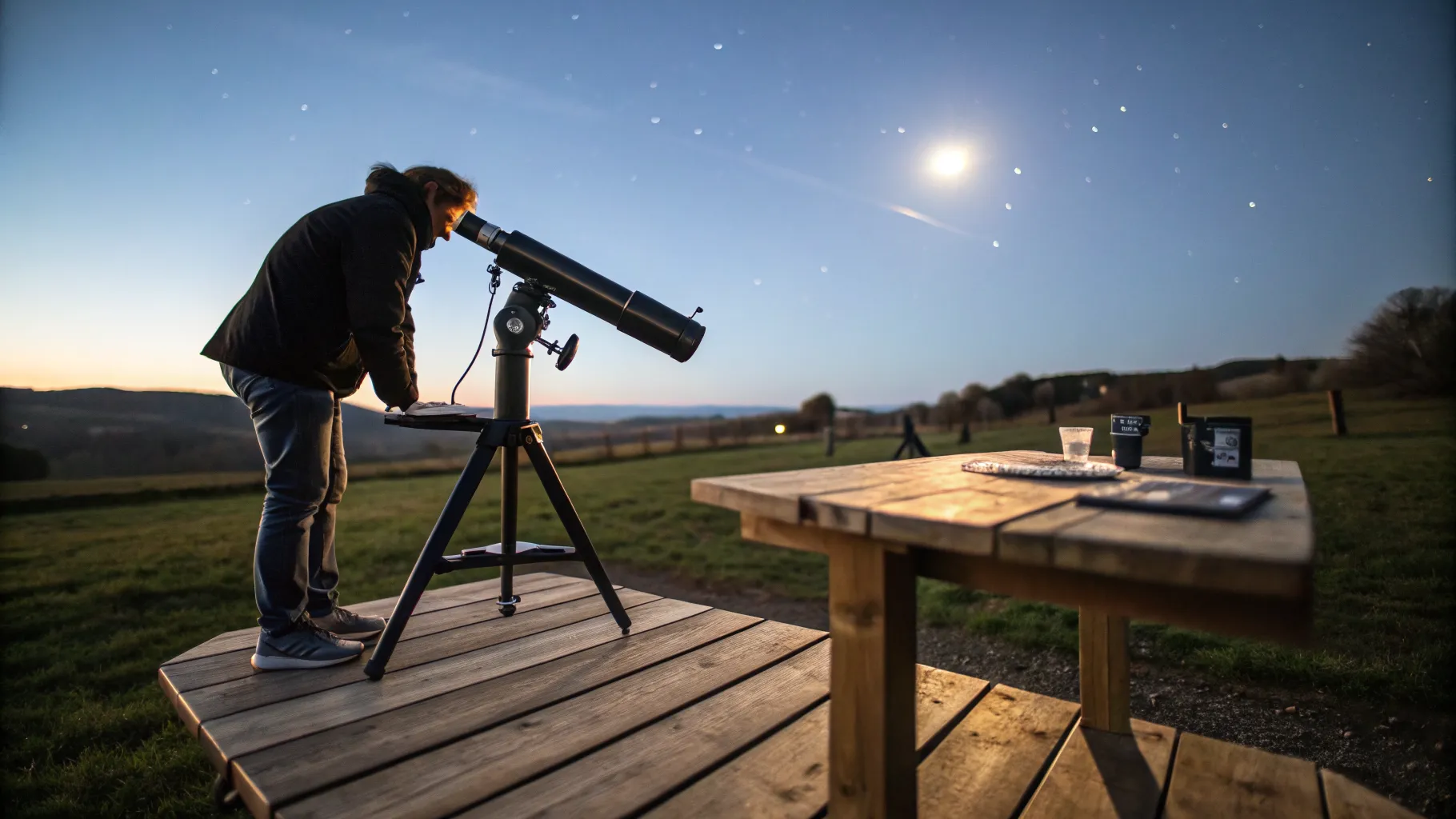
Best Telescopes for Beginners in the UK (Tested by Price Bracket)
The best beginner telescopes in the UK by budget, from sub-£150 tabletop scopes to app-guided and smart telescopes, with real 2026 prices.
What Can You See with Binoculars at Night? A Realistic Astronomy List
A realistic list of what you can see with binoculars in astronomy, from the Moon and Jupiter's moons to Andromeda, with tips for spotting each from the UK.
How to Set Up and Use Your First Telescope (Step by Step)
How to use a telescope as a beginner: assemble the mount, align the finder, focus, and find your first targets. A clear step-by-step UK guide.