Telescope Dew Shield or Heater? Stop Dew on UK Nights
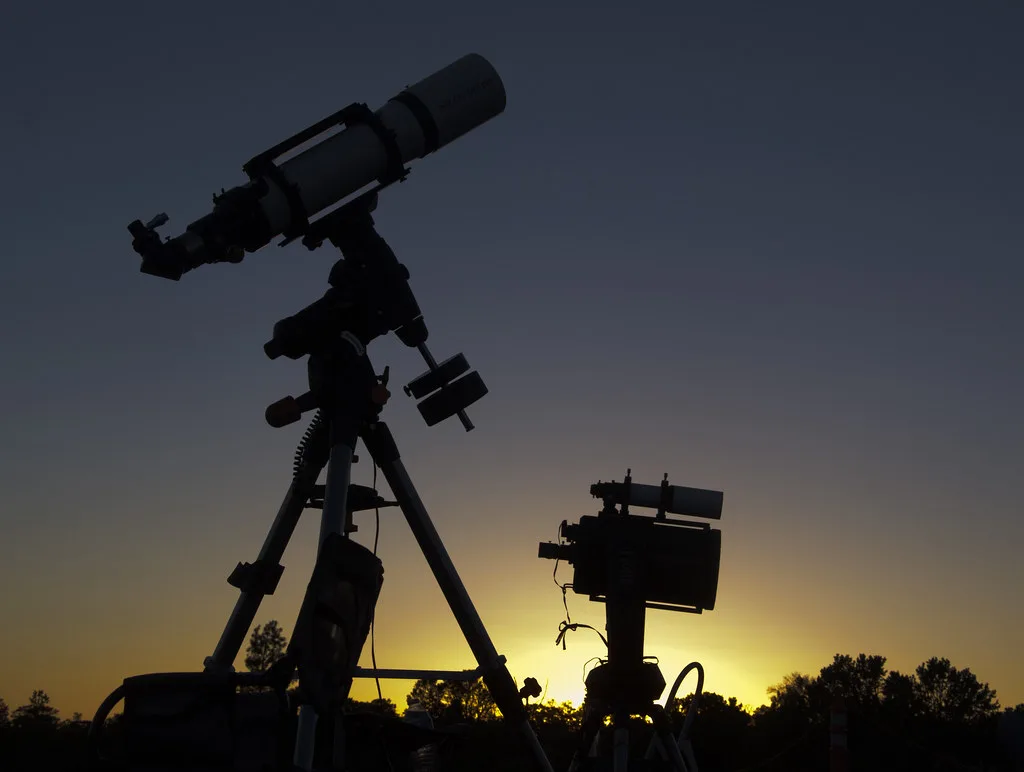
A telescope dew shield is the first thing most British observers buy after their second ruined session, and it is only half the answer. Dew is the single most reliable way a clear UK night ends early. You set up under a sharp sky in October, everything is crisp for forty minutes, then the stars go soft, the finder turns milky, and you carry a wet telescope indoors wondering what you did wrong. You did nothing wrong. Physics did it, and the fix is cheap once you understand which of your optics is losing the argument.
Why your telescope dews and the air does not
Dew is not the air condensing onto cold glass at random. On a clear, calm night a surface pointed at open sky radiates heat away into space far faster than it gains it back, so the surface falls below the temperature of the air around it. When the glass drops to the dew point, water vapour in the air condenses onto it. The Met Office describes the same mechanism for dew on grass and car roofs: surfaces that do not conduct heat up from the ground cool the fastest, and dew forms most readily in the calm conditions that come with high pressure.
That is why the worst dew nights are exactly the nights you want to observe. Clear sky, no wind, high pressure, a mild day followed by a rapid drop after sunset. A hazy, breezy night rarely dews a scope; a diamond-clear, still one will soak it.
Two consequences follow, and they run this whole page:
- A dew shield works by hiding the glass from the sky. It narrows the cone of cold sky the optic can radiate into, so the glass cools more slowly. It does not add any heat, so it only delays the problem.
- A heater works by keeping the glass above the dew point. It beats the physics rather than slowing it, which is why it is the only thing that lasts all night.
Which optic fogs first, in order
Not every telescope has the same problem, and knowing yours saves you buying the wrong thing.
| Optic | How exposed it is | How badly it dews |
|---|---|---|
| SCT or Maksutov corrector plate | Flat glass at the very front, seeing the whole sky | Worst. Schmidt-Cassegrain owners buy a shield first for a reason |
| Refractor objective | Sits at the front but recessed inside the tube | Bad, though the tube already acts as a short shield |
| Newtonian secondary mirror | Angled up, exposed through the open end of the tube | Bad on damp nights, and often missed because you cannot see it |
| Newtonian primary mirror | Deep at the closed end of the tube | Rarely dews; airflow from a rear fan handles it |
| Eyepieces | Warm from your eye, then left uncapped | Constant, and usually your own breath rather than the sky |
| Telrad and red dot finders | A flat window aimed straight at the zenith | Notorious. Dews before anything else on the scope |
If you own a Schmidt-Cassegrain or a Maksutov, the corrector plate is your problem and everything below applies to it. If you own a Dobsonian or Newtonian and the view is going soft, look at the secondary before you blame the primary or reach for a collimation tool. Our guide to fixing a blurry telescope image covers how to tell dew apart from collimation and thermal issues.
Dew shields: cheap, passive, and not enough on their own
A dew shield is a tube extension in front of the objective or corrector. Two useful things happen. Less cold sky reaches the glass, so it cools more slowly. Stray light from streetlamps and the Moon is blocked too, which visibly lifts contrast on faint targets.
What to know before buying one:
- Length matters more than material. The usual rule of thumb is a shield that extends roughly one and a half times the aperture beyond the glass. A short decorative shield on an 8-inch SCT does very little.
- Flexible or rigid. Astrozap style flexible shields wrap on and are easy to store flat; Celestron sells rigid aluminium shields for its SCT range. Both work. The flexible ones are easier to live with if your scope travels in a case.
- A rolled camping mat and some Velcro does the same job. This is one of the few pieces of astronomy kit where a homemade version is genuinely as good, provided the inside is matt black.
- On a Newtonian, the shield you want is over the secondary, not the front of the tube, so most Newtonian owners skip shields and go straight to a heater strap.
Expect a good shield to buy you one to three hours on a typical damp British night. On a still, high-pressure night in autumn it may buy you less than one. That is the honest limit of a passive fix.
Dew heater bands: the thing that actually ends the problem
A heater band is a resistive strap that wraps round the tube at the level of the optic and keeps the glass a degree or two above the dew point. Fitted correctly, dew stops being a thing you think about.
How they are put together in the UK:
- The band. Lynx Astro, First Light Optics’ own brand, makes its straps in the UK; the eyepiece and finder straps are rated at 3W and draw around 0.25A at 12V. Bands for a large objective or corrector are longer and hungrier, with heavy-duty straps for big scopes drawing well over 10W at full power. Celestron sells dedicated dew heater rings sized for its 9.25-inch and 11-inch SCTs.
- The controller. A band wired straight to 12V runs at full power constantly, which wastes battery and, on a corrector, can push warm air across the optical path and soften the image. A controller dials the power down. Lynx Astro’s Essentials two-port controller handles up to 3A in total, the four-port version up to 8A with each channel adjustable, and the premium two-port model up to 10A.
- The power. Almost all of this kit is 12V on RCA plugs, not 5V USB. A USB power bank will not run a 12V band unless the band is specifically a USB model. A 12V lithium power tank is the usual answer.
The run time is simple arithmetic. A 12W band at full power draws 1A at 12V, so a 10Ah battery gives about 10 hours before you account for the mount, dew controller losses and the cold knocking capacity off. Halve the heater’s duty cycle with a controller and it lasts twice as long. Add a mount and a camera and you want more headroom than you think.
Use both. A shield keeps cold air and cold sky off the glass so the heater has less to fight, and the heater can then run at a lower setting. That combination is what stops overheating the corrector and turning dew into tube currents.
What never to do
- Do not wipe the optics. Dew carries dust, and wiping grinds it across coated glass. A single impatient wipe with a sleeve or a lens cloth can leave marks you will see for the life of the telescope. Let it evaporate instead.
- Do not breathe on it or blow on it. Your breath is warm, wet air. It is the fastest way to fog an eyepiece.
- Do not run a mains hair dryer on an extension lead across a wet lawn. If you want warm air as an emergency fix, use a 12V car blower, on low, held well back and kept moving, and only long enough to clear the film.
- Do not cap and case a dewed telescope. Sealing damp glass into a foam-lined case is how mould and coating marks start. Bring it indoors with the caps off, stand it somewhere with moving air, and cap it only when it is dry to the touch.
- Do not store the scope indoors and expect a heater to save you. Glass carried from a warm house into cold air will fog instantly from the other direction. Let it cool outside before you start, which it needs anyway for steady seeing.
Reading the night before you go out
You can predict a dew night rather than discover it. Look at the forecast temperature and the forecast dew point for your location overnight. When the gap between them closes to a degree or two, and the wind is light, and the sky is clear, everything outdoors will dew. A cheap digital thermometer with a humidity readout on the tripod leg tells you the same thing live.
Practical positioning helps at the margins:
- Set up on a patio, driveway or decking rather than a lawn. Grass releases moisture all night and is usually the dampest air on the property.
- Get the scope up off the ground if you can. The coldest, wettest layer is the first foot or so.
- A little air movement is your friend. A completely sheltered walled corner dews faster than a spot with a breath of breeze.
- Cap the scope during long breaks, and keep your spare eyepieces in a closed case or a pocket rather than on an open tray. See telescope accessories for beginners for what is worth carrying.
What to buy first, by telescope
- SCT or Maksutov: a full-length dew shield, then a corrector heater band and a controller when you get tired of packing up early.
- Refractor: the tube gives you a head start, so a heater strap at the objective is usually the better first purchase; add a shield for contrast.
- Newtonian or Dobsonian: a secondary mirror heater strap. Shields do little for you. A rear fan on the primary is worth having for cool-down as much as dew.
- Everyone: a heater strap for eyepieces and finders, and something over the Telrad. These are cheap, they draw almost nothing, and they fix the failure that ends most sessions.
Frequently asked questions
Does a telescope dew shield actually work? Yes, but only as a delay. It cuts the amount of open sky the glass can radiate heat into, so the optic cools more slowly and reaches the dew point later. On a typical damp British night expect one to three extra hours, and less than that on a still, clear, high-pressure night. To observe all night through, pair it with a heater.
Why does my telescope dew up when nothing else outside is wet? Because the glass is colder than the air. A surface aimed at clear sky radiates heat away and drops below ambient temperature, so it reaches the dew point before the air does. That is also why car roofs and grass dew before fence panels and walls do.
Can I use a USB power bank for a dew heater? Only if the heater is a USB model. Most astronomy dew bands sold in the UK are 12V with RCA plugs, and a 5V power bank will not drive them properly. Check the voltage and connector before you buy, and if you are running 12V, size the battery from the band’s wattage.
Should I run a dew heater at full power? No. Full power wastes battery and, on an SCT corrector, can warm the air inside the tube enough to soften the image with tube currents. Use a controller and run at the lowest setting that keeps the glass clear, which on most nights is well under half power.
How do I clear dew that has already formed? Stop observing on that optic, cap the rest, and let it evaporate. A 12V blower on low, held back and kept moving, speeds it up. Never wipe a dewed lens or corrector. When you get indoors, leave the scope uncapped until the glass is dry before it goes back in the case.
Do Newtonians and Dobsonians need dew protection? Yes, just in a different place. The primary mirror sits deep in the tube and rarely dews, but the secondary is angled up at the open sky and fogs readily on damp nights. A secondary heater strap is the fix. A front dew shield does very little for a Newtonian.
Clear skies forecast? Get a nudge.
Our weekly email flags the next good UK observing window and one easy target to find.
Join the listMore from Starvest
Keep reading
Best Telescopes for Beginners in the UK (Tested by Price Bracket)
The best beginner telescopes in the UK by budget, from sub-£150 tabletop scopes to app-guided and smart telescopes, with real 2026 prices.
What Can You See with Binoculars at Night? A Realistic Astronomy List
A realistic list of what you can see with binoculars in astronomy, from the Moon and Jupiter's moons to Andromeda, with tips for spotting each from the UK.
How to Set Up and Use Your First Telescope (Step by Step)
How to use a telescope as a beginner: assemble the mount, align the finder, focus, and find your first targets. A clear step-by-step UK guide.