Telescope Cool Down Time: 1 Hour, or 2 for an SCT
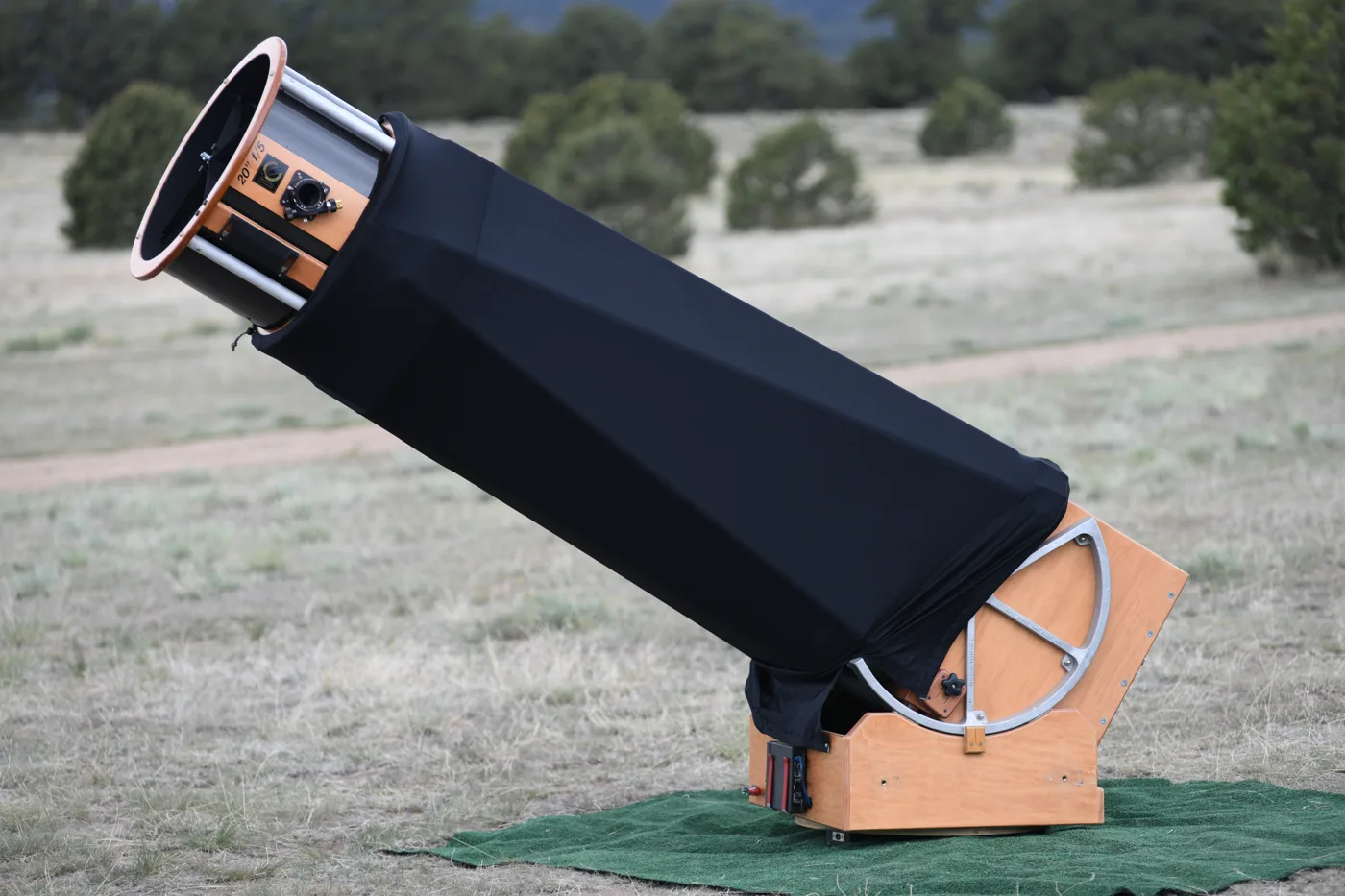
Telescope cool down time is the wait between carrying a scope out of a warm house and it showing sharp detail. As a working figure, BBC Sky at Night Magazine gives about an hour for Newtonians and refractors, and a couple of hours for Schmidt-Cassegrains and Maksutovs. Small refractors are ready in far less. Big, thick-mirrored reflectors can take longer, and on a night when the temperature keeps falling, some never fully catch up.
If you have ever set up on a clear evening, pointed at Jupiter and seen a soft, boiling blob that sharpened an hour later, this is why. The rest of this page covers what is going on inside the tube, how long each design really needs, how to tell when yours is ready, and what actually speeds it up.
Why a warm telescope gives a bad image
Glass holds heat. A mirror that has been sitting in a living room at 20°C and is taken into a 6°C autumn garden will spend a long time shedding the difference, and while it does, it warms the air right against its surface. That thin layer of warm air, the boundary layer, rises and swirls in front of the mirror and bends the light passing through it. The rest of the tube adds its own currents, warm air creeping up one side of the tube and falling down the other.
The result looks like bad seeing, but it is inside your telescope. Gary Seronik, a long-standing Sky & Telescope contributor, puts the target at a mirror within 3°C of the air around it; beyond that, high-power views suffer. Low-power views of star clusters and wide nebulae barely notice, which is why you can start on those while the scope settles.
Cool down time by telescope type
| Design | Typical wait from a warm house | Why |
|---|---|---|
| Small refractor (60 to 80mm) | 10 to 20 minutes | Thin lenses, small mass, open to air at both ends once the diagonal is out |
| Larger refractor (100mm+) | 30 minutes to an hour | Thicker lens elements, sometimes a triplet |
| Newtonian or Dobsonian (130 to 200mm) | About an hour | Open tube, but a solid glass mirror at the bottom |
| Large Dobsonian (250mm+) | One to two hours, or more | Thicker mirror; often needs a fan |
| Maksutov-Cassegrain | Two hours or more | Closed tube, thick meniscus front lens |
| Schmidt-Cassegrain (SCT) | About two hours | Closed tube traps warm air round the primary mirror |
The one-hour and two-hour figures are Sky at Night’s. The small-refractor and large-Dobsonian ranges are what owners commonly report and depend heavily on how big the temperature drop is: a scope stored in an unheated garage in October may be ready almost at once.
Why an SCT or Maksutov takes longest
Both are closed tubes. The corrector plate or meniscus seals the front, so warm air around the primary mirror has nowhere to escape except by conducting slowly through the tube walls. A Maksutov adds a thick curved front lens that is itself a lump of glass to cool. Celestron’s EdgeHD tubes carry filtered vents on the rear cell to let warm air out from behind the mirror, which helps, but the design still cools more slowly than an open tube.
Why mirror thickness matters more than size
It is the thickness of the glass, not the diameter, that sets how long a mirror takes to shed its heat. Seronik’s guidance is that mirrors thicker than about 1½ inches (38mm) benefit from fans on both the back and the front surfaces, and that mirrors over 2 inches (51mm) may not reach equilibrium even with two fans. A typical 150mm or 200mm Newtonian, such as the Sky-Watcher Skyliner 200P, is the kind of scope the one-hour figure fits; go much bigger and a fan starts to earn its place.
How to tell when your telescope is ready
You do not need a thermometer. Use a bright star and a medium-high power eyepiece:
- Defocus a bright star slightly until it becomes a small disc of rings.
- Look for a plume. A warm mirror shows a flickering wedge or “flame” rising across the rings, usually from one side, and the rings look like they are boiling. That is heat leaving the mirror.
- Check again in 15 minutes. When the rings are steady and evenly lit, the scope is at or close to air temperature.
If the rings are steady but the focused star still dances, the problem is the atmosphere, not your telescope. Our explainer on astronomical seeing covers how to tell the two apart, and the full list of causes of a soft view is in why is my telescope blurry.
How to cut the wait
Store it cold. The single biggest improvement. Sky at Night recommends keeping the telescope somewhere cool, such as a garage or shed, so it starts the night close to outdoor temperature. A scope that lives in an unheated outbuilding may need only 10 or 15 minutes. Keep it in a closed case with silica gel packs if the building is damp.
Put it out early. Set up at sunset, not when it is fully dark. Planets and the Moon are often best later in the evening anyway.
Take the caps off, both ends. Remove the front dust cap and, on a Newtonian, any rear cap over the mirror cell. On a refractor, remove the diagonal and eyepiece so air can move through the tube.
Point it the right way. Sky at Night suggests a Newtonian pointing upwards, so warm air can rise out of the tube, and a refractor pointing downwards with the focuser empty.
Use a fan on a reflector. A small 12-volt computer fan blowing on the back of the primary mirror shortens cool-down noticeably and, left running at low speed, keeps the mirror tracking the falling air temperature through the night. Seronik notes that a fan moving about 20 cubic feet per minute is as effective as anything larger, and it should be mounted on rubber or foam so its vibration does not reach the eyepiece. Switch it off if you see the view shaking.
The trade-off: a cold telescope dews up sooner
Once a telescope is fully cooled, and especially as it radiates heat to a clear sky, its front optics can drop below the dew point. That is when a refractor lens, a finder or an SCT corrector fogs over. A dew shield slows this down and a heater strap stops it. Our guide to stopping telescope dew explains which you need. Newtonian mirrors, sitting at the bottom of the tube, are the least affected.
Frequently asked questions
How long should I let my telescope cool down? About an hour for a Newtonian, Dobsonian or refractor brought out of a warm house, and about two hours for a Schmidt-Cassegrain or Maksutov. Small refractors of 60 to 80mm are usually ready in 10 to 20 minutes. Storing the scope somewhere cold cuts all of these sharply.
Can I use my telescope before it has cooled down? Yes, at low power. Wide star fields, clusters and bright nebulae look fine through a warm scope. Save the Moon, planets and double stars, which need high magnification, until the scope has settled.
Why does my SCT take so long to cool? The corrector plate seals the front of the tube, so warm air around the primary mirror cannot escape easily. Rear-cell vents, a cold storage place and setting up two hours early are the practical fixes.
Should I keep my telescope in the garage or shed? Yes, if it is dry. A telescope stored cold is ready to use almost at once. Keep it in a closed case with silica gel, and bring it indoors to dry out if it gets damp or dewed during a session.
Do telescope cooling fans work? On reflectors, yes. A fan behind the primary mirror speeds cool-down and helps the mirror keep pace with falling night-time temperatures. They are less useful on refractors, and most SCT fan systems are aftermarket add-ons.
Does a telescope need to warm up in summer? Rarely. If the scope is stored somewhere cooler than the evening air, the difference is small and tends to reverse quickly. The problem is almost always a warm scope going into a colder night, which in the UK is most of the year.
Sources
Cool-down times and orientation advice from BBC Sky at Night Magazine. The 3°C target, mirror thickness guidance and fan specification from Gary Seronik’s “Beat the Heat” series, which builds on Bryan Greer’s 2004 Sky & Telescope work on boundary layers. EdgeHD vent details from Celestron.
Clear skies forecast? Get a nudge.
Our weekly email flags the next good UK observing window and one easy target to find.
Join the listMore from Starvest
Keep reading
Best Telescopes for Beginners in the UK (Tested by Price Bracket)
The best beginner telescopes in the UK by budget, from sub-£150 tabletop scopes to app-guided and smart telescopes, with real 2026 prices.
What Can You See with Binoculars at Night? A Realistic Astronomy List
A realistic list of what you can see with binoculars in astronomy, from the Moon and Jupiter's moons to Andromeda, with tips for spotting each from the UK.
How to Set Up and Use Your First Telescope (Step by Step)
How to use a telescope as a beginner: assemble the mount, align the finder, focus, and find your first targets. A clear step-by-step UK guide.