Dobsonian vs Equatorial Mount: Which Telescope Mount Is Best?
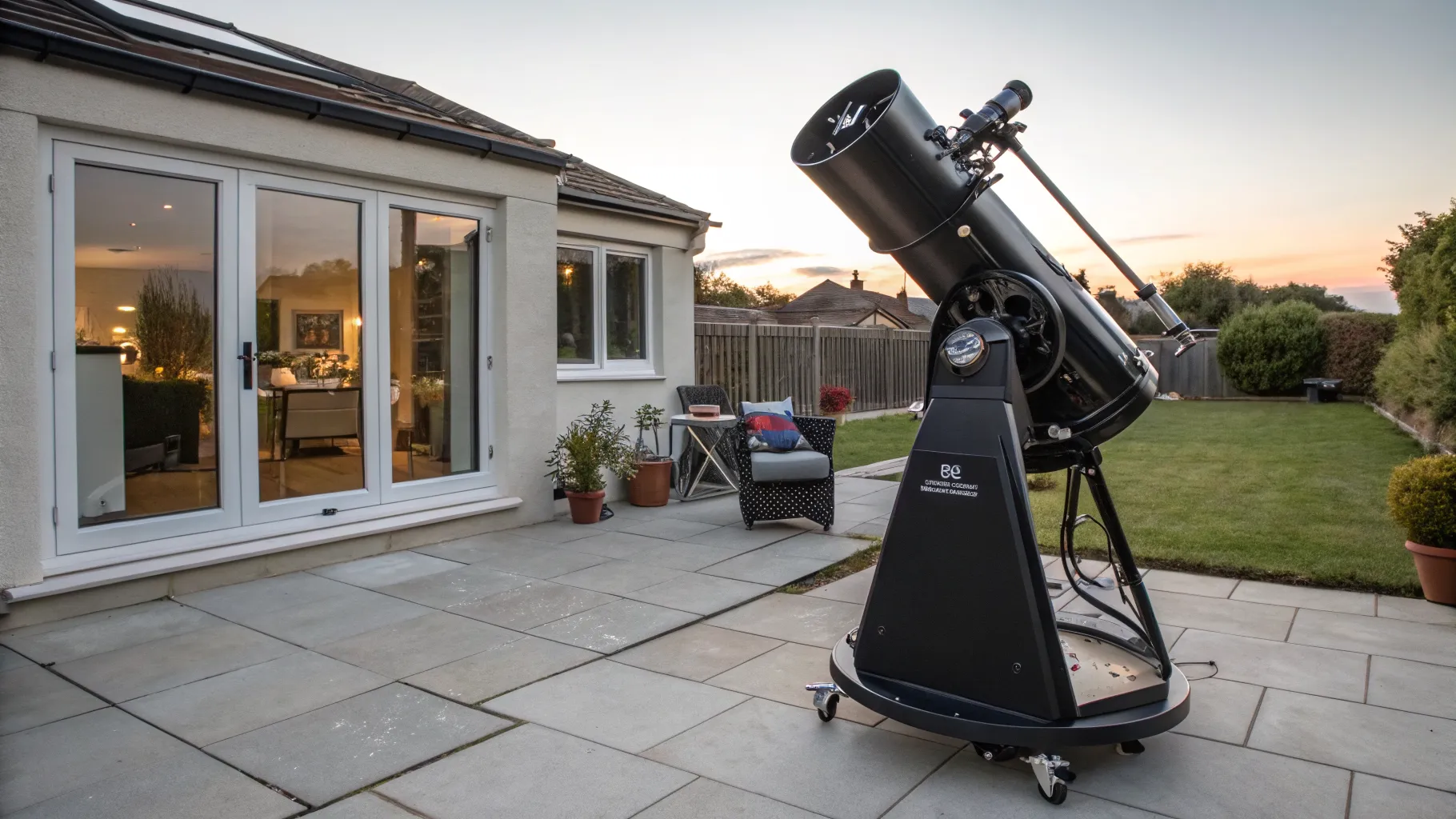
The Dobsonian vs equatorial mount decision trips up more first-time buyers than the choice of telescope itself, because the mount is the part you actually touch every night. The tube gathers the light; the mount decides whether the next hour is relaxed stargazing or a wrestling match with counterweights. Both designs hold the same kind of reflector, so this is not about optics. It is about how you move the scope, whether it tracks the sky for you, and what you plan to do once a faint smudge drifts into view.
Here is the honest comparison, built around the things that genuinely decide it rather than a tidy winner that ignores how you will actually use the scope.
What each mount actually is
A Dobsonian is a Newtonian reflector sitting on a simple alt-azimuth base, often just a plywood box that swivels left and right and tilts up and down. You point it the way you would point a garden hose: move it toward the target and let go. The base carries the weight directly, so there are no counterweights and almost nothing to set up.
An equatorial mount, usually the German equatorial (GEM) you see under many beginner Newtonians, tilts its whole framework over so that one axis lines up with the Earth’s rotation. That axis is called right ascension. Once it is aligned, a single slow turn of one knob (or one motor) follows a star across the sky. To balance the tube on that tilted axis, the mount needs counterweights roughly equal to the weight of the optical tube itself.
Setup and ease of use
This is where a Dobsonian wins outright for a beginner. Carry it outside, set it down, and you are observing in under a minute. There is nothing to align, nothing to balance, no manual to reread in the dark.
An equatorial mount asks for more before you see anything. You level the tripod, balance the tube against the counterweights on two axes, and then polar align so the right ascension axis points at the celestial pole. With practice and the polar scope built into most mounts, a rough alignment takes ten to fifteen minutes; on your first few nights it takes longer and feels fiddly. None of it is hard once learned, but it is a real, repeated tax on every session.
Tracking the sky
The sky drifts. At typical magnifications a planet crosses the eyepiece and vanishes in under a minute, so you are constantly renudging the scope. Both mounts deal with this, just differently.
With a Dobsonian you nudge by hand, and because the motion is intuitive (up, down, left, right) most people get the knack quickly. The downside is that you cannot let go for long, which matters at high power and when showing the view to other people.
A polar-aligned equatorial mount tracks with one motion. Add a single motor on the right ascension axis and the scope follows a target on its own, keeping a planet centred for as long as you like. For high-magnification planetary viewing and for sharing the eyepiece, that hands-off tracking is genuinely lovely.
Astrophotography: the real dividing line
If you want to photograph faint deep-sky objects, this is where the decision is made for you. Long-exposure astrophotography needs the camera to follow the sky for minutes or hours without the field rotating. An alt-azimuth Dobsonian cannot do that: even with tracking, the whole image slowly rotates because the mount is not aligned to the Earth’s axis, so stars smear into arcs. That is why you cannot do serious deep-sky imaging on a Dob.
A properly polar-aligned equatorial mount turns around a single axis matched to the Earth, so the field stays still and stars stay as points through long exposures. Entry-level equatorial mounts can deliver clean multi-minute frames of nebulae and galaxies, which is simply impossible on a Dobsonian. If imaging is your goal, you want an equatorial. If you only ever want to look, you do not need one.
Eyepiece comfort and the quirks
A Dobsonian keeps the eyepiece in a sensible, reachable place as you move around the sky, which is part of why it is so relaxing to use. An equatorial-mounted Newtonian does the opposite: as you swing to different parts of the sky the eyepiece can end up underneath the tube or at an awkward angle, and you sometimes have to rotate the tube in its rings to get comfortable. It is a small thing on paper and a real annoyance at the eyepiece.
Cost and what you get for the money
Pound for pound, a Dobsonian gives you far more telescope. A mount is expensive engineering, and a sturdy equatorial mount eats a large share of the budget before you have paid for any aperture. Spend the same money on a Dob and almost all of it goes into the mirror, so you get a noticeably bigger aperture and brighter, more detailed views. For a first scope aimed at observing, that is a strong argument for the Dobsonian.
So which should you buy?
If you want the most aperture for your money, the least faff, and relaxed visual stargazing of the Moon, planets and deep-sky objects, buy a Dobsonian. It is the classic beginner recommendation for exactly these reasons.
If you already know you want to photograph the night sky, or you specifically want hands-off motor tracking for high-power planetary viewing, choose an equatorial mount and accept the extra setup, weight and cost that come with it. The one thing not to do is buy an equatorial “just in case”: it adds complexity you may never use, and if you catch the imaging bug later you can buy a dedicated setup then.
For more on choosing the tube itself, see our guide to refractor vs reflector telescopes and telescope aperture explained, and for the whole process read how to buy a telescope in the UK. The BBC’s Sky at Night Magazine mount guide is a useful second opinion.
Frequently asked questions
Is a Dobsonian or equatorial mount better for a beginner? For most beginners a Dobsonian is better. It needs no setup or alignment, gives the most aperture for the money, and keeps the eyepiece comfortable. Choose an equatorial mount only if you specifically want astrophotography or motorised tracking.
Can you do astrophotography with a Dobsonian? Not for deep-sky objects. Because a Dobsonian is an alt-azimuth mount, the image field slowly rotates even when tracking, smearing stars during long exposures. You can take short snaps of the Moon and bright planets, but serious deep-sky imaging needs an equatorial mount.
Why do equatorial mounts need counterweights? An equatorial mount tilts the tube on an angled axis, so the optical tube would be unbalanced without something to offset it. The counterweights, roughly equal to the weight of the tube, balance it on the right ascension axis so it moves smoothly and tracks accurately.
What is polar alignment and do I have to do it every time? Polar alignment points the mount’s right ascension axis at the celestial pole so it can track the sky with one motion. You realign each time you set the mount up outdoors. A rough alignment for visual use takes about ten to fifteen minutes once you are practised; imaging needs a more careful job.
Is a Dobsonian an alt-azimuth mount? Yes. A Dobsonian is a Newtonian reflector on a simple alt-azimuth base that moves up-down and left-right. That intuitive motion is why it is so easy to use, and also why it cannot track for long-exposure astrophotography the way an equatorial mount can.
Clear skies forecast? Get a nudge.
Our weekly email flags the next good UK observing window and one easy target to find.
Join the listMore from Starvest
Keep reading
Best Telescopes for Beginners in the UK (Tested by Price Bracket)
The best beginner telescopes in the UK by budget, from sub-£150 tabletop scopes to app-guided and smart telescopes, with real 2026 prices.
What Can You See with Binoculars at Night? A Realistic Astronomy List
A realistic list of what you can see with binoculars in astronomy, from the Moon and Jupiter's moons to Andromeda, with tips for spotting each from the UK.
How to Set Up and Use Your First Telescope (Step by Step)
How to use a telescope as a beginner: assemble the mount, align the finder, focus, and find your first targets. A clear step-by-step UK guide.