Double Cluster in Perseus: Find It Tonight From the UK
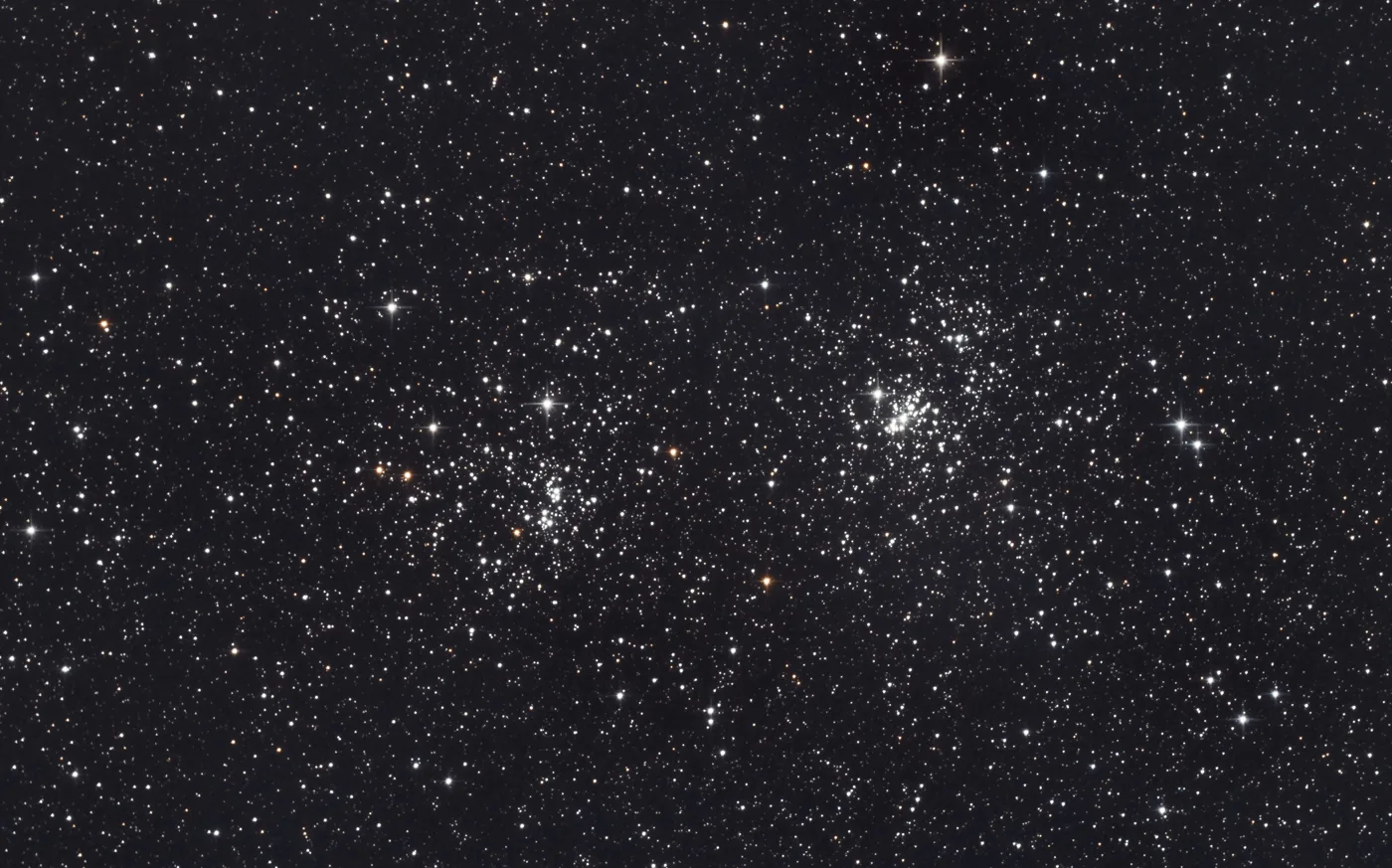
The Double Cluster in Perseus is the best binocular object in the northern sky that most beginners have never looked at. It is two rich star clusters, NGC 869 and NGC 884, sitting side by side in a patch of sky about a degree across, and from anywhere in Britain it never sets. On an autumn night it climbs almost straight overhead, clear of rooftops and the worst of the light pollution, which is more than you can say for most showpieces.
It asks very little: a pair of binoculars or a small telescope at low power, and two minutes of star-hopping from Cassiopeia. This page covers where it is and when, how to find it, what each kind of instrument shows, and the one mistake that makes it look disappointing.
What the Double Cluster is
Two open clusters, catalogued as NGC 869 and NGC 884, also known as h and Chi Persei (Johann Bayer gave them star-style letters in 1603 because they look like fuzzy stars to the naked eye). Together they are Caldwell 14. Messier left them out of his catalogue, which is why they are less famous than they deserve to be.
| NGC 869 (h Persei) | NGC 884 (Chi Persei) | |
|---|---|---|
| Brightness | Magnitude 3.7 | Magnitude 3.8 |
| Distance | About 7,460 light years | About 7,640 light years |
| Age | About 14 million years | About 14 million years |
| What stands out | Denser, brighter core | Looser, with several orange-red stars |
Figures from the Wikipedia summary of the published studies. For scale, the Pleiades is estimated at 75 to 150 million years old, so these clusters are infants by comparison. They are the heart of a larger group of young, hot stars called the Perseus OB1 association.
The detail worth looking for is in NGC 884: five red supergiants of around 8th magnitude, RS, AD, FZ, V403 and V439 Persei. Against the blue-white crowd of the clusters they show as small orange sparks, and they are all variable.
When to look from the UK
The clusters sit at a declination of about +57 degrees. Anything north of roughly +40 degrees never sets from southern England, so the Double Cluster is circumpolar from the whole of the UK. It is up every clear night of the year; what changes is how high it is at a convenient hour.
| From | Highest above the horizon | Lowest above the horizon |
|---|---|---|
| Plymouth | 83 degrees | 18 degrees |
| London | 84 degrees | 19 degrees |
| Manchester | 86 degrees | 21 degrees |
| Edinburgh | 89 degrees | 23 degrees |
| Inverness | 90 degrees | 25 degrees |
From Scotland it passes almost exactly overhead. At its highest it is due south of the zenith, and at its lowest it skims the northern horizon.
It reaches its highest point at these times (for Greenwich; add about four minutes for every degree of longitude west of London, so roughly ten minutes from Manchester and thirteen from Edinburgh):
| Date | Highest at |
|---|---|
| 15 October 2026 | 01:47 BST |
| 1 November 2026 | 23:36 GMT |
| 15 November 2026 | 22:41 GMT |
| 1 December 2026 | 21:38 GMT |
| 15 December 2026 | 20:43 GMT |
| 15 January 2027 | 18:42 GMT |
| 15 February 2027 | 16:40 GMT |
We worked those out from the clusters’ position and sidereal time; they are good to within a few minutes. The pattern is simple: October to February is the season, with November and December the sweet spot, when it is near the overhead point by mid-evening. In spring it sinks into the north-west after dark, and on summer nights it sits low in the north-east in twilight, still visible but washed out.
Because it is so high in autumn, the Double Cluster is one of the few deep-sky objects that suburban observers can enjoy properly. Light pollution is worst near the horizon, where you look through the most air and sky glow. Near the zenith you get the darkest patch of sky your site has.
How to find it: two star-hops from Cassiopeia
You need to recognise Cassiopeia, the bright W (or M, depending on the time of night) high in the north-east in autumn evenings.
Method 1: from Cassiopeia towards Mirfak. Find Mirfak, the brightest star in Perseus, which sits below Cassiopeia in the autumn evening sky and has a little scatter of stars around it. Draw a line from Mirfak to the middle of the W. The Double Cluster lies a little more than halfway along that line, closer to Cassiopeia. Sweep along it with binoculars and you cannot miss two bright knots of stars in one field.
Method 2: by eye from a dark site. Away from street lights, the clusters show without optics as a small, slightly elongated hazy patch in the Milky Way between Cassiopeia and Perseus. If you can see it, point binoculars straight at it. From a town you will probably not see it with the naked eye; use Method 1.
If you have a telescope, find it in the finder or a red dot first, then go to the main tube at your lowest power. Our step-by-step guide to finding objects with a telescope explains the routine if you have not star-hopped before.
What you will see in binoculars, a small scope and a bigger one
Binoculars (7x50, 10x50 or 15x70). Arguably the best view for the pair as a whole. A typical 10x50 shows about six to seven degrees of sky, so both clusters sit together in the middle of a rich Milky Way field, with chains of stars running away from them. Steadied on a tripod, 10x50s split each cluster into dozens of individual stars. The extra magnification of 15x70s helps with the cluster cores; our 10x50 vs 15x70 comparison covers the trade-off.
A small telescope at low power. This is where it becomes spectacular, provided you get the magnification right (see below). In a 130mm reflector at around 20x, both clusters fill the field with a glittering spray of stars, NGC 869 with its tighter core and NGC 884 with its scattered orange stars.
A bigger telescope (8-inch Dobsonian and up). More stars, deeper colour in the red supergiants, but you may have to choose: at most magnifications an 8-inch shows one cluster at a time, and you nudge between them.
The mistake: too much magnification
The pair spans roughly a degree of sky, about two full Moons side by side. To see both clusters together you need an eyepiece that shows at least 1 to 1.5 degrees.
A quick way to estimate it: divide the eyepiece’s apparent field (printed on it or in the spec, about 50 degrees for a Plössl) by the magnification. Magnification is telescope focal length divided by eyepiece focal length.
| Telescope | Eyepiece | Magnification | Field of view (approx.) | Both clusters? |
|---|---|---|---|---|
| 650mm focal length (e.g. a 130mm reflector) | 25mm Plössl | 26x | 1.9 degrees | Yes, comfortably |
| 650mm focal length | 10mm | 65x | 0.8 degrees | No, one at a time |
| 1,200mm focal length (e.g. an 8-inch Dobsonian) | 32mm Plössl | 37.5x | 1.3 degrees | Yes, just |
| 1,200mm focal length | 25mm Plössl | 48x | 1.0 degree | Only just, or not |
Calculated using a 50-degree apparent field. A wide-angle eyepiece with a 68 or 82-degree field gives more room at the same magnification. Our telescope eyepieces explained page goes further into apparent and true field.
The rule of thumb: put in your longest-focal-length eyepiece, look at the pair, and only then try more power on each cluster’s core.
Nearby while you are there
- Stock 2, a large, loose open cluster about two degrees north of the Double Cluster, sometimes called the Muscleman Cluster for the stick-figure shape of its brighter stars. It spans about a degree, too big for most telescopes and best in binoculars.
- Melotte 20, the Alpha Persei Cluster, the bright scatter of stars around Mirfak that you used for the star-hop. It is a superb binocular field in its own right.
- The Andromeda Galaxy, a short binocular sweep away in the same part of the autumn sky. Our guide to seeing the Andromeda Galaxy has the route.
Frequently asked questions
Can you see the Double Cluster with the naked eye? Yes, from a dark site, as a small hazy patch between Cassiopeia and Perseus; each cluster is around magnitude 3.7 to 3.8 but spread out, so it looks fainter than a star of that brightness. From towns you will usually need binoculars.
What is the best time of year to see the Double Cluster from the UK? October to February, with November and December best, when it is near the overhead point between about 21:00 and midnight. It never sets from the UK, so it is technically visible all year, but summer twilight and its low position then make it much less impressive.
What magnification is best for the Double Cluster? Low. You need a field of view of at least 1 to 1.5 degrees to fit both clusters, which usually means 20x to 40x, depending on your eyepiece. Higher power shows only one cluster at a time.
Are the two clusters really next to each other? Roughly. They are both about 7,500 light years away, with published distances of about 7,460 and 7,640 light years, and are both about 14 million years old, so they probably formed in the same region of star formation.
Why is the Double Cluster not a Messier object? Charles Messier catalogued fuzzy objects that could be mistaken for comets, and he did not include the pair. It was recorded as long ago as Hipparchus, around 130 BC, and is listed in Patrick Moore’s Caldwell catalogue as Caldwell 14.
What are the orange stars in the Double Cluster? Mostly red supergiants in NGC 884, about 8th magnitude, including RS Persei and AD Persei. They are within reach of a small telescope and stand out against the blue-white stars around them.
Sources
- Double Cluster summary and references: Wikipedia, Double Cluster.
- NASA Hubble Caldwell catalogue entry, Caldwell 14.
- Rise, transit and altitude figures calculated by Starvest from the clusters’ J2000 position (RA 2h 20m, Dec +57 degrees 08 minutes), precessed to 2026.
Clear skies forecast? Get a nudge.
Our weekly email flags the next good UK observing window and one easy target to find.
Join the listMore from Starvest
Keep reading
Best Telescopes for Beginners in the UK (Tested by Price Bracket)
The best beginner telescopes in the UK by budget, from sub-£150 tabletop scopes to app-guided and smart telescopes, with real 2026 prices.
What Can You See with Binoculars at Night? A Realistic Astronomy List
A realistic list of what you can see with binoculars in astronomy, from the Moon and Jupiter's moons to Andromeda, with tips for spotting each from the UK.
How to Set Up and Use Your First Telescope (Step by Step)
How to use a telescope as a beginner: assemble the mount, align the finder, focus, and find your first targets. A clear step-by-step UK guide.