See the Milky Way in the UK: the Core Only Gets 10° Up
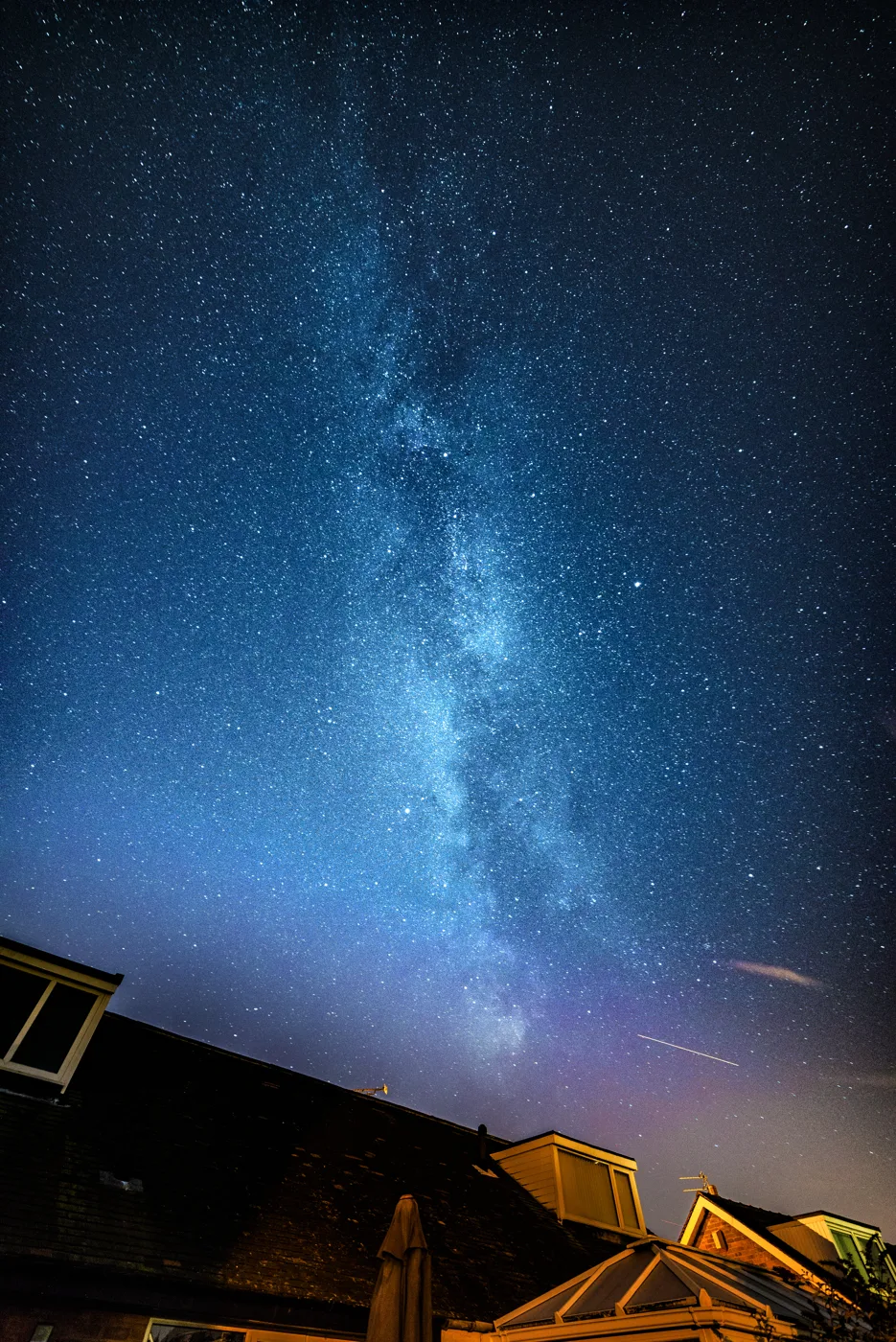
Almost every article about how to see the Milky Way in the UK is illustrated with a photograph that cannot be taken from Britain: a bright orange galactic core standing high in a black sky. From the latitude of Exmoor the centre of our galaxy never climbs higher than about ten degrees, which is the width of your fist held at arm’s length, and it does that only in the few weeks of the year when British nights are barely dark. Understanding that one limit is the difference between a good night out and driving three hours to see nothing.
The good news is that the Milky Way is genuinely spectacular from the UK. It is just a different part of it, at a different time of year, in a different direction, and it passes almost directly overhead.
The core is a low southern object from anywhere in Britain
The bright centre of the galaxy sits in Sagittarius, at a declination of about 29 degrees south. From a given latitude, the highest it can ever reach is 90 degrees minus your latitude minus 29. At 51 degrees north that is nine and a half degrees. No date, no equipment and no amount of clear sky changes it.
The solid bars are the number that matters, and they are lower than the ceiling, because the core reaches its highest point at a moment when the sky is often not dark. In 2026 the best the galactic centre managed at Bodmin Moor while the sun was more than 18 degrees below the horizon was 9.6 degrees, at just after three in the morning on 8 May. From the Isle of Skye it did not clear the horizon in darkness at all.
There is an awkward conclusion in that chart. Britain’s most celebrated dark sky destinations are in the north: Galloway Forest Park, Northumberland, and the whole of the Scottish Highlands. For the galactic core specifically, they are the worst places in the country. Kielder gets it to 2.7 degrees. Cornwall gets it three and a half times higher. If your goal is the bright Sagittarius star clouds, you want to be as far south as you can get and as far from a town as possible, which in practice means Bodmin Moor, Exmoor, the South Downs or the Pembrokeshire coast.
Ten degrees is also the altitude at which the atmosphere is doing the most damage. You are looking through roughly five and a half times as much air as you would be at the zenith, which dims and reddens everything, and any light dome from a town on your southern horizon sits exactly where you need to be looking. Choose a site with open sea or open moor to the south.
The part of the Milky Way that actually passes overhead
Fixating on the core means missing the thing Britain is good at. The Cygnus section of the Milky Way, the stretch through Cygnus, Lyra and Aquila with the Great Rift splitting it down the middle, transits within six degrees of the zenith from southern England.
Here is the whole year at Exmoor, computed for 2026, showing hours of true astronomical darkness alongside how high each part of the galaxy climbs while that darkness lasts:
| Month | Hours of full darkness | Core, highest in the dark | Cygnus, highest in the dark | Time the core peaks |
|---|---|---|---|---|
| January | 11.7 | below the horizon | 49° | - |
| February | 10.4 | 3.1° | 38° | 05:20 |
| March | 8.7 | 6.8° | 45° | 04:20 |
| April | 6.2 | 8.3° | 50° | 03:48 |
| May | 2.8 | 8.7° | 51° | 02:40 |
| June | 0.0 | no darkness at all | no darkness at all | - |
| July | 0.4 | 6.7° | 84° | 00:44 |
| August | 4.3 | 7.4° | 84° | 23:48 |
| September | 7.2 | 6.4° | 84° | 22:04 |
| October | 9.3 | 3.7° | 84° | 20:44 |
| November | 11.0 | below the horizon | 82° | - |
| December | 11.9 | below the horizon | 70° | - |
Read the two middle columns together and the answer falls out. The core peaks in May, when Exmoor gets under three hours of darkness and the peak happens at twenty to three in the morning. Cygnus sits at 84 degrees, effectively straight up, for four solid months, and in September you get more than seven hours of darkness to enjoy it in.
The best months are late August and September
September is the month where every constraint relaxes at once. There are seven hours of proper darkness. Cygnus is overhead as soon as it gets dark. The core is still six degrees up in the south southwest at around ten in the evening, so you can see the brightest section of the arch and the low core in the same look. And you are not standing outside at three in the morning to do it.
Late August is a close second, with four hours of darkness and the core about a degree higher, but everything happens later: the core peaks just before midnight and darkness does not arrive until nearly eleven.
October still works for the overhead arch, but the core is gone by then, sinking below four degrees. April and early May are the alternative if you specifically want the core at its highest and do not mind a pre dawn start.
June is not a difficult month, it is an impossible one
The reason the season is so short has nothing to do with the galaxy and everything to do with the sun. Astronomical darkness needs the sun more than 18 degrees below the horizon, and at Exmoor’s latitude the sun only reaches about 15 degrees below at midsummer midnight. There is no astronomical darkness anywhere in Britain from roughly the third week of May to the third week of July, and the further north you go the longer that gap runs. It is about 48 nights at Bodmin Moor, 56 at Exmoor, 91 at Kielder and 105 on Skye.
That is why northern dark sky parks and the Milky Way core pull in opposite directions. Going north buys you darker skies for nine months of the year and takes away both the altitude and the summer nights when the core is up.
Moon first, weather second, site third
You can be at the darkest site in Britain on the perfect date and see nothing but a grey wash, because a moon anywhere above the horizon at more than a slim crescent will drown the Milky Way completely.
The Royal Observatory Greenwich publishes the full moon calendar for 2026: the autumn full moons fall on 26 September at 5.49pm and 26 October at 4.12am. Work outward from those. The week either side is unusable for the Milky Way, and the darkest skies of the autumn are in the first ten days of each month.
After the moon, check the forecast for high cloud rather than low cloud, because thin cirrus is the thing that quietly ruins a night that looks clear from a car park. And give your eyes a proper 30 to 40 minutes with no white light at all. The Milky Way is a low contrast object and dark adaptation matters more for it than for anything else in the sky.
Where to go, and what you need
You need a site with a genuinely dark southern horizon. The DarkSky International list of International Dark Sky Places includes several in the right latitude band, and Exmoor, which became the first International Dark Sky Reserve in Europe, publishes its own stargazing and dark skies guidance with named viewing spots. Our own round ups of dark sky sites across the UK and the best stargazing spots in England go further into access and parking.
Equipment is the easy part, because the Milky Way is a naked eye object and a telescope actively makes it worse by narrowing your field of view to a fraction of a degree. Go out with nothing, let your eyes adapt, and read our guide to naked eye stargazing first. If you want to add something, a pair of binoculars sweeping along Cygnus and Aquila resolves the glow into thousands of individual stars, which is arguably the best view of the Milky Way anyone gets from Britain. Binoculars for stargazing covers what to look for.
Frequently asked questions
Can you see the Milky Way in the UK at all? Yes, and easily, from a properly dark site on a moonless night. What you see is the Cygnus and Aquila section, a broad soft band running from the north east horizon through the zenith and down towards the south west, with a dark lane splitting it. What you will not see from Britain is the bright orange galactic core standing high in the sky, because from UK latitudes it never rises more than about ten degrees.
What is the best month to see the Milky Way in the UK? September, for most people. There are more than seven hours of astronomical darkness, the overhead section is at its highest as soon as darkness falls, and the core is still six degrees above the south south west horizon at about ten in the evening. Late August is the alternative if you want the core slightly higher and do not mind waiting until nearly eleven for darkness.
Why can I not see the Milky Way in June? Because there is no astronomical darkness in Britain in June at all. The sun stays too close to the horizon all night. At Exmoor’s latitude the sun only gets about 15 degrees below the horizon at midsummer midnight, and full darkness needs 18. The gap runs roughly from the third week of May to the third week of July in the south, and considerably longer in Scotland.
Do I need a telescope to see the Milky Way? No, and a telescope is the wrong instrument for it. The Milky Way spans the whole sky and a telescope shows you a fraction of a degree at a time. Your eyes, fully dark adapted, are the right tool. Binoculars are a good addition because they resolve the glow into star fields, particularly around Cygnus and Aquila.
Is Scotland a good place to see the Milky Way? For dark skies in general, yes, it is among the best in Europe. For the galactic core specifically, no. From the Isle of Skye the core never clears the horizon during astronomical darkness at all, and from Galloway Forest Park it reaches under three degrees. Scotland is superb for the overhead arch in autumn and winter, for the aurora, and for faint deep sky objects. For the Sagittarius star clouds, head south.
How dark does a site need to be? Dark enough that the Milky Way is the reason you notice the sky, not something you have to hunt for. In practice that means being well away from any town, with no direct lights in view, and crucially with nothing bright on your southern horizon if the core is what you are after. The light pollution maps are the quickest way to find a candidate site, but the deciding factor is usually what sits on the horizon in the direction you want to look, which a map will not tell you.
Clear skies forecast? Get a nudge.
Our weekly email flags the next good UK observing window and one easy target to find.
Join the listMore from Starvest
Keep reading
Best Telescopes for Beginners in the UK (Tested by Price Bracket)
The best beginner telescopes in the UK by budget, from sub-£150 tabletop scopes to app-guided and smart telescopes, with real 2026 prices.
What Can You See with Binoculars at Night? A Realistic Astronomy List
A realistic list of what you can see with binoculars in astronomy, from the Moon and Jupiter's moons to Andromeda, with tips for spotting each from the UK.
How to Set Up and Use Your First Telescope (Step by Step)
How to use a telescope as a beginner: assemble the mount, align the finder, focus, and find your first targets. A clear step-by-step UK guide.