Naked Eye Astronomy: 9 Things to Find Tonight in the UK
The fastest way to fall out of love with astronomy is to buy a telescope first. Naked eye astronomy costs nothing, works from a back garden in a light-polluted town, and teaches you the one skill every other piece of kit depends on: knowing where you are pointing. Learn the sky with your eyes and a telescope becomes a magnifier for things you already know how to find. Buy the telescope first and it becomes a tripod-shaped reminder that you cannot find anything.
This is the order to work through, easiest first, plus the dated events between now and the end of 2026 that are worth setting an alarm for.
Before you go out: the twenty minutes that doubles what you see
Your eyes take roughly 20 to 30 minutes to dark-adapt, and one glance at a phone screen resets most of it. Get outside, put the phone away or switch it to a red night mode, stand somewhere a wall or hedge blocks the nearest streetlight, and give it time. Almost everyone who says “there is nothing to see from my garden” walked out, looked up for 90 seconds and went back in.
Two other basics. A clear night after rain or with a brisk wind is usually the most transparent. And a bright Moon washes out everything faint, so save the galaxy hunting for the week around new Moon and use the bright-Moon nights to look at the Moon itself.
1. The Plough, and how it finds you north
Seven bright stars in the shape of a saucepan, high in the north. From the UK it never sets, so it is up every clear night of the year, just rotating around the pole. Find it once and you have a permanent signpost.
Take the two stars at the end of the pan, away from the handle. They are Dubhe and Merak, and astronomers call them the Pointers. Follow the line they make upwards about five times the gap between them and you land on a moderately bright, lonely-looking star. That is Polaris, the Pole Star, and it sits almost exactly over the North Pole. Its height above your horizon equals your latitude, so from southern England it is a little over halfway up, and from northern Scotland noticeably higher.
Polaris is not the brightest star in the sky, which surprises most beginners. Its usefulness is that it barely moves.
2. Cassiopeia, the other circumpolar anchor
Directly across the pole from the Plough is a lopsided W of five stars. That is Cassiopeia. Because it and the Plough sit on opposite sides of Polaris, when one is low the other is high, so between them you can orient yourself on any clear night. If you can find these two shapes, you can find everything else on this list.
3. The Summer Triangle
Look overhead on an August or September evening and three bright stars dominate. Vega is the brightest and nearly straight up; Deneb sits to its east at the tail of Cygnus the swan; Altair is the lower one to the south. They belong to three different constellations, which is why it is called an asterism rather than a constellation.
Cygnus is worth learning properly, because it doubles as a cross laid along the Milky Way and points the way to the next target.
4. The Milky Way, and the dark rift running through it
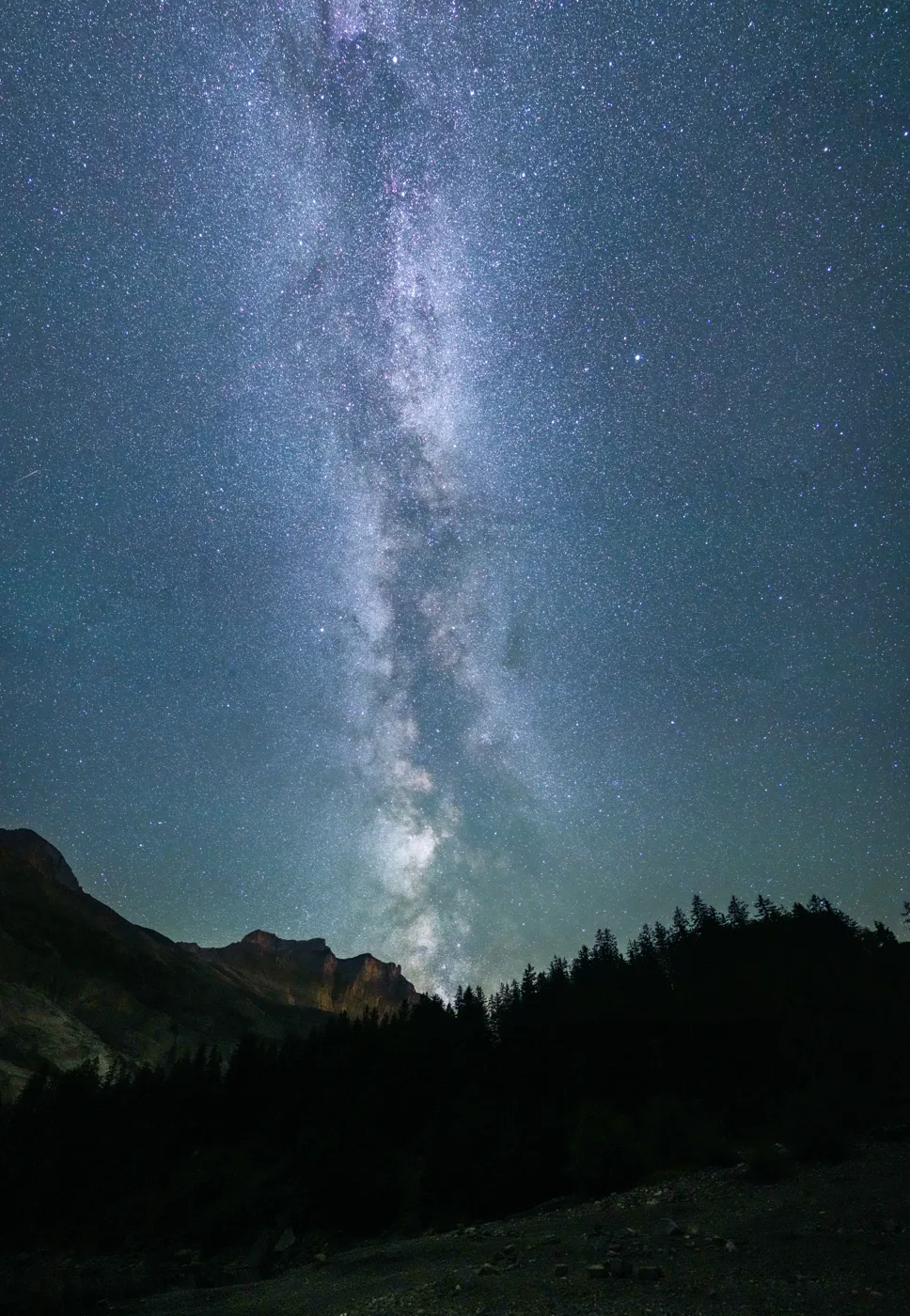
Late summer is the best time of year for this from the UK. Look south after dark and, from a genuinely dark site, the Milky Way arches across the sky as a faint band of light. Running through it from Cygnus overhead down towards Sagittarius near the southern horizon is a darker channel, the Great Rift, which is dust in our own galaxy blocking the starlight behind it.
Be honest about what your sky allows. From a town centre you will see nothing of this. From a rural garden on a moonless night you will see the band; from a dark sky reserve you will see structure in it. The Royal Observatory Greenwich night sky notes confirm this is prime season for it, looking south after sunset.
5. The Andromeda Galaxy
The furthest thing your unaided eye can see, at roughly 2.5 million light years. It is a faint smudge, not a spiral; every photograph you have seen is a long exposure. Find the W of Cassiopeia, take the deeper V of the W as a rough arrowhead, and follow where it points for about three fist-widths at arm’s length.
The trick that makes it appear is averted vision: look slightly to one side of where you think it is, and the more sensitive part of your retina picks it up. It vanishes when you look straight at it. This is the single most useful observing technique on this page and it works on every faint object.
6. The Pleiades
From autumn through winter, a small tight knot of stars sits in Taurus, often mistaken for the Little Dipper by people who have not yet found the Plough. Most people see six stars; sharp eyes under dark skies see more, and it is a genuinely good test of your sky and your eyesight.
The Pleiades is also the best possible argument for ordinary binoculars over a telescope as a first purchase. A telescope magnifies too much to fit the cluster in; a modest pair of binoculars turns the six stars into dozens.
7. Orion, from December onwards
Nothing else in the winter sky is as easy. Three bright stars in a short straight row make the Belt, with orange Betelgeuse above and blue-white Rigel below. The colour difference is obvious to the naked eye once you know to look, and it is real: one is a red supergiant near the end of its life, the other a hot blue supergiant.
Hanging below the Belt is the fainter line of the Sword, and the middle “star” in it is not a star but the Orion Nebula, a cloud where stars are still forming. On a dark night it looks softer and fuzzier than the stars around it, which is as much as any eye can do.
8. Planets, and how to know you are looking at one
Planets do not twinkle in the way stars do. A star is effectively a point of light, so turbulence in our atmosphere makes it flicker and flash colour; a planet is a small disc, and the effect averages out to a steadier light. If something bright is sitting rock-steady while everything around it shimmers, that is a planet.
They also move against the background stars from week to week and always sit near the ecliptic, the line the Sun and Moon follow, so they never appear near Polaris. Jupiter and Venus are the two that regularly outshine every star in the sky. Venus is only ever visible near sunrise or sunset, never in the middle of the night. A sky map app will tell you which is which in about five seconds.
9. The International Space Station
The one satisfying naked-eye target that is not astronomical. The ISS crosses in a few minutes as a bright, steady, unblinking point moving at a constant speed, usually within a couple of hours of sunset or sunrise, and it often fades out mid-pass as it enters the Earth’s shadow. Aircraft have flashing red and green lights and engine noise; the station has neither. Any decent astronomy app will alert you to passes over your postcode.
Dated events worth an alarm before the end of 2026
Partial lunar eclipse, 28 August 2026. From the UK it starts around 03:33 BST and reaches maximum at 05:12 BST, with roughly 90% of the Moon inside the Earth’s shadow. It happens low on the western horizon, so you need a clear, unobstructed westward view; the Moon takes on a red tinge at maximum.
Orionids, peaking 21 October 2026. Debris from Halley’s Comet, and typically around 20 meteors an hour at best. A waxing gibbous Moon will drown all but the brightest this year, so treat it as a bonus rather than a plan.
Geminids, peaking 14 December 2026. The strongest shower of the year, with rates that can reach 150 an hour under ideal conditions, and in 2026 only a waxing crescent Moon to spoil it. Cold, long nights and a well-placed radiant make this the best meteor night of the year from Britain. The Natural History Museum’s meteor shower guide sets out the wider calendar.
For any shower the advice is the same: no equipment, no looking directly at the radiant, lie back so you take in as much sky as possible, and give it at least an hour.
What to buy, when you finally buy something
In order of how much they improve a beginner’s night: a red torch, a reclining chair, warm boots, then binoculars. A telescope comes fifth, and it should come after you can find the objects on this page without help. Our guide to binoculars for stargazing in the UK covers the sensible first pair, and how to buy a telescope covers what to do when you are genuinely ready.
Frequently asked questions
How many stars can you see with the naked eye in the UK? Under a genuinely dark rural sky, a few thousand at any one time, down to about sixth magnitude. From a suburban garden that falls to a few hundred, and from a city centre you may see only the couple of dozen brightest stars and the planets.
Do I need to go somewhere dark to start naked eye astronomy? No. The Plough, Cassiopeia, the Summer Triangle, Orion, the planets and the ISS are all visible from an ordinary town garden. Only the faint targets, the Milky Way and the Andromeda Galaxy, genuinely require a dark site.
How long do my eyes take to adjust to the dark? Around 20 to 30 minutes for most of the benefit, and it continues to improve for longer. A single look at a white phone screen undoes much of it, which is why a red torch or a phone in red night mode matters.
How do I tell a planet from a star? Planets shine with a steady light while stars twinkle, planets sit near the ecliptic rather than scattered across the whole sky, and they shift position against the background stars over days and weeks.
Is the Andromeda Galaxy really visible without a telescope? Yes, on a moonless night from a dark site. It appears as a faint elongated smudge rather than a spiral, and it is easiest to spot using averted vision, looking slightly to one side of it.
When is the best time of year for naked eye stargazing in Britain? Autumn and winter, because the nights are long and genuinely dark. Midsummer nights in Scotland never get fully dark at all. Late summer is the exception worth keeping: it is the best season for the Milky Way, and the nights are warm enough to stay out.
Clear skies forecast? Get a nudge.
Our weekly email flags the next good UK observing window and one easy target to find.
Join the listMore from Starvest
Keep reading
Best Telescopes for Beginners in the UK (Tested by Price Bracket)
The best beginner telescopes in the UK by budget, from sub-£150 tabletop scopes to app-guided and smart telescopes, with real 2026 prices.
What Can You See with Binoculars at Night? A Realistic Astronomy List
A realistic list of what you can see with binoculars in astronomy, from the Moon and Jupiter's moons to Andromeda, with tips for spotting each from the UK.
How to Set Up and Use Your First Telescope (Step by Step)
How to use a telescope as a beginner: assemble the mount, align the finder, focus, and find your first targets. A clear step-by-step UK guide.