Ring Nebula Telescope View: Find M57 in Lyra From the UK
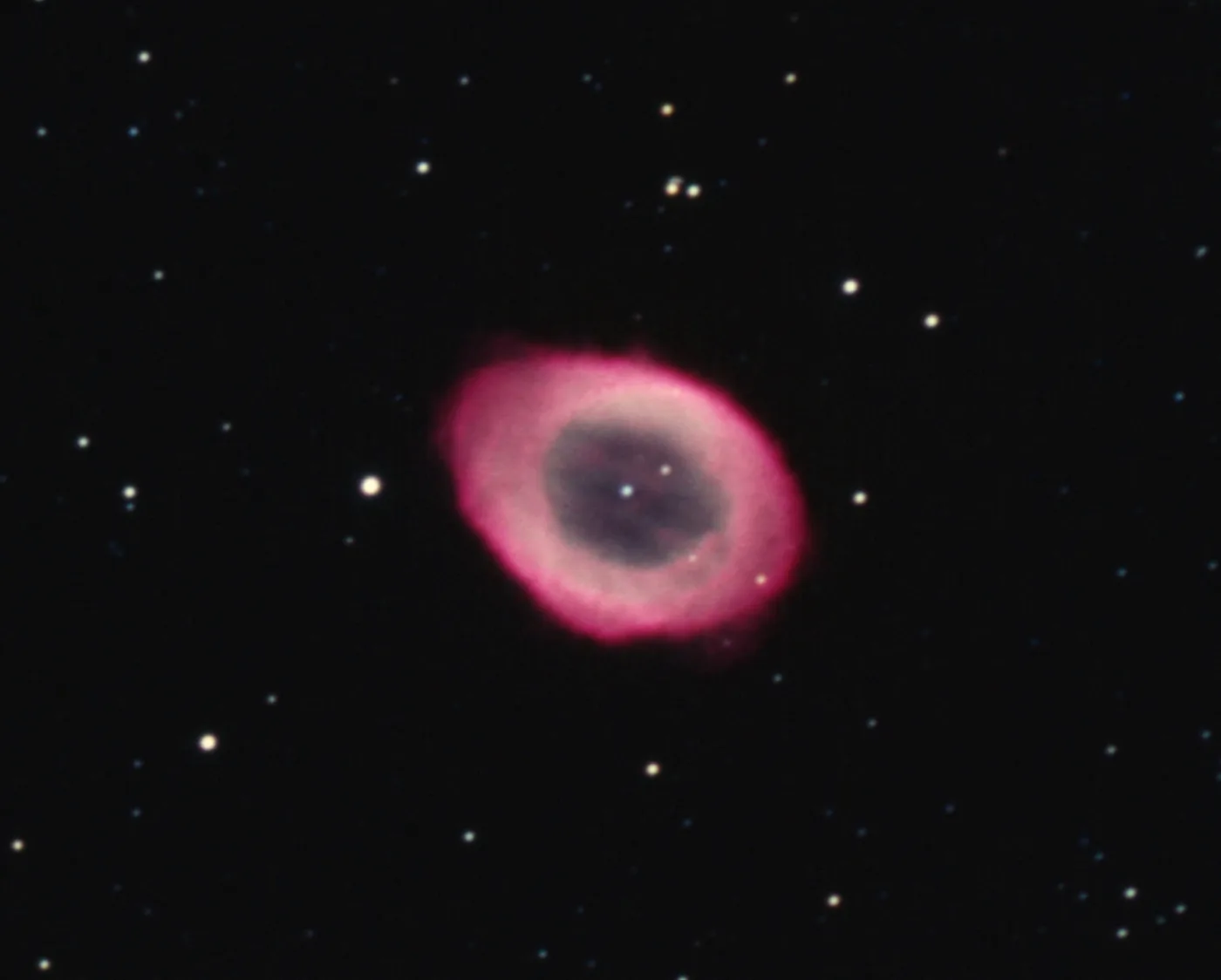
The Ring Nebula is one of the few deep-sky objects that looks in a small telescope roughly like it does in the photographs: a little smoke ring hanging among the stars. It is easy to find, because it sits between two stars you can see with the naked eye from a town garden, and it is bright enough to show through moderate light pollution. What catches people out is the size. At low power it is a tiny, slightly fuzzy dot that is easy to sweep straight past, and it only becomes a ring once you put the magnification up.
This page covers where M57 is, when it is well placed from Britain, the magnification and aperture that show the ring, and why the view is grey rather than the orange and blue of the pictures.
What the Ring Nebula is
M57, also catalogued as NGC 6720, is a planetary nebula: the shell of gas thrown off by a dying Sun-like star, lit up by the hot white dwarf left at its centre. “Planetary” is a historical label; it has nothing to do with planets.
| Ring Nebula (M57) | |
|---|---|
| Constellation | Lyra |
| Brightness | Magnitude 8.8 |
| Apparent size | About 1.4 by 1 arcminute |
| Distance | About 2,570 light years (Gaia) |
| Central star | Magnitude 15 to 16 |
| Found | 1779, by Charles Messier and, independently, Antoine Darquier |
Figures from the Wikipedia summary of the published measurements. Two numbers matter for observing. Magnitude 8.8 is well within reach of any telescope, but the light is packed into an object that is only about one-twentieth the width of the full Moon, so it behaves more like a faint, swollen star than a big glow. And the central star is far too faint for a small telescope; ignore anything that claims otherwise.
Where to find it: between Sheliak and Sulafat
Start at Vega, the brilliant blue-white star that is one of the brightest in the summer and autumn sky. Just to its south-east is a small parallelogram of fainter stars; together they make up Lyra. The two stars at the far end of the parallelogram from Vega are Sheliak (Beta Lyrae) and Sulafat (Gamma Lyrae), about two degrees apart.
The Ring Nebula sits on the line between them, roughly 40 per cent of the way from Sheliak towards Sulafat. In practice:
- Put a low-power eyepiece in (25 mm or so) and centre Sheliak.
- Move slowly towards Sulafat. Both stars fit in the field of most finder scopes, so you can line the finder up on the gap between them.
- Look for a “star” that refuses to come to a sharp point. That is M57.
- Swap to a higher-power eyepiece and centre it again.
One thing to know about Sheliak: it is an eclipsing binary that varies between about magnitude 3.3 and 4.4 every 13 days, so some nights it looks noticeably fainter than Sulafat and other nights they are a match. If the two stars do not look the way your chart says, that is why. Our page on how to find objects with a telescope covers star-hopping and finder alignment if you are new to it.
While you are in Lyra, Epsilon Lyrae, the “Double Double” just north-east of Vega, is the best test of a small telescope’s sharpness in the same patch of sky. It is in our list of double stars for small telescopes.
When to look from the UK
M57 is at a declination of about +33 degrees, which means it climbs high from anywhere in Britain:
| From | Highest above the horizon |
|---|---|
| Plymouth | 73 degrees |
| London | 72 degrees |
| Manchester | 70 degrees |
| Edinburgh | 67 degrees |
| Inverness | 66 degrees |
It is not quite circumpolar from England: it dips a few degrees below the northern horizon for part of each night. From the far north of Scotland it only just stays up.
It is highest in the south at these times (Greenwich; add about four minutes for each degree of longitude west of London):
| Date | Highest at |
|---|---|
| 15 June 2026 | 02:21 BST |
| 15 July 2026 | 00:19 BST |
| 15 August 2026 | 22:17 BST |
| 15 September 2026 | 20:15 BST |
| 15 October 2026 | 18:18 BST |
| 15 November 2026 | 15:16 GMT |
We worked those out from the nebula’s position and sidereal time; they are good to within a few minutes.
August and September are the best months. In June and early July it is well placed, but the UK gets no proper astronomical darkness around the solstice, and the bright sky costs you contrast on a faint object like this. From August the nights are dark again and Lyra is high by the end of twilight.
It is still worth chasing now. On 21 October, from London, M57 is about 61 degrees up at 8pm BST, 42 degrees at 10pm and 24 degrees by midnight, getting lower in the west. Look early in the evening, as soon as it is fully dark. By mid-November it is down to about 36 degrees at 8pm, and through December it is only well placed for an hour or so after dark before it sinks into the north-western murk.
What magnification shows the ring
This is where most first attempts go wrong. The ring is only about an arcminute across, so:
| Magnification | What you see |
|---|---|
| 25x to 40x | A slightly soft “star”, easy to miss. Good for finding it, not for seeing it. |
| 60x to 80x | A small oval disc, clearly not a star. The darker middle starts to hint at itself. |
| 100x to 150x | The ring: an oval with a darker centre, the shape most people are hoping for. |
| 200x and up | Bigger but dimmer. Only worth it on steady nights with 150 mm or more. |
Work out what your eyepieces give you with our telescope magnification calculator: divide the telescope’s focal length by the eyepiece focal length. On a typical 130 mm f/5 reflector (650 mm focal length), a 6 mm eyepiece gives about 108x, which is ideal. On a 70 mm refractor with a 700 mm focal length, a 6 mm or 7 mm eyepiece gives 100x to 117x.
What size telescope you need
- Binoculars: you can just about pick M57 up in 10x50s as a star-like point, but you cannot tell it is not a star. Binoculars will not show the ring.
- 60 mm to 80 mm: the oval shape and the darker centre show at around 100x on a dark, steady night. It looks small and faint, but it is unmistakably a ring once you have seen it.
- 100 mm to 130 mm: the ring is obvious and holds up well from a suburban garden. This is the size most beginners own, and M57 is a rewarding target for it.
- 200 mm and up: the ring brightens, its ends look slightly dimmer than its sides, and the centre shows a faint haze rather than pure black.
Aperture matters more than anything else here, because you are spreading a small amount of light over a bigger image as you raise the power. Our aperture explainer has the numbers behind that.
Why it looks grey, not orange and blue
The photographs show a blue-green inside and an orange-red edge. The blue-green is light from oxygen, the red from hydrogen and nitrogen. Your eyes cannot see most of it, for two reasons. At night your eyes switch to the rod cells, which are sensitive but colour-blind, so anything faint looks grey. And a camera stacks minutes or hours of light, while your eye works in a fraction of a second. Large telescopes on bright planetary nebulae sometimes show a faint green or blue tint; in a small telescope, expect a pale grey ring.
Three things make the grey ring easier to see:
- Dark adaptation. Give your eyes 20 minutes away from screens and lights. A phone held up “just to check the chart” resets most of it.
- Averted vision. Look slightly to one side of the nebula. The edge of your vision is more sensitive to faint light, and the dark centre often pops into view.
- A narrowband filter. A UHC or OIII filter blocks much of the streetlight glow while letting the nebula’s oxygen light through. Planetary nebulae are one of the few cases where these filters really earn their keep; see whether a light pollution filter is worth it.
If it still looks blurry, the problem is often the telescope rather than the sky: one that has not cooled down, or a reflector that needs collimating. Our blurry image fixes cover the usual causes.
Frequently asked questions
Can you see the Ring Nebula with a small telescope? Yes. A 70 mm or 80 mm telescope shows it as a small oval ring at around 100x on a dark night, and a 130 mm reflector shows the ring clearly from most gardens. It is one of the easiest planetary nebulae to see.
What magnification do you need to see the Ring Nebula? About 100x to 150x shows the ring with its darker centre. At lower powers it looks like a slightly fuzzy star; use those to find it, then switch to a shorter eyepiece.
Where is the Ring Nebula in the sky? In Lyra, between the stars Sheliak and Sulafat at the bottom of the small parallelogram south-east of Vega, about 40 per cent of the way from Sheliak to Sulafat.
When is the best time to see the Ring Nebula from the UK? August and September evenings, when it is high in the south after dark. It stays visible in the western sky early in the evening through October and into November.
Can you see the Ring Nebula with binoculars? Only as a star-like point, and you cannot tell it apart from a star. It needs a telescope at higher magnification to show its shape.
Why does the Ring Nebula look grey through a telescope? Your eyes rely on colour-blind rod cells in the dark, and the nebula is too faint to trigger colour vision. Photographs collect light for minutes or hours, which is why they show colours the eye cannot.
Clear skies forecast? Get a nudge.
Our weekly email flags the next good UK observing window and one easy target to find.
Join the listMore from Starvest
Keep reading
Best Telescopes for Beginners in the UK (Tested by Price Bracket)
The best beginner telescopes in the UK by budget, from sub-£150 tabletop scopes to app-guided and smart telescopes, with real 2026 prices.
What Can You See with Binoculars at Night? A Realistic Astronomy List
A realistic list of what you can see with binoculars in astronomy, from the Moon and Jupiter's moons to Andromeda, with tips for spotting each from the UK.
How to Set Up and Use Your First Telescope (Step by Step)
How to use a telescope as a beginner: assemble the mount, align the finder, focus, and find your first targets. A clear step-by-step UK guide.