Stargazing News: UK's Deepest Eclipse Since 1999
The 12th of August was the busiest evening British stargazers have had in years: a deep partial solar eclipse at teatime, then the Perseids peaking under a new Moon the same night. Both are worth going over now, because one of them is still running and the other has a long tail of lessons for next time. There is also a genuinely significant piece of solar science from the start of the month.
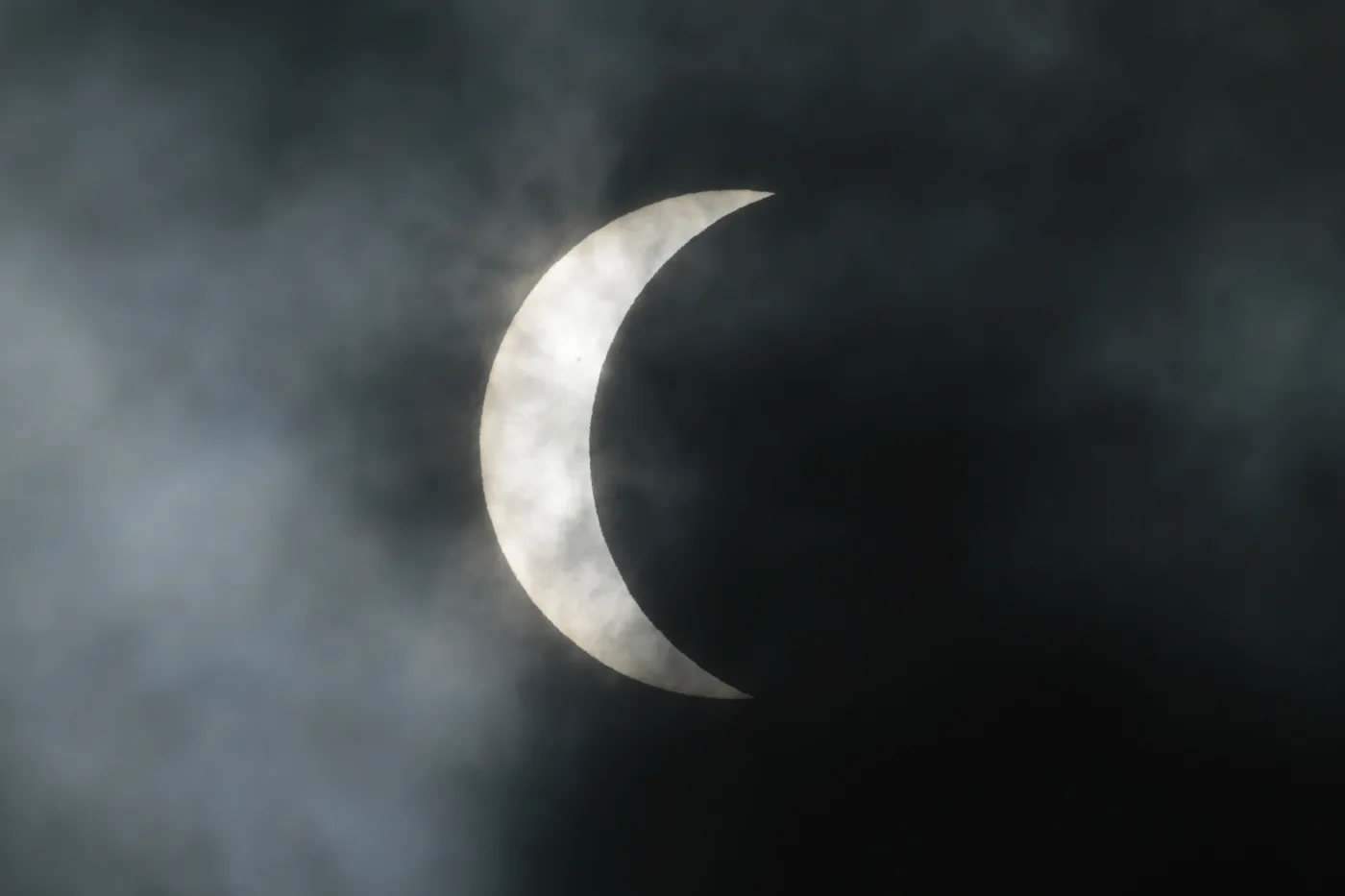
The eclipse took 90 to 95 per cent of the Sun, and it was the best since 1999
The partial solar eclipse on the evening of 12 August was the deepest seen from the UK and Ireland since the total eclipse of August 1999. Coverage rose towards the southwest: about 90 per cent from London, roughly 94 per cent from Pembrokeshire and about 95 per cent from Cornwall, with the Royal Observatory Greenwich putting first contact at 6.17pm and maximum at 7.12pm for London, a few minutes earlier further north. Because the Sun was low and this was a partial eclipse rather than a total one, the sky never went dark, it dimmed and cooled the way it does before a storm.
If you missed it or watched it through cloud, the honest news is that the next total solar eclipse visible from the UK is not until 2090, so treat the deep partials as the main event for the rest of your observing life. The practical lesson is the same one that catches people out every time: nothing in a normal telescope or binocular kit is safe to point at the Sun. Eclipse glasses must be ISO 12312-2 certified, and the only safe telescopic route is a purpose-made full-aperture solar filter fitted over the front of the tube or a dedicated solar scope. Sunglasses, exposed film, welding glass of the wrong shade and eyepiece-end “sun filters” are all dangerous. A pinhole projector, or the gaps between the leaves of a tree, costs nothing and works. The Royal Observatory’s guide is at Royal Museums Greenwich.
The Perseids peaked under a new Moon, and they run to 24 August
The Perseids peaked overnight on 12 to 13 August, and 2026 was the good year: the peak fell on a new Moon, so there was no moonlight washing out the fainter meteors. Under a genuinely dark sky the shower can deliver around 100 an hour at its best, though a typical UK site with some light pollution will show a fraction of that.
The shower stays active until 24 August, so there are still meteors to be had, thinning night by night. Two things worth knowing if you are heading out: the radiant in Perseus never sets from the UK, so you can see Perseids from nightfall onwards rather than waiting for the small hours, and telescopes and binoculars are actively unhelpful here, because they cut down the patch of sky you can watch. Lie back, give your eyes twenty minutes to adapt, and look at as much sky as you can. If you are trying to photograph them, our 500 rule calculator sets your maximum exposure before the stars trail, and the Bortle scale calculator is a quick sanity check on how dark your site actually is. The Royal Observatory’s shower guide is at Royal Museums Greenwich.
The sharpest ever pictures of the Sun’s surface settle an old argument
On 5 August a team from the National Solar Observatory, the NCAR High Altitude Observatory and the Max Planck Institute for Solar System Research published in Nature the highest-resolution observations yet made of the Sun’s visible surface, taken with the NSF Daniel K. Inouye Solar Telescope in Hawaii at a wavelength of 416 nanometres. The images resolve ultra-fine dark stripes, striations, along the deformed edges of magnetic elements, at scales of tens of kilometres. Matching those observations against simulations, the team concluded the stripes and the swirls beside them are produced by the Kelvin-Helmholtz instability, the same shearing process that puts wave shapes into cloud layers and into the surface of a river. It had been predicted for decades and never demonstrated on the Sun.
For a backyard observer the value here is not that you can see any of this, you cannot, the Inouye is a four-metre telescope in exceptional seeing. It is that the images make the physics legible: the granulation you can see in white light with a safe solar filter is the top of a convecting fluid, and it behaves like one. If the eclipse has left you interested in the Sun as a target, understanding what aperture actually buys you is the right next read, and the telescope resolution calculator shows how far your own kit can be pushed. Coverage is at Sky & Telescope and the observatory’s own release at NSO.
Clear skies forecast? Get a nudge.
Our weekly email flags the next good UK observing window and one easy target to find.
Join the listMore from Starvest
Keep reading
Best Telescopes for Beginners in the UK (Tested by Price Bracket)
The best beginner telescopes in the UK by budget, from sub-£150 tabletop scopes to app-guided and smart telescopes, with real 2026 prices.
What Can You See with Binoculars at Night? A Realistic Astronomy List
A realistic list of what you can see with binoculars in astronomy, from the Moon and Jupiter's moons to Andromeda, with tips for spotting each from the UK.
How to Set Up and Use Your First Telescope (Step by Step)
How to use a telescope as a beginner: assemble the mount, align the finder, focus, and find your first targets. A clear step-by-step UK guide.