Stargazing News: Roman Telescope Launches 30 August
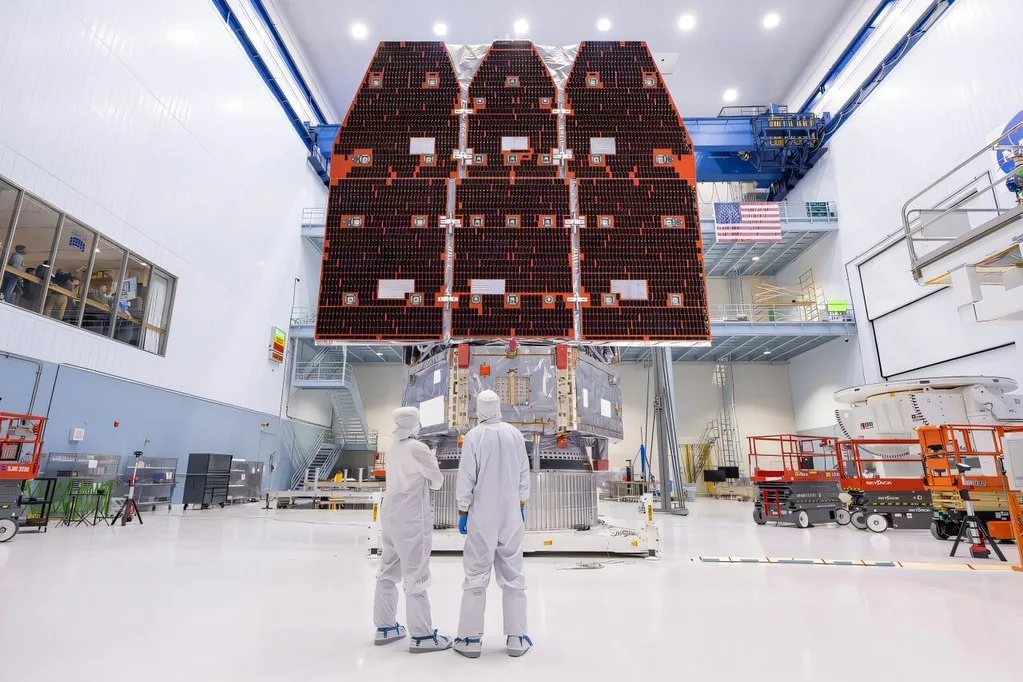
A quieter fortnight for the night sky itself, but a big one for the telescopes doing the looking. NASA’s next flagship observatory is now sitting at Kennedy Space Center waiting for its fairing, and a paper in Nature offered an explanation for one of the stranger things Webb has been finding.
Roman is fuelled and mated, with launch set for 30 August
NASA and SpaceX are targeting no earlier than 7.26am EDT on Sunday 30 August for the launch of the Nancy Grace Roman Space Telescope, on a Falcon Heavy from Launch Complex 39A at Kennedy Space Center. On 10 August the Roman team confirmed it had begun integrated operations, mating the observatory to its payload adapter and payload attach fitting in the Payload Hazardous Servicing Facility. Next comes encapsulation in the Falcon Heavy fairing and the move to the pad. Propellant loading is already done, the fuel that will take Roman out to the Sun-Earth L2 point and keep it there. The mission is running roughly nine months ahead of its original schedule, which is not a sentence often written about a flagship observatory.
Roman is built to study dark energy, the force accelerating the universe’s expansion, to map how galaxies formed by tracing the influence of dark matter, and to find thousands of new planets around other stars. For anyone with a telescope in the garden the connection is not direct, but it is real: the exoplanet catalogue that amateur astronomers now take for granted, and the transit method most of us have read about, came out of exactly this kind of wide-survey mission. If you want to know what your own equipment can and cannot resolve while you wait, our telescope resolution calculator is a useful reality check, and telescope aperture explained covers why aperture is the number that matters. The countdown page is at NASA and the integration update on the Roman blog.
Webb finds a “black hole star” at the cosmic dawn
On 13 August, researchers at the Institute of Science and Technology Austria and international collaborators published a paper in Nature describing what they have dubbed a “black hole star”: an early, rapidly growing black hole wrapped in a shroud of dense gas. The interest is in what it might explain. Since Webb started returning deep-field data, astronomers have been puzzling over the “little red dots”, compact red objects that crowd the early universe and do not fit neatly into existing categories. A black hole feeding hard inside a thick envelope of gas would look, from here, very much like one of those dots, and it would help account for how black holes of a billion solar masses managed to assemble so soon after the Big Bang.
This is worth following rather than filing as settled. The little red dots have already generated several competing explanations, and the honest position is that Webb found something nobody predicted and the theory is still catching up. That is a better advertisement for astronomy than any tidy result: a telescope launched to answer known questions came back with a new one. Nothing here is visible through a garden telescope, but if it makes you want to look at where these objects are, our how to read a star chart guide is the place to start, and the Bortle scale calculator will tell you how much your own sky is holding you back. The write-up is at ScienceDaily and Phys.org.
Clear skies forecast? Get a nudge.
Our weekly email flags the next good UK observing window and one easy target to find.
Join the listMore from Starvest
Keep reading
Best Telescopes for Beginners in the UK (Tested by Price Bracket)
The best beginner telescopes in the UK by budget, from sub-£150 tabletop scopes to app-guided and smart telescopes, with real 2026 prices.
What Can You See with Binoculars at Night? A Realistic Astronomy List
A realistic list of what you can see with binoculars in astronomy, from the Moon and Jupiter's moons to Andromeda, with tips for spotting each from the UK.
How to Set Up and Use Your First Telescope (Step by Step)
How to use a telescope as a beginner: assemble the mount, align the finder, focus, and find your first targets. A clear step-by-step UK guide.