Seestar S50 Pro Now £999 in UK, Origin Gets Mosaic Mode
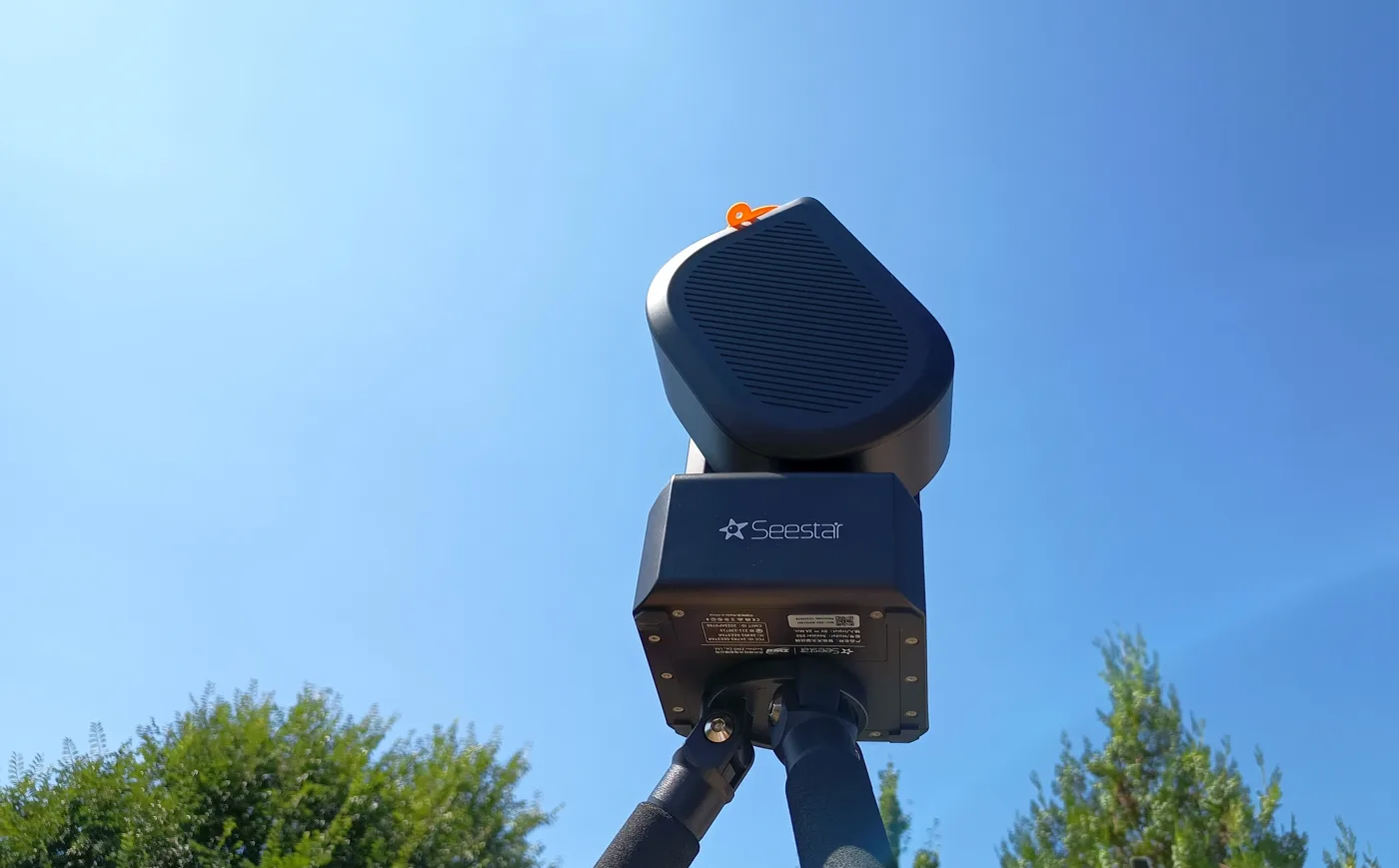
Two smart telescope stories matter this fortnight: the long-promised successor to the most popular one is now on sale in the UK, and a rival has added a feature it was missing. Beginners get a free, low-pressure reason to go outside in early October, and the argument over UK astronomy funding reached Parliament. Here is what each one means if you observe from Britain.
The Seestar S50 Pro is on sale in the UK at £999
ZWO’s Seestar brand says the S50 Pro has been available since 25 August through its own website and authorised retailers. It arrives three years after the original S50. UK dealer The Widescreen Centre lists it at £999 including VAT, and is taking orders in sequence with a £50 deposit to hold a place in the queue, so expect to wait rather than get next-day delivery.
The headline change is not the aperture, which stays at 50mm, but almost everything around it. According to the retailer’s specification, the main camera moves from a 2.1 megapixel sensor to an 8.3 megapixel, 1/1.2-inch one, the optics go from three elements to a four-element apochromat with one ED glass element, and a second 4K wide-angle camera with a 63 degree field of view is added for Milky Way panoramas and star trails. It has 128GB of storage, a 10,000mAh battery rated for up to 9 hours (ZWO’s lab figure, measured above 25°C, so a cold British night will give you less), an equatorial mode that allows 60-second exposures, and ASCOM Alpaca support so it can be run from software such as N.I.N.A.
For UK buyers the most useful addition is the one that sounds least exciting: a built-in dew heater. The original S50 did not have one, and dew is the reason a lot of damp autumn sessions end early. Our guide to stopping telescope dew explains why. One buying trap to note: the retailer warns that Seestar units come in a Mainland China version that cannot be activated outside China, Hong Kong and Macau, so buy the overseas version from a UK dealer.
If you were weighing up the original, our Seestar S50 review still covers what the older model does well, and the best smart telescope UK roundup sets it against the alternatives. The launch announcement is on Seestar’s site and UK pricing is at The Widescreen Centre.
Celestron Origin adds Mosaic Mode
Celestron says it launched Mosaic Mode for its Origin smart telescope in early September. You mark out the area you want in the Celestron Origin app, the telescope splits it into overlapping tiles, captures each tile in turn, and then stitches the results into one image.
This matters because big targets do not fit in a single frame. The Andromeda Galaxy and the large nebulae of autumn and winter spill beyond the camera’s field of view, and until now Origin owners had to crop them or stitch frames by hand on a computer. It narrows one of the practical gaps we describe in Seestar S50 vs Celestron Origin. The feature is listed on Celestron’s Origin product page.
100 Hours Under One Sky runs 1 to 4 October
The Royal Astronomical Society announced on 17 September that “100 Hours Under One Sky”, a stargazing event for beginners in the UK and Ireland, runs from 1 to 4 October. It is the UK strand of the International Astronomical Union’s 100 Hours of Astronomy, which will run in more than 60 countries.
The format is deliberately easy. The 100hours.online site has four simple challenges, badges to earn and a shared map to add your mark to, plus a finder for local stargazing events. You do not need binoculars or a telescope, you do not need to travel to a dark sky site, and you do not have to give an email address or your exact location. If someone in your household has been curious but has never known where to start, this is a good first night; pair it with our naked-eye stargazing guide and, for what comes after, how to start stargazing. The announcement is on the Royal Astronomical Society site.
MPs debate astronomy cuts, and the RAS opens its doors on Saturday
MPs debated cuts to research funding for fundamental physics and astronomy in Westminster Hall on 1 September. In a statement the next day, the Royal Astronomical Society welcomed the support from MPs and said it hoped the Prime Minister’s commitment to Jodrell Bank would extend to reinstating funding for the science done there. It also pointed out that the concerns raised went beyond one site, naming the Boulby Underground Laboratory, the CLARA electron beam test facility and UK participation in the LHCb upgrade at CERN. For amateurs this is background rather than something that changes your next night out, but the funding question is not settled. The statement is on the RAS site.
Closer to home, the Society is opening its Burlington House headquarters in London for free self-guided tours on Saturday 19 September as part of the Open House Festival, from 10am to 1pm and 2pm to 5pm, with last entry at 12.30pm and 4.30pm. No booking is needed, and the galleried library will have a display of books, manuscripts and artefacts. Details are on the RAS site, and our list of UK stargazing events and star parties has more through the autumn.
Clear skies forecast? Get a nudge.
Our weekly email flags the next good UK observing window and one easy target to find.
Join the listMore from Starvest
Keep reading
Best Telescopes for Beginners in the UK (Tested by Price Bracket)
The best beginner telescopes in the UK by budget, from sub-£150 tabletop scopes to app-guided and smart telescopes, with real 2026 prices.

What Can You See with Binoculars at Night? A Realistic Astronomy List
A realistic list of what you can see with binoculars in astronomy, from the Moon and Jupiter's moons to Andromeda, with tips for spotting each from the UK.
How to Set Up and Use Your First Telescope (Step by Step)
How to use a telescope as a beginner: assemble the mount, align the finder, focus, and find your first targets. A clear step-by-step UK guide.