Mars Opposition 2027: 19 February, 54° High From London
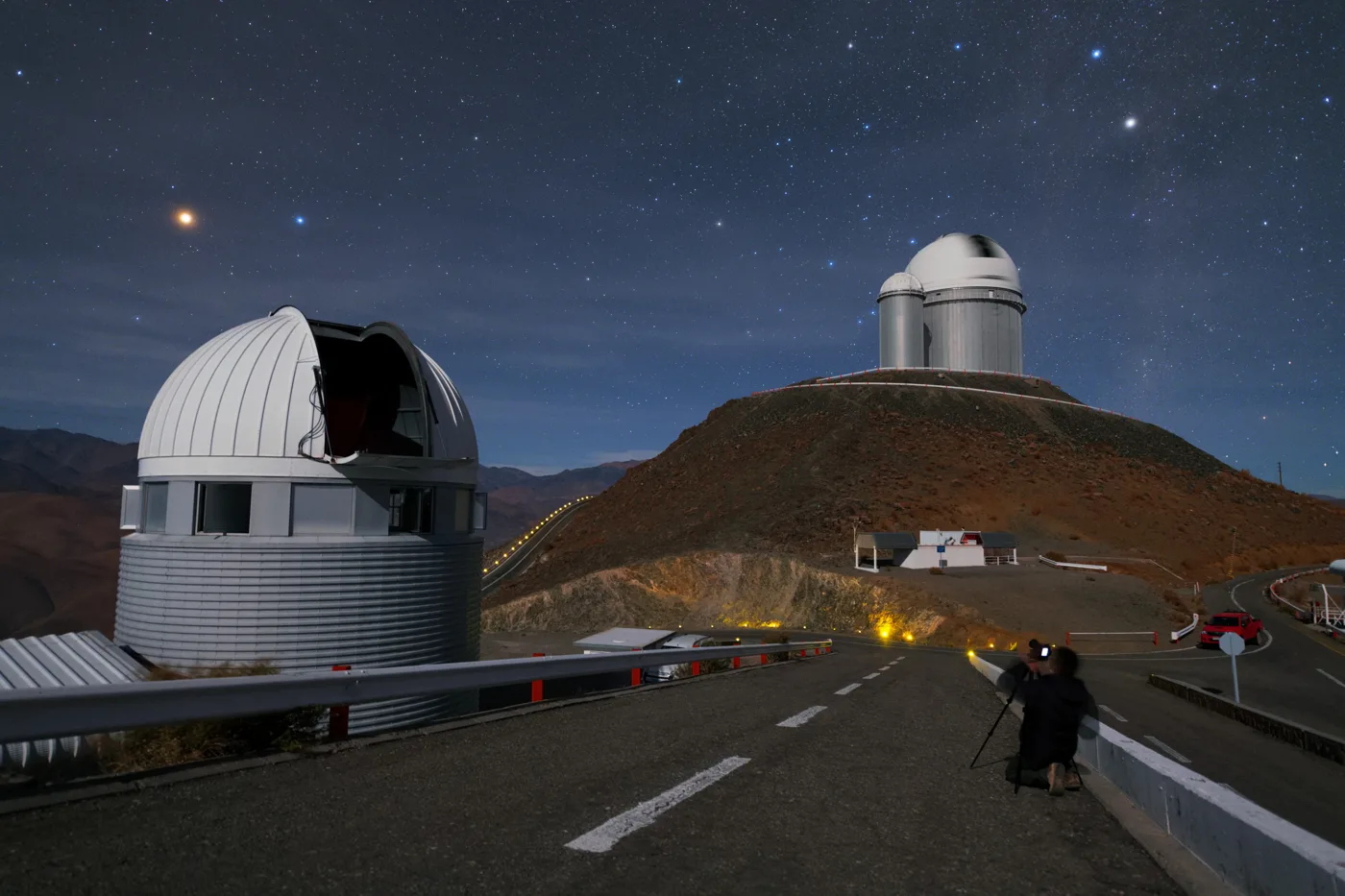
The Mars opposition of 2027 falls on 19 February 2027, with Earth passing between Mars and the Sun at 15:44 GMT. Mars will sit in Leo, shine at about magnitude -1.3, and show a disc 13.8 arcseconds across, the largest it gets on this pass. Closest approach comes a few hours later, just after midnight on 20 February, at about 101.4 million kilometres.
That is the headline. The part that matters for British observers is the angle: Mars will be high. From London it climbs to about 54 degrees above the southern horizon around half past midnight, against the 13 degrees it managed at the famous 2018 opposition. A smaller disc, seen through far less air, is the trade this winter offers, and from the UK it is a good one.
All figures on this page come from NASA’s JPL Horizons ephemeris, queried on 7 October 2026.
Mars opposition 2027 at a glance
| Opposition | 19 February 2027, 15:44 GMT |
| Closest to Earth | 20 February 2027, about 00:00 GMT, 0.678 au (about 101.4 million km) |
| Apparent diameter | 13.8 arcseconds |
| Brightness | magnitude -1.3 at its peak |
| Constellation | Leo, about 10 degrees east of Jupiter |
| Highest from London | about 54 degrees, around 00:30 GMT |
| Highest from Edinburgh | about 49 degrees |
| Retrograde loop | about 12 January to 3 April 2027 |
Why this opposition is small, and why that is not the whole story
Mars’s orbit is noticeably oval. When opposition happens near the point where Mars is closest to the Sun (a perihelic opposition), the gap to Earth shrinks to under 60 million kilometres and the disc swells past 24 arcseconds. In February 2027 Mars is near the far end of its orbit, so this is an aphelic opposition and the disc tops out at 13.8 arcseconds.
The big oppositions have a catch for anyone north of about 50 degrees. In 2018 Mars sat at a declination of about -25.5 degrees, in Capricornus, and from London it never got much above 13 degrees. You looked at it through a long, turbulent column of air, low over rooftops, and the image boiled. In February 2027 Mars is at about +15 degrees declination, so it climbs about as high as the midday Sun does in early May. Steady air matters more than raw size for what you can actually see, which is why many UK observers will get better views this time than they did in 2018.
When to look
Do not fixate on 19 February. The disc is above 13 arcseconds from early February to about 10 March, and above 12 arcseconds from about 20 January to 23 March. Any clear, steady night in that window is as good as opposition night.
- Mid January to late March: the main observing season. Mars rises in the east around sunset and is best seen when it is high, roughly 22:00 to 03:00 GMT in February.
- Opposition night: Mars rises at about 17:00 GMT, peaks around 00:30 and sets after dawn, at about 07:50. It is up all night.
- After opposition: each week Mars is highest a little earlier in the evening, which suits anyone who cannot stay up. By late March it is well placed by 22:00.
- The retrograde loop: Mars stops its usual eastward drift through the stars around 12 January, moves westward until about 3 April, then resumes. Marking its position against Leo’s stars once a week is a good project for binoculars or a phone camera.
Jupiter reaches its own opposition on 11 February 2027, also in Leo, at magnitude -2.6 and 45 arcseconds across. The two planets are about 10 degrees apart, a fist’s width at arm’s length, so one session covers both. Our page on how to see the planets covers Jupiter and Saturn.
What a 100mm to 150mm telescope will show
A 13.8 arcsecond disc is about a third the width of Jupiter at the same time. At 150x it looks roughly the size of the full Moon to the naked eye, which is enough to see real detail on a steady night. For finer points on choosing power, see the best magnification for planets.
What to look for in February 2027:
- The north polar cap. Mars’s north pole is tilted about 20 degrees toward us at opposition, so the northern hemisphere is on show. It is late spring in the Martian north, so the cap is shrinking but still a bright white patch at the top of the disc (or the bottom, in many telescopes, which invert the view).
- Dark markings. Syrtis Major, the largest and darkest, is visible in a 100mm scope when it faces Earth. In the north, look for Mare Acidalium and Utopia. Southern features such as Hellas sit low near the edge of the disc this time and are poorly placed.
- Clouds and haze. Bright limb haze and white orographic clouds over the big volcanoes can show, especially with a blue filter.
- Phase. Mars is near full at opposition. In the weeks either side you may notice a slight gibbous shape.
Mars spins once every 24 hours 37 minutes, so a feature that faces you at a given clock time will be there about 37 minutes later the next night. Over five weeks or so the whole planet turns past. If you want to see Syrtis Major and it is not showing tonight, check again in a fortnight or look at a later hour. Free software such as Stellarium shows which side faces Earth at any moment.
Filters, eyepieces and the setup that helps
- Let the telescope cool. A tube that is warmer than the night air sets up currents that blur fine planetary detail. Our guide to telescope cool-down time gives timings by size.
- Check collimation on any reflector before the season. A small misalignment costs more on Mars than on almost any other target. See how to collimate a telescope.
- Use an orange or red filter for dark markings. A Wratten 21 (orange) or 23A (light red) raises the contrast of the surface features.
- Use a blue filter, such as a Wratten 80A, for clouds and the polar cap edge. Most budget filter sets include these colours; you do not need anything expensive.
- Wait for steady air. Seeing changes minute to minute. Stay at the eyepiece and the detail comes in short moments. Our page on astronomical seeing explains how to judge a night.
- Do not overdo the power. If the disc looks soft at 200x, drop to 120x or 150x; a smaller sharp view shows more than a big blurry one.
If you are choosing a telescope with this opposition in mind, our list of the best telescopes for planets explains why aperture and good optics matter more than magnification claims on the box.
Photographing Mars in 2027
A phone held to the eyepiece will record the colour and maybe the polar cap. For real detail, astrophotographers use a small planetary video camera at the focus, record a few thousand frames, and stack the sharpest with free software. Mars’s height above the UK horizon this year makes this much more rewarding than in 2018. Keep each video under about three minutes, because Mars’s rotation smears detail over longer runs.
Frequently asked questions
When is Mars at opposition in 2027? 19 February 2027, at 15:44 GMT. Closest approach to Earth follows at about midnight on 20 February. The good observing window runs from mid January to late March.
How big will Mars look in February 2027? Its disc reaches 13.8 arcseconds across. That is smaller than the 24.3 arcseconds of 2018 and the 25.1 arcseconds of 2003, but large enough to show the polar cap and dark markings in a 100mm telescope.
Can I see Mars without a telescope? Yes. It will be a bright, steady orange point in Leo, at about magnitude -1.3, brighter than any star in that part of the sky. Only Jupiter, about 10 degrees away, will outshine it.
Where is Mars in the sky from the UK at opposition? Low in the east at dusk, due south and about 54 degrees high from London around 00:30 GMT, and in the west by dawn. From Scotland it peaks at about 49 degrees.
What is the next Mars opposition after 2027? Late March 2029, with a disc of about 14.5 arcseconds. Oppositions come roughly every 26 months; the next big one for disc size is in 2033.
What telescope do I need to see detail on Mars? A good 100mm to 150mm refractor or reflector at 120x to 200x will show the polar cap and the main dark markings on a steady night. Larger apertures help, but steady air matters more than size.
Sources
- NASA JPL, Horizons ephemeris system, geocentric and London-topocentric positions for Mars and Jupiter, queried 7 October 2026.
- Sky at Night Magazine, Mars opposition 2027 observing advice.
Clear skies forecast? Get a nudge.
Our weekly email flags the next good UK observing window and one easy target to find.
Join the listMore from Starvest
Keep reading
Best Telescopes for Beginners in the UK (Tested by Price Bracket)
The best beginner telescopes in the UK by budget, from sub-£150 tabletop scopes to app-guided and smart telescopes, with real 2026 prices.
What Can You See with Binoculars at Night? A Realistic Astronomy List
A realistic list of what you can see with binoculars in astronomy, from the Moon and Jupiter's moons to Andromeda, with tips for spotting each from the UK.
How to Set Up and Use Your First Telescope (Step by Step)
How to use a telescope as a beginner: assemble the mount, align the finder, focus, and find your first targets. A clear step-by-step UK guide.