Webb Images NGC 7129, Plus Comet Hartley-IRAS at Its Best
A quieter week for the naked eye, but a good one for anyone with a telescope and a dark sky. Webb has published a new picture of a nebula that sits well placed for British observers this autumn, a faint periodic comet is at its brightest, and two European missions have had results to show: Smile has started science after filming the northern lights from space, and Mars Express has explained an odd cloud on Mars.
Webb photographs NGC 7129, and you can find it in Cepheus
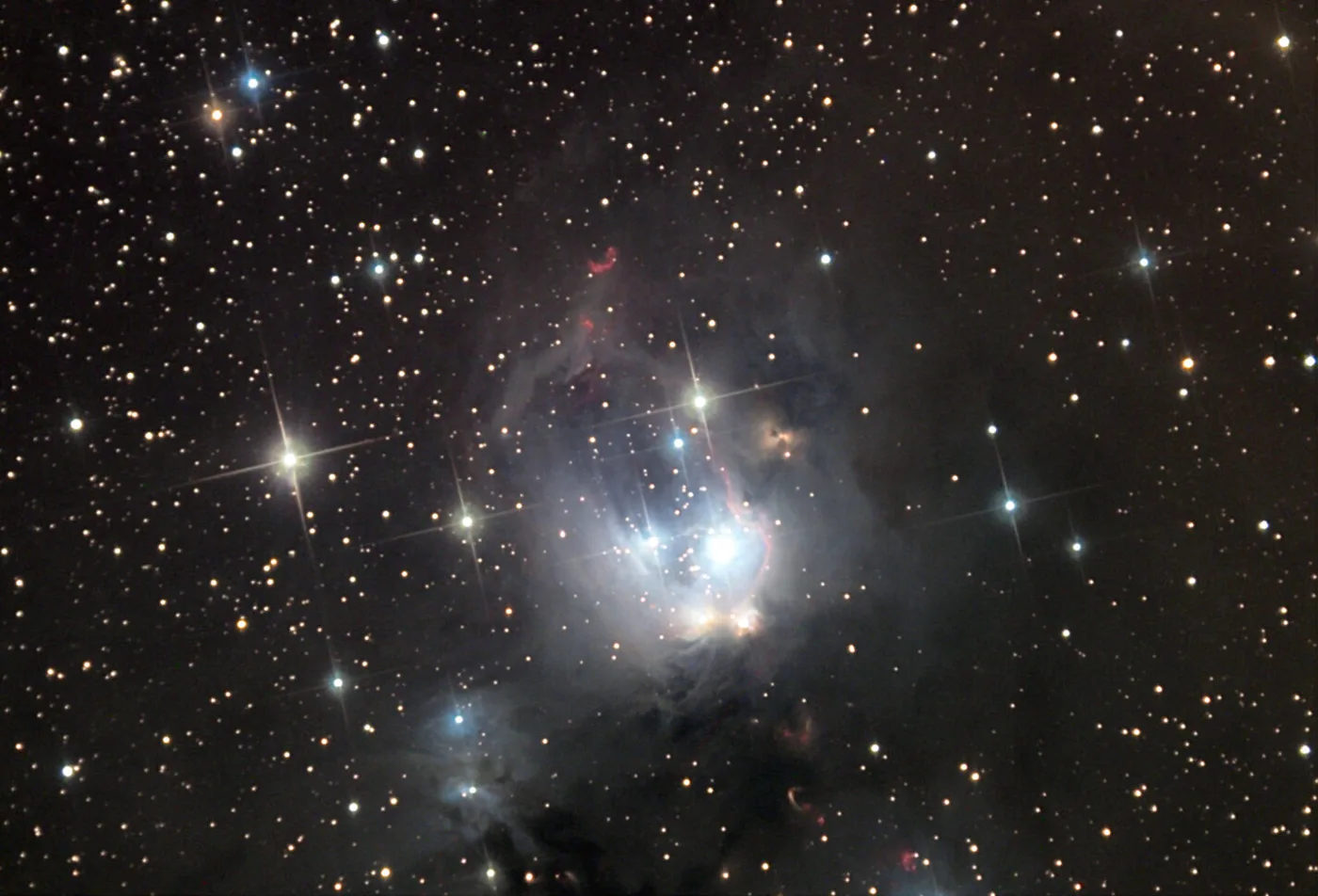
On 6 October the European Space Agency released a James Webb Space Telescope image of NGC 7129, a star-forming region about 3,300 light-years away. In infrared light Webb sees through the dust to stars that ordinary telescopes miss. The brightest, LkHα 234, is estimated at 5 to 8 times the mass of the Sun; its outflows have carved a glowing gold cavity about 3.5 light-years across, while the red, clumpy region to its right hides even younger protostars blowing jets into the surrounding cloud.
The reason this one is worth your time is that NGC 7129 is a real target from a British garden. It sits in Cepheus, which is high overhead on October evenings, and in a 150mm to 200mm telescope under a dark sky it shows as a small, soft glow around a little knot of stars. You will not see anything like the Webb colours, so think of it as a faint-nebula challenge for a moonless night; the moon phase calculator will show you the dark evenings coming up. Our guide to finding objects with a telescope explains star-hopping to a target like this, and the Bortle scale calculator will tell you whether your sky is dark enough to bother. Source: ESA, Webb captures commotion from nebula’s stellar jets.
Comet 161P/Hartley-IRAS is at its brightest now
The British Astronomical Association’s comet predictions for 2026, written by Jonathan Shanklin, single out 161P/Hartley-IRAS as one of the year’s better telescopic comets. It is making its third return since its discovery in 1983, reached 10th magnitude on both previous visits and is expected to do so again. It is at its brightest in early October, when it is 0.5 astronomical units from Earth, and although it does not reach perihelion until late November, it fades slowly from here as its distance from us grows.
It is conveniently placed in the evening sky, and around 27 October it passes just over a degree from the planetary nebula NGC 6891, which makes a useful signpost. At 10th magnitude this is a telescope object rather than a binocular one: expect a faint, fuzzy spot that you confirm by its movement against the stars from night to night. Our guide to how to see a comet in the UK covers what to expect, and the limiting magnitude calculator shows whether your scope will reach it. Source: BAA Comet Section, Comet Prospects for 2026.
Smile starts science after filming the northern lights from space
ESA said on 30 September that its joint mission with the Chinese Academy of Sciences, Smile, was declared ready for science on 23 September. The spacecraft launched on 19 May and reached its science orbit on 20 June. Its ultraviolet imager is the first camera since 2008 to capture the whole ring of northern lights around the North Pole in ultraviolet, and it can now record the auroras for 45 hours at a stretch. The first footage, taken on 24 July, shows the ring brightening as a rush of solar wind disturbed Earth’s magnetic field.
Smile’s X-ray camera is working but picking up too much stray light when pointed at Earth. ESA expects that to reach a minimum in mid-October, when it hopes to take its first good image of the magnetopause, the boundary where the solar wind meets Earth’s magnetic field. For British aurora chasers, a mission built to understand geomagnetic storms is good news; our guide to seeing the northern lights from the UK covers what to watch for meanwhile. Source: ESA, Science begins for Smile.
Mars Express explains the planet’s oddest cloud
The Arsia Mons Elongated Cloud is a streak of water ice that forms downwind of the 20 km high Arsia Mons volcano every morning for months during the southern Martian spring and summer, stretching up to 1,800 km before evaporating. In a study announced by ESA on 7 October, a team led by Jorge Hernández-Bernal found that the cloud only appears in their models if water vapour freezes directly into ice particles without any dust to form on, a process called homogeneous nucleation that has not been seen before in a planetary atmosphere. The volcano kicks up a wave that lifts moist air several kilometres in minutes, dropping its temperature by 30 degrees in 10 minutes.
You will not see the cloud from Earth, but Mars itself is well worth an early start this month as it climbs the morning sky ahead of its 2027 opposition; our page on Mars at opposition in 2027 explains how it will grow in a telescope. Source: ESA, Mars’s oddest cloud may be even odder than we thought.
Clear skies forecast? Get a nudge.
Our weekly email flags the next good UK observing window and one easy target to find.
Join the listMore from Starvest
Keep reading
Best Telescopes for Beginners in the UK (Tested by Price Bracket)
The best beginner telescopes in the UK by budget, from sub-£150 tabletop scopes to app-guided and smart telescopes, with real 2026 prices.
What Can You See with Binoculars at Night? A Realistic Astronomy List
A realistic list of what you can see with binoculars in astronomy, from the Moon and Jupiter's moons to Andromeda, with tips for spotting each from the UK.
How to Set Up and Use Your First Telescope (Step by Step)
How to use a telescope as a beginner: assemble the mount, align the finder, focus, and find your first targets. A clear step-by-step UK guide.