What Is a Star Diagonal? Why Your View Is Mirror-Flipped
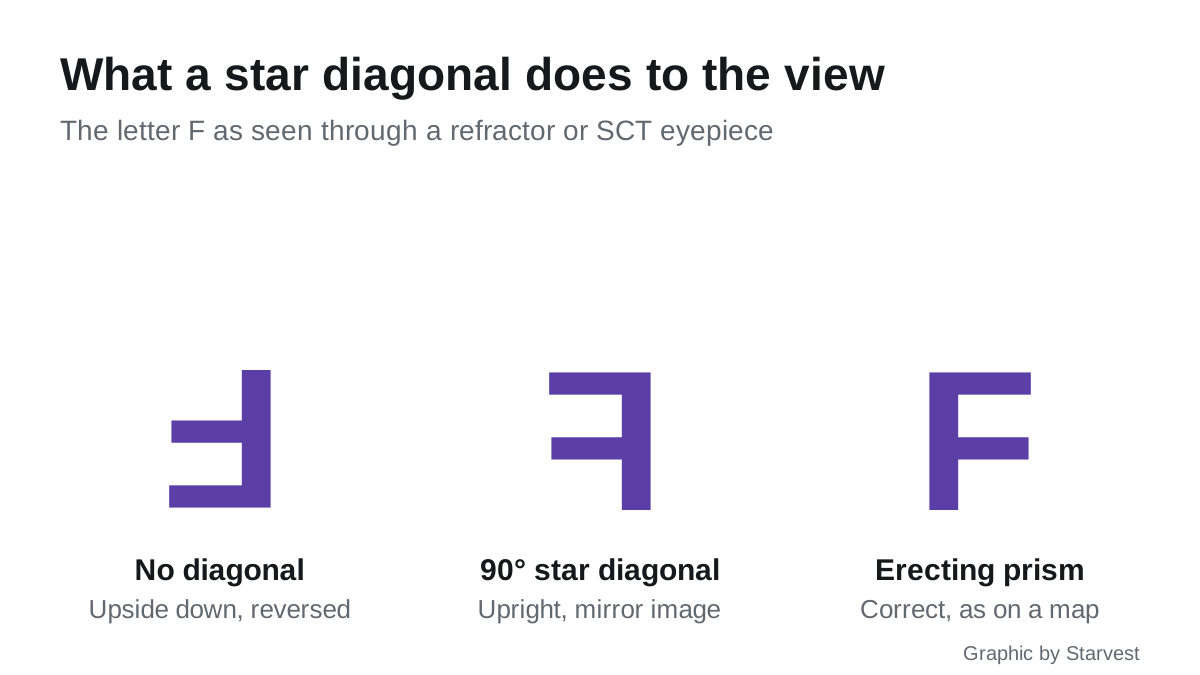
What is a star diagonal? It is the small angled box that slots into the back of a refractor or Schmidt-Cassegrain telescope, between the focuser and the eyepiece. Inside is a mirror or a prism set at 45 degrees, which bends the light through 90 degrees so you can look down into the eyepiece instead of crouching under the tube. It is the reason a refractor pointed high in the sky is comfortable to use. It is also the reason the Moon looks back to front compared with a photo.
This page explains what the diagonal does to your view, the difference between mirror and prism types, whether a dielectric upgrade is worth it, and why your Newtonian does not have one at all.
Why telescopes need one
Point a refractor at something high overhead and the eyepiece ends up near the ground, often pointing at the tripod legs. Without a diagonal you would be lying on the grass to look through it. The diagonal turns the eyepiece to the side or upwards, so you can sit on a chair and observe at any altitude.
That is why almost every beginner refractor and every Schmidt-Cassegrain is sold with one in the box. If you are still deciding between telescope types, our refractor vs reflector comparison covers where the eyepiece ends up on each.
Why your view is flipped
A telescope on its own turns the image upside down and left to right, which is the same as rotating it 180 degrees. A 90-degree star diagonal adds one reflection. The result is an image that is the right way up but mirror-reversed, like looking at writing in a bathroom mirror.
| Setup | What you see | Matches a printed star chart? |
|---|---|---|
| Refractor or SCT, no diagonal | Rotated 180 degrees | Yes, if you turn the chart upside down |
| Refractor or SCT with a 90° star diagonal | Upright but mirror-reversed | No, it is a mirror image |
| Newtonian reflector | Rotated, at an angle depending on where the eyepiece points | Yes, rotate the chart to match |
| Any scope with an erecting prism diagonal | Correct, as you would see by eye | Yes |
For stars and planets this does not matter: there is no “right way up” in space. It matters when you are matching the view to a chart. The mirror image cannot be fixed by rotating the chart, because no amount of turning a page makes writing read backwards. Some printed atlases and most astronomy apps offer a mirrored view for this reason; look for a “mirror” or “flip” setting. Our guide to reading a star chart covers the rest of the technique.
It also explains why Jupiter’s moons can appear on the “wrong” side compared with an app’s prediction. Set the app to match your diagonal and the positions line up; see how to see Jupiter’s moons.
Mirror or prism diagonal
The angled surface inside can be a mirror or a glass prism. Both send the light through 90 degrees and both give the same mirror-reversed image.
Mirror diagonals use a flat front-surface mirror. Basic ones use an aluminium coating. Dielectric mirrors use a stack of thin coating layers to reach higher reflectivity: Celestron’s 1.25-inch dielectric diagonal (model 93571), for example, uses 58 layers of coating and is rated at over 99% reflectivity. A mirror adds no glass to the light path, so it adds no colour fringing.
Prism diagonals reflect the light inside a block of glass by total internal reflection. A good prism gives a crisp, high-contrast image on slower telescopes, and Baader’s T-2 prism diagonal is a well-known example. The catch is that the light passes through several centimetres of glass. In a fast telescope, roughly f/6 or faster, that glass can add a little extra colour and spherical aberration, which shows up most at high magnification. On those scopes a mirror diagonal is the safer choice.
A simple rule: on a long-focus refractor or a Schmidt-Cassegrain at f/10, either works and a good prism is excellent. On a short, fast refractor, choose a dielectric mirror. If you are unsure what your focal ratio means, see telescope focal ratio explained.
Is a dielectric diagonal worth it?
Often, yes, as the first accessory upgrade for a refractor or SCT owner. The diagonals included with budget telescopes are usually basic, and some use plastic bodies or loose-fitting barrels that let the eyepiece tilt. A decent dielectric diagonal brings:
- More light. A 99% mirror against an older aluminium one is a modest gain, a few per cent, which you might notice on faint galaxies but not on the Moon.
- Better build. A metal body, a compression ring or twist-lock clamp that holds eyepieces square, and a barrel that sits true in the focuser. In practice this is often a bigger improvement than the coating.
- Durability. Dielectric coatings are hard and resist tarnishing, where aluminium coatings slowly degrade.
What it will not do is transform a poor telescope. Spend on eyepieces first if your diagonal is merely ordinary rather than badly made; our telescope eyepieces explained page covers what to buy.
1.25-inch or 2-inch?
Diagonals come in two barrel sizes, matching the two eyepiece sizes.
- 1.25-inch fits almost every beginner telescope and every standard eyepiece. Light, cheap and fine for planets, the Moon and most deep-sky viewing.
- 2-inch needs a 2-inch focuser or visual back. It allows wide-field 2-inch eyepieces, which show more sky at low power, and most come with a 1.25-inch adapter so your existing eyepieces still fit. Worth it only if your telescope takes 2-inch accessories and you plan to buy a wide-field eyepiece.
Check the focuser before you buy. Many small refractors only accept 1.25-inch.
45-degree and erecting diagonals
Erecting prisms (often called Amici prisms or correct-image diagonals) give an image that is the right way up and the right way round. They are made for daytime use: birdwatching, landscapes, spotting distant wildlife. Many come at 45 degrees, which is comfortable for looking horizontally. For astronomy they are a compromise. The roof prism design can add a faint bright line or spike next to bright stars and planets, and image quality at high power is usually lower than a good 90-degree star diagonal.
If your telescope doubles as a spotting scope during the day, keep an erecting prism for that and a proper star diagonal for night.
Why your Newtonian does not have one
Newtonian reflectors, including Dobsonians such as the Sky-Watcher Heritage tabletop models, already send the light out of the side of the tube near the top. The eyepiece sits at a comfortable angle without any extra reflection, so there is no need for a diagonal.
There is also a practical reason you cannot add one. A diagonal adds several centimetres of light path, and most Newtonians do not have enough inward focus travel to reach focus with that extra distance. Put a diagonal in a Newtonian and you will usually find the image never sharpens. If your reflector will not focus, the diagonal is the first thing to check; our blurry telescope image fixes page lists the other causes.
A related point for refractor owners: because the telescope is designed around a diagonal, some will not reach focus without one when you look straight through. Taking the diagonal out is a common reason a camera or eyepiece will not focus, and an extension tube solves it.
Which star diagonal to buy
- Came with a cheap plastic diagonal: a 1.25-inch metal dielectric diagonal from an established brand such as Celestron, Sky-Watcher or William Optics. Look for a compression ring or twist-lock clamp.
- Fast refractor (f/6 or faster): a dielectric mirror diagonal, not a prism.
- Schmidt-Cassegrain or slow refractor (f/8 and above): either a dielectric mirror or a quality prism.
- 2-inch focuser and wide-field ambitions: a 2-inch dielectric diagonal with a 1.25-inch adapter.
- Daytime use too: add a 45-degree erecting prism; do not replace your star diagonal with it.
Check current prices with a UK astronomy retailer before buying; they vary widely between brands.
Frequently asked questions
What is a star diagonal used for? A star diagonal bends the light from a refractor or Schmidt-Cassegrain through 90 degrees, so the eyepiece points sideways or upwards. That makes it comfortable to observe objects high in the sky without crouching under the telescope.
Why is my telescope image mirror-reversed? A 90-degree star diagonal adds one reflection to a telescope that already rotates the image. The result is upright but reversed left to right. Use a mirrored setting in your star chart app to match it.
Is a prism or mirror diagonal better? On fast telescopes, around f/6 or faster, a dielectric mirror diagonal is better because a prism can add colour and spherical aberration. On slower refractors and Schmidt-Cassegrains, a good prism performs very well.
Do I need a star diagonal for a Dobsonian? No. Dobsonians and other Newtonian reflectors place the eyepiece at the side of the tube, and most cannot reach focus with a diagonal fitted.
Can I use a star diagonal for daytime viewing? You can, but the image will be mirror-reversed, which is confusing on landscapes and text. An erecting prism diagonal gives a correct image and is the better choice for daytime use.
Is a 2-inch diagonal worth it? Only if your focuser accepts 2-inch accessories and you want wide-field 2-inch eyepieces. For a beginner telescope with a 1.25-inch focuser, a good 1.25-inch diagonal is the right choice.
Sources
- Celestron, Dielectric Star Diagonal 1.25” with Twist-Lock, model 93571 specifications
- Wikipedia, Star diagonal, image orientation and Newtonian focus notes
Clear skies forecast? Get a nudge.
Our weekly email flags the next good UK observing window and one easy target to find.
Join the listMore from Starvest
Keep reading
Best Telescopes for Beginners in the UK (Tested by Price Bracket)
The best beginner telescopes in the UK by budget, from sub-£150 tabletop scopes to app-guided and smart telescopes, with real 2026 prices.

What Can You See with Binoculars at Night? A Realistic Astronomy List
A realistic list of what you can see with binoculars in astronomy, from the Moon and Jupiter's moons to Andromeda, with tips for spotting each from the UK.

How to Set Up and Use Your First Telescope (Step by Step)
How to use a telescope as a beginner: assemble the mount, align the finder, focus, and find your first targets. A clear step-by-step UK guide.