Telescope Focal Ratio: What f/5 and f/10 Really Change
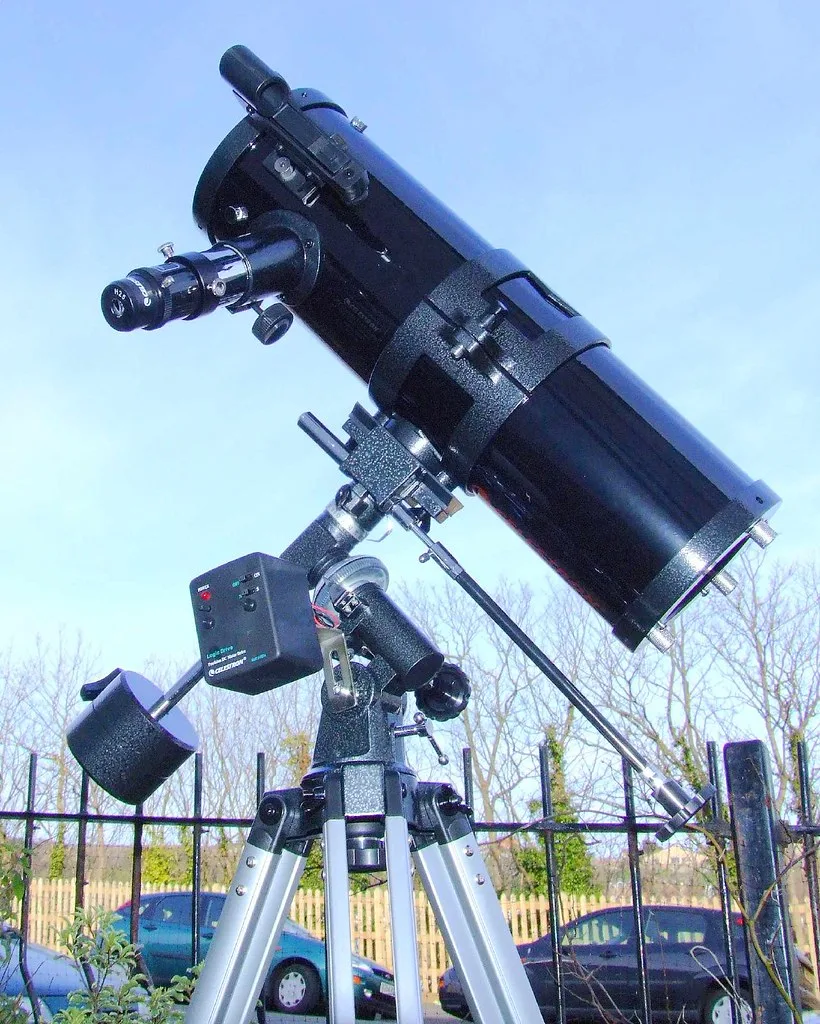
Here is telescope focal ratio explained in one line: it is the focal length divided by the aperture, and for visual stargazing it decides how wide a view you get, how long the tube is and how fussy your eyepieces need to be. It does not decide how bright the image looks. That last point is the one almost every buying page gets wrong, because it borrows the rule from photography, where a “fast” lens really does cut your exposure time.
A 130mm Newtonian with a 650mm focal length is f/5. A 127mm Maksutov with a 1500mm focal length is f/11.8. Same rough aperture, very different telescopes. This page works through what actually changes between them, with the numbers.
The sum, and three UK scopes as worked examples
Focal ratio = focal length ÷ aperture. Both in millimetres. Write it with an f and a slash.
- Sky-Watcher Heritage 130P: 130mm aperture, 650mm focal length. 650 ÷ 130 = f/5. Fast.
- Sky-Watcher Skyliner 200P: 200mm aperture, 1200mm focal length. 1200 ÷ 200 = f/6. Still on the fast side.
- Sky-Watcher Skymax 127: 127mm aperture, 1500mm focal length. 1500 ÷ 127 = f/11.8. Slow, and folded into a tube about 370mm long, per Sky-Watcher’s own specification.
Roughly, f/4 to f/6 is fast, f/7 to f/9 is middling, and f/10 and above is slow. Those words are inherited from camera lenses and they mislead people, so it helps to translate them: fast means short and wide, slow means long and narrow.
What focal ratio does NOT do: brightness
The myth is that an f/5 scope gives a brighter view than an f/10 scope. For looking through an eyepiece, it does not.
Image brightness at the eye depends on aperture and magnification, and nothing else. Put a 130mm f/5 and a 130mm f/10 side by side, set both to 65x, and the view is equally bright, because both are collecting light with the same 130mm of glass and spreading it over the same apparent image size. The only thing you changed to get there is which eyepiece you used: a 10mm in the f/5, a 20mm in the f/10.
Where “fast” genuinely means faster is on a camera sensor, where the frame is fixed and a shorter focal length crams the same light into a smaller image. Going from f/10 to f/5 quarters the exposure time for a nebula or a galaxy, because the ratio of the areas is (10 ÷ 5)² = 4. Celestron’s own explainer treats it as an imaging specification for exactly this reason. If a camera is your goal, see our notes on the best telescope for astrophotography beginners.
What focal ratio does do: field of view
This is the real visual difference, and it is large.
Magnification is focal length ÷ eyepiece focal length. True field of view is roughly the eyepiece’s apparent field ÷ magnification. Take one ordinary 25mm Plössl with a 52-degree apparent field and put it in each scope:
| Scope | Focal length | Magnification | True field |
|---|---|---|---|
| Heritage 130P (f/5) | 650mm | 26x | about 2.0 degrees |
| Skymax 127 (f/11.8) | 1500mm | 60x | about 0.87 degrees |
The full Moon is half a degree across. So the f/5 scope frames four Moons side by side and will hold the whole Pleiades cluster; the f/11.8 scope frames not much more than one and a half. That is why fast scopes are recommended for sweeping large nebulae and star clusters, and slow scopes for planets, the lunar surface and splitting double stars. You can run your own combinations through our telescope magnification calculator and eyepiece field of view calculator.
The other side of the same coin: a slow scope makes high power easy. Getting 200x out of the Skymax 127 needs a 7.5mm eyepiece, which is comfortable. Getting 200x out of the Heritage 130P needs a 3.25mm, which is a tiny eye lens and a pinhole of eye relief, or a Barlow lens in front of something longer.
The hidden cost of fast: your eyepieces
A fast telescope throws a steep cone of light at the eyepiece, and cheap eyepiece designs cannot straighten it out. The same £25 Plössl that looks crisp edge to edge at f/11 will show stars near the field edge as small seagulls at f/5.
So the money you saved on a compact fast scope tends to reappear in the eyepiece case. At f/10 and slower, simple Plössls and Kellners are honestly fine. At f/5, you start wanting the wide-field designs with more elements in them, which cost several times as much. Budget for that before you buy, and read our telescope eyepieces explained page first.
Exit pupil is the other constraint that runs the other way. Exit pupil = eyepiece focal length ÷ focal ratio, and a fully dark-adapted adult eye opens to roughly 7mm. At f/5, a 35mm eyepiece already gives a 7mm exit pupil, so anything longer wastes light. At f/11.8 you would need an absurd 83mm eyepiece to hit that limit, which is another way of saying a slow scope will happily use any eyepiece you own.
Coma: the fast Newtonian’s tax
Coma is an aberration built into the parabolic mirror of every Newtonian. Stars in the centre are points; stars towards the edge grow little comet tails pointing outward. It is not a fault, it is geometry, and it gets worse quickly as the focal ratio drops.
The usual working figure is Everhart’s formula: the diameter of the coma-free patch at the focal plane, in millimetres, is about 0.022 multiplied by the focal ratio cubed.
- f/5: 0.022 x 125 = 2.8mm
- f/6: 0.022 x 216 = 4.8mm
- f/10: 0.022 x 1000 = 22mm
For scale, a 25mm Plössl’s field stop is around 21mm across. At f/10 the whole field is effectively clean. At f/5 the clean patch is under 3mm, a small circle in the middle of a 21mm field, and the rest of the view carries some coma. Whether you notice it is another matter: at 26x on a dewy night in a British back garden, most beginners never do, and planets sit in the middle of the field anyway. It matters much more for photography, where the corners of every frame are on show and a coma corrector becomes a real purchase.
Refractors, Maksutovs and Schmidt-Cassegrains do not suffer Newtonian coma. They have their own compromises, covered in refractor vs reflector.
The physical size problem
Focal length is what sets the tube length, and a slow scope with meaningful aperture gets long fast. A 200mm f/10 Newtonian would be a two-metre tube on a mount to match, which is why they are not sold. The market solved this in two directions: Newtonians went fast and short, and Maksutovs and Schmidt-Cassegrains fold a long light path back on itself with a secondary mirror, which is how the Skymax 127 packs 1500mm into 370mm.
That folding is not free. Catadioptric scopes have a large central obstruction, which softens contrast slightly, and a thick Maksutov corrector plate needs 30 to 60 minutes outside before the view settles. A fast Newtonian is ready in about ten. If you keep your scope indoors and observe in short windows between clouds, that cooldown is a genuine factor, not a footnote.
Which focal ratio should you actually buy?
Pick by what you want to look at and where the scope will live, not by the number:
- Deep sky, wide views, small storage space: f/4 to f/6. Accept that good eyepieces cost more and that edge stars will not be perfect.
- Planets, the Moon, double stars, a balcony or small garden: f/10 and up. Long focal length, high power comes easily, cheap eyepieces perform.
- One scope for everything: f/6 to f/8 is the honest compromise, and it is where most 150mm to 200mm Dobsonians sit.
- Astrophotography of nebulae and galaxies: f/5 or faster is worth real money to you, because here the exposure maths is on your side.
And the thing to keep in perspective: aperture decides what your telescope can show you at all, and the mount decides whether the view sits still. Focal ratio only decides how that light is packaged. It is the third question, not the first. Our how to buy a telescope in the UK page runs through them in order.
Frequently asked questions
Is a lower f-number better for a telescope? No, it is just different. A low f-number gives a wider field and a shorter tube, which suits star clusters, large nebulae and astrophotography. A high f-number gives higher magnification from ordinary eyepieces and cleaner star images across the field, which suits planets and the Moon.
Does focal ratio affect image brightness when looking through the eyepiece? Not at the same magnification. Brightness at the eye is set by aperture and magnification. Two 130mm scopes at 65x look equally bright whatever their focal ratios. The exposure-time advantage of a fast system only applies to a camera.
What focal ratio is best for planets? f/10 or slower is the easiest route, because you reach 200x or more with a comfortable eyepiece and the field is free of coma. A fast Newtonian can still show excellent planetary detail, it just needs a very short eyepiece or a Barlow to get there.
Do I need a coma corrector for an f/5 Newtonian? For visual observing, usually not. The coma-free patch is under 3mm at f/5, but at low magnification on a typical British night most people never notice the edge stars. For imaging, where every corner of the frame is inspected, a coma corrector is close to essential.
Can I change my telescope’s focal ratio? Only in one direction, and only in effect. A Barlow lens multiplies the focal length, so a 2x Barlow makes an f/5 scope behave as f/10 for magnification purposes. Focal reducers do the reverse on Schmidt-Cassegrains. Neither changes the aperture, so neither changes the resolution ceiling.
Why do cheap eyepieces look worse in a fast telescope? A fast scope delivers a steeper cone of light, and simple three or four element eyepiece designs cannot correct it across the whole field. The result is bloated or seagull-shaped stars away from the centre. The same eyepiece in a slow scope looks fine.
Clear skies forecast? Get a nudge.
Our weekly email flags the next good UK observing window and one easy target to find.
Join the listMore from Starvest
Keep reading
Best Telescopes for Beginners in the UK (Tested by Price Bracket)
The best beginner telescopes in the UK by budget, from sub-£150 tabletop scopes to app-guided and smart telescopes, with real 2026 prices.
What Can You See with Binoculars at Night? A Realistic Astronomy List
A realistic list of what you can see with binoculars in astronomy, from the Moon and Jupiter's moons to Andromeda, with tips for spotting each from the UK.
How to Set Up and Use Your First Telescope (Step by Step)
How to use a telescope as a beginner: assemble the mount, align the finder, focus, and find your first targets. A clear step-by-step UK guide.